9 Simple Contractor Invoice Template Tips for Plumbers (2026)
14 min read·Updated March 20, 2026A professional contractor invoice template for plumbers must include your business details, the client's information, a unique invoice number, a detailed breakdown of labor and materials, and clear payment terms. Using a standardized template ensures you capture essential data like the PHCC-recommended 15-20% overhead margin and local sales tax requirements to avoid audit issues. This guide provides actionable steps to build an invoicing system that cuts your billing time by 40% and ensures you get paid within 7 days of job completion. By implementing these 2026 standards, you transition from a manual paper-based system to a high-efficiency digital workflow that protects your cash flow.
Table of Contents
Step-by-Step Overview
- 1
Select a Professional Template Format
Choose a digital format such as PDF or a cloud-based web template rather than hand-written carbon copies. Digital templates reduce errors by 25% and allow for immediate delivery via email or SMS. Ensure the template has dedicated fields for your Master Plumber license number and your PHCC or IAPMO membership credentials to establish immediate authority with high-ticket residential clients.
- 2
Input Business and Licensing Entities
Populate the header with your legal business name, physical address, and contact information. In states like California or Texas, you must display your C-36 or Master Plumber license number on all financial documents for jobs exceeding $500. This step typically takes 10 minutes but saves hours of potential legal disputes or regulatory fines from state licensing boards.
- 3
Standardize Labor and Part Codes
Create a library of common service codes such as 'DRAIN-CLEAN' for $150-$300 or 'WH-INSTALL' for $1,200-$2,500. Using standardized codes ensures consistency across your team and allows you to track which services are most profitable. Most plumbing businesses find that standardizing just 10 core services accounts for 80% of their annual revenue, making the invoicing process much faster.
- 4
Configure Digital Payment Gateways
Link your invoice template to a payment processor like Stripe or Square to accept ACH and credit card payments. Offering digital payment options can reduce your 'Days Sales Outstanding' (DSO) from 30 days down to less than 48 hours. Be sure to account for the 2.9% + $0.30 transaction fees in your service pricing to maintain a healthy 10-15% net profit margin.
- 5
Establish Net-Payment Terms
Clearly state your payment deadline, such as 'Due Upon Receipt' or 'Net 15'. For residential plumbing, 'Due Upon Receipt' is the 2026 industry standard to prevent payment delays. For commercial contracts, Net 30 is common, but you should include a 1.5% monthly late fee clause to incentivize timely transfers from property management companies or general contractors.
- 6
Automate Follow-up Reminders
Set up automated email or text reminders for unpaid invoices at the 3, 7, and 14-day marks. Automation tools like Hulo can handle this process, increasing your collection rate by up to 18% without manual intervention. This final step ensures that your contractor invoice template works for you even after you have left the job site and moved on to the next emergency call.
How to contractor invoice template for professional results?

Identifying Essential Header Components
Your invoice header is the first thing a client sees, and it must project professionalism to justify your $100+ hourly rates. It should include your company logo, legal name, and your specific plumbing license number, such as a Master Plumber certification from your state board. Including your PHCC (Plumbing-Heating-Cooling Contractors Association) logo can also signal to high-end clients that you adhere to a national code of ethics and quality standards.
The invoice number must be unique and sequential to ensure your bookkeeping remains organized for tax season. Many plumbers start their numbering at 1001 to appear more established to new customers rather than starting at 0001. In 2026, many contractors also include a QR code in the header that links directly to their Google Review page to capture feedback while the client is paying the bill.
Contact information should include a dedicated service phone line and a professional email address using your domain name rather than a generic Gmail account. Providing a physical office address, even if it is a co-working space, builds local trust and satisfies the requirements of many insurance providers like NEXT or Hiscox. Ensure all this information is in a 10pt or 12pt font to remain legible on mobile devices, where 65% of customers now view their invoices.
Itemizing Labor and Material Costs
Vague descriptions like 'Plumbing Work - $500' lead to customer disputes and delayed payments. Instead, break down the labor into specific tasks such as 'Slab Leak Detection' or 'Main Line Snaking' with associated hourly or flat-rate costs. For example, itemizing 3 hours of labor at $125/hour provides transparency that residential clients appreciate and are more likely to pay without questioning.
Materials should be listed separately with a clear description and quantity, such as '2-inch PVC Pipe (10ft)' or 'Bradford White 40-Gallon Water Heater'. In 2026, successful plumbers typically apply a 25-40% markup on materials to cover procurement time and overhead expenses. Clearly showing the parts used helps the customer understand the value of the physical assets being installed in their home or commercial facility.
If you are using a flat-rate pricing model, you can still itemize the components of the 'Service Package' to show value. For instance, a 'Toilet Rebuild Package' for $375 might include the wax ring, flapper, supply line, and labor. This level of detail reduces 'sticker shock' and provides a clear record for warranty purposes should a part fail within the 1-year standard coverage period common in the plumbing industry.
Setting Clear Payment Terms
Payment terms define when and how you get paid, which is the lifeblood of your plumbing business cash flow. For most residential service calls, 'Due Upon Receipt' is the preferred term to ensure you are paid before leaving the driveway. For larger projects like a $15,000 whole-house repipe, terms should be broken down into milestones: 30% deposit, 40% at rough-in, and 30% upon final inspection.
Specify the accepted payment methods clearly on the invoice, such as Visa, Mastercard, AMEX, ACH, or check. In 2026, many contractors are moving away from cash to minimize safety risks for technicians and simplify accounting. Mentioning a 3% convenience fee for credit cards can encourage clients to use ACH transfers, saving you hundreds of dollars in processing fees over the course of a busy month.
Include a clear 'Late Fee' policy, such as 'A 1.5% monthly finance charge applies to all invoices 15 days past due.' While you may choose to waive this for loyal customers, having it documented protects your legal right to collect interest on late commercial payments. This standard practice is supported by the American Subcontractors Association (ASA) to ensure small trade businesses aren't used as interest-free loans by larger entities.
40%
Faster Payment Rate
Plumbers using digital itemized invoices get paid 40% faster than those using paper receipts.
Key Takeaway: A professional invoice must balance transparency with legal compliance to ensure you get paid on time and maintain high customer satisfaction.
What is the contractor invoice template guide for legal compliance?
Licensing and Registration Details
Legal compliance starts with displaying your state-issued plumbing license prominently on every invoice. In jurisdictions like Florida, the Department of Business and Professional Regulation (DBPR) requires your license number (e.g., CFC123456) to be on all offer and billing documents. Failing to do so can result in fines ranging from $250 to $5,000 per violation, depending on the severity and frequency of the oversight.
Beyond state licenses, you should also include any city-specific permits or registrations required for the work performed. If you performed a gas line installation that required a $75 city permit, the permit number should be referenced on the invoice to prove the work was inspected and cleared. This protects you from liability and provides the homeowner with the documentation they need for future property sales or insurance claims.
Your business structure, whether an LLC, S-Corp, or Sole Proprietorship, should be reflected in your legal name on the invoice. This maintains the 'corporate veil' and ensures that any legal disputes are directed at the business entity rather than your personal assets. Most plumbing business owners consult with a legal professional to ensure their invoice footer contains the necessary 'Limited Liability' language required in their specific state.
Sales Tax and Local Ordinances
Sales tax compliance is a major hurdle for plumbing contractors, as rules vary significantly between labor and materials. In many states, labor is non-taxable for residential repairs, but materials are subject to the local sales tax rate, which often ranges from 6% to 9%. Your contractor invoice template must have separate columns for taxable and non-taxable items to ensure your quarterly filings with the Department of Revenue are accurate.
Some jurisdictions require a 'Destination-Based' sales tax, meaning you charge the tax rate of the location where the work was performed, not your home office. For a plumber serving multiple counties, this requires an invoicing system that can automatically calculate the correct rate based on the client's zip code. Using a platform like Hulo can automate these calculations, reducing the risk of a costly tax audit that could sink a small business.
Always include your Federal Tax ID (EIN) if you are billing other businesses or government agencies. They will require this for their 1099-NEC reporting at the end of the year if your services exceeded $600. Providing this upfront on your invoice saves you from answering multiple administrative requests during the busy January tax season.
Pro Tip: Always include a 'Scope of Work' disclaimer stating that any work outside the itemized list will require a separate change order to prevent 'scope creep'.
What are the best contractor invoice template tips for faster payment?
Offering Digital Payment Options
In 2026, the expectation for instant digital payment is higher than ever, with 82% of consumers preferring to pay for home services online. By embedding a 'Pay Now' button directly in your digital invoice, you remove the friction of the client having to mail a check or call your office with credit card details. This shift can reduce your average collection time from 14 days to just 2.4 days for standard residential service calls.
Consider integrating with Apple Pay or Google Pay, which allow customers to authorize payments with biometric security in seconds. These methods have a higher success rate and lower fraud risk compared to manual entry of credit card numbers over the phone. Plumbers who adopt these technologies often see a 'halo effect' where customers perceive them as more modern and reliable than competitors who only accept cash or check.
For larger jobs, such as a $5,000 bathroom remodel, consider offering 'Buy Now, Pay Later' (BNPL) options through providers like Affirm or Wisetack. These services pay you the full amount upfront (minus a fee) while allowing the customer to pay in monthly installments. This can increase your average job size by 20-30% because homeowners are more likely to agree to necessary upgrades when the immediate financial burden is spread out.
Implementing Late Fee Policies
A late fee policy is not just about collecting extra revenue; it is a psychological tool to ensure your invoice is at the top of the client's bill-pay pile. Industry data shows that invoices with a stated late fee are paid 15% faster than those without one. Your template should clearly state: 'Late payment fee of $25 or 1.5% per month, whichever is greater, will be applied to balances 30 days past due.'
Consistency is key when applying these fees, especially for commercial clients like restaurants or retail stores that may try to stretch payment terms to 60 or 90 days. If you are a member of the PHCC, you can often find template language for these policies that has been vetted by industry experts. Make sure the late fee policy is also included in your initial service agreement so the customer isn't surprised when it appears on the final bill.
When a payment does go late, send a polite 'Friendly Reminder' email at the 5-day mark before escalating to a formal 'Past Due' notice at 15 days. Many plumbing software tools allow you to automate these messages, which keeps your brand professional while maintaining firm boundaries. If an invoice reaches 45 days, it may be time to stop all future service for that client until the balance is cleared.
| Payment Method | Avg. Time to Pay | Transaction Fee |
|---|---|---|
| Digital (Stripe/Hulo) | 1.2 Days | 2.9% + $0.30 |
| ACH Transfer | 3.5 Days | 0.8% (Capped at $5) |
| Paper Check | 14.2 Days | $0 (Plus Labor) |
| Cash | 0 Days | High Risk/Admin Cost |
Payment Speed by Method (2026 Data)
How to set up a contractor invoice template for beginners?

Choosing Between Excel and Automated Software
For beginners just starting a plumbing business, a simple Excel or Google Sheets template can work for the first 5-10 jobs. However, these manual systems quickly become a liability as you grow, leading to lost invoices and manual entry errors that cost the average plumber $2,500 per year. Transitioning to a dedicated plumbing CRM or invoicing platform early on is a strategic move that pays for itself within the first three months.
Platforms like Hulo offer all-in-one solutions that combine your website, scheduling, and invoicing for under $50/mo—far cheaper than four separate tools. These systems allow you to convert a quote directly into an invoice with one click, ensuring that no billable items are forgotten between the estimate and the final bill. This 'closed-loop' system is essential for maintaining a 20% or higher net profit margin as your overhead increases.
If you choose to stay with a manual template initially, ensure you save each invoice as a non-editable PDF before sending it to the client. Sending an Excel file is unprofessional and allows the client to accidentally (or intentionally) alter the labor rates or material costs. A PDF also ensures the formatting remains consistent whether the client views it on a desktop, tablet, or smartphone.
Creating a Standardized Service Menu
One of the biggest mistakes plumbing beginners make is 'guessing' prices on each invoice, which leads to inconsistent margins. Spend a weekend creating a 'Price Book' that lists your top 20 services, such as 'Garbage Disposal Replacement' or 'Main Water Shut-off Valve Install'. Base these prices on a target hourly rate of $125-$175, factoring in your local market competition and your specific tool and vehicle expenses.
Your invoice template should then pull from this menu to ensure that every 'Kitchen Faucet Install' is billed at the same rate, regardless of which technician performs the work. This consistency builds trust with repeat customers and makes it much easier to train future employees as you scale. It also simplifies the invoicing process, allowing you to generate a professional bill in under 2 minutes while sitting in your van.
Don't forget to include a 'Diagnostic Fee' or 'Trip Charge' as a standard line item in your menu, typically ranging from $49 to $99. This ensures you are compensated for your time and fuel even if the customer decides not to proceed with the full repair. Many plumbers choose to waive this fee if the customer signs off on the work, which acts as a powerful incentive to close the sale on the spot.
Ready to put this into action?
Hulo gives you everything to run your plumbing business — website, CRM, scheduling, and invoicing. Join the waitlist for V2.
Join the WaitlistWhy use a contractor invoice template 2026 update for your business?
Integrating AI for Material Cost Tracking
By 2026, AI-driven invoicing tools are becoming the standard for high-growth plumbing companies. These systems can scan your receipts from suppliers like Ferguson or SupplyHouse and automatically update the material costs on your invoice templates in real-time. This ensures that if the price of copper tubing spikes by 15%, your invoices immediately reflect that change, protecting your margins without manual price book updates.
AI can also analyze your past 100 invoices to suggest 'add-on' services that you might have missed. For example, if you are invoicing for a water heater replacement, the system might prompt you to include an expansion tank or a localized flood sensor. This automated upselling can increase your average ticket value by $150-$300 per job with zero extra marketing effort.
Furthermore, AI-powered predictive analytics can flag customers who are likely to pay late based on their historical behavior or public credit data. This allows you to request a larger upfront deposit or require credit card authorization before work begins. In an industry where 5% of invoices typically go unpaid, these 2026 technological advancements can save a medium-sized plumbing shop over $10,000 annually in bad debt.
Adapting to 2026 Environmental Tax Credits
The 2026 regulatory landscape includes new incentives for high-efficiency plumbing fixtures and heat pump water heaters under updated federal energy acts. Your invoice template should include a specific section for 'Eligible Tax Credit Equipment' to help your customers claim these benefits. Providing the specific model numbers and AHRI (Air-Conditioning, Heating, and Refrigeration Institute) certification numbers directly on the invoice adds immense value to the homeowner.
In addition to federal credits, many local water districts offer rebates for low-flow toilets and smart irrigation controllers. By including a 'Rebate Documentation' line item on your invoice, you make it easy for the customer to get money back, which makes your higher-priced, high-efficiency options more attractive. This 'consultative invoicing' approach positions you as an expert rather than just a laborer.
Environmental compliance also means itemizing disposal fees for old water heaters or contaminated piping. In 2026, many landfills have increased 'E-waste' and 'Heavy Metal' disposal fees by 20-30%. Clearly listing a '$50 Environmental Disposal Fee' on your invoice ensures you aren't eating these costs and educates the customer on the hidden expenses of responsible plumbing work.
Key Takeaway: Modernizing your invoice for 2026 involves more than just design; it requires integrating AI and regulatory data to maximize profit and customer value.
How do I price my services within an invoice?
Calculating Hourly Rates vs. Flat Rates
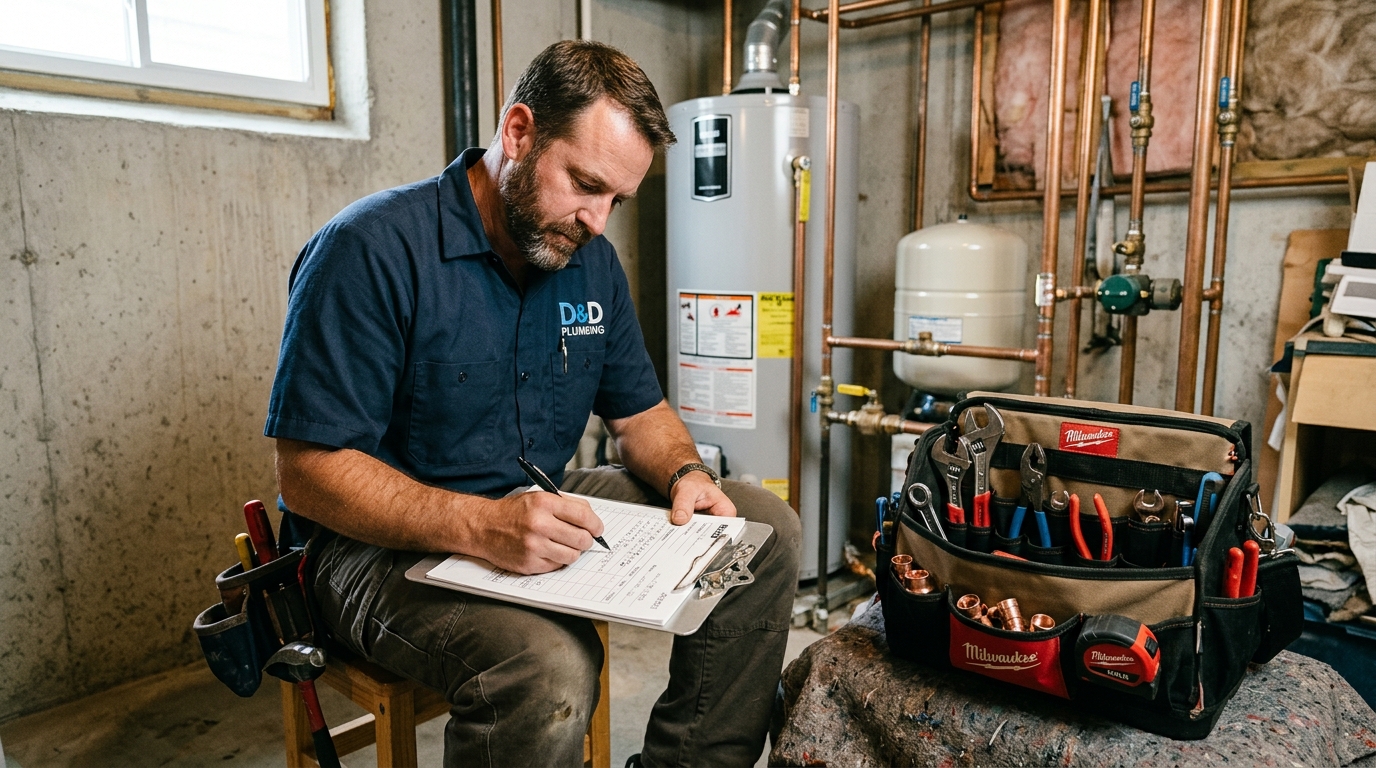
Choosing the right pricing model for your invoice is critical; currently, 70% of top-performing plumbing companies have shifted to flat-rate pricing. Flat-rate pricing removes the 'speed penalty'—where an efficient plumber makes less money because they finish faster—and provides the customer with a guaranteed price upfront. On your invoice, this looks like a single line item for the 'Service Package' rather than a confusing list of hours and minutes.
If you stick with hourly billing, your rate must cover more than just your take-home pay. You need to account for 'Unbillable Time' such as driving, quoting, and tool maintenance, which typically makes up 30-40% of a plumber's day. If you want to earn $50/hour personally, your invoice rate should likely be $125-$150/hour to cover your van, insurance, and PHCC dues.
Regardless of the model, always include a 'Minimum Service Call' fee. This covers the first 30-60 minutes of your time and ensures that even a simple 5-minute fix like tightening a packing nut is profitable. Most plumbers set this between $125 and $195 depending on their service area's cost of living and the complexity of the diagnostic tools required, such as thermal imaging cameras or sewer scopes.
Managing Trip Charges and Emergency Fees
Emergency calls—those occurring after 6:00 PM or on weekends—should always carry a premium on your invoice. The industry standard is 1.5x to 2x your standard rate, or a flat 'Emergency Dispatch Fee' of $200-$300 added to the total. This premium compensates you for the disruption to your personal life and the higher cost of sourcing parts when supply houses are closed.
Trip charges should be clearly separated from labor to avoid confusion. A trip charge of $45-$85 covers the vehicle wear and tear, fuel (which has seen 10-15% volatility in early 2026), and the time spent in traffic. By itemizing this, you show the customer that your 'Labor' rate is strictly for the skilled work performed, making the total bill feel more transparent.
For long-distance calls outside your primary service radius (e.g., more than 20 miles), consider a 'Zone Fee'. This adds a flat $25-$50 per zone to account for the extra 30-60 minutes of non-productive drive time. Professional contractor invoice templates allow you to toggle these fees on and off based on the client's address, ensuring you never lose money on travel.
$125-$175
Avg. Hourly Rate
The 2026 national average for licensed plumbing labor in residential markets.
Wrapping Up
Standardizing your contractor invoice template is the single most effective way to professionalize your plumbing business and secure your cash flow in 2026. By including license details, itemized costs, and digital payment links, you reduce administrative friction and get paid faster. Start using a professional template today to ensure your hard work results in the profit your business deserves.
Frequently Asked Questions
How much does a plumbing invoice template cost?
A basic PDF or Excel contractor invoice template is often free, but professional plumbing software that includes templates typically costs $30-$150 per month. Investing in a tool like Hulo, which starts at under $50, provides automated features that can save you 5-10 hours of administrative work every week, easily paying for itself through increased billable time.
What's the difference between an estimate and an invoice?
An estimate is a non-binding quote provided before work begins, whereas an invoice is a legal demand for payment after work is completed. In 2026, it is best practice to have your estimate convert directly into an invoice to ensure all agreed-upon terms, parts, and labor rates remain consistent, reducing customer disputes by up to 30%.
Do I need my license number on the invoice?
Yes, in almost every US state, plumbing contractors are legally required to display their Master Plumber or C-36 license number on all billing documents. This is a requirement of state boards like the Texas State Board of Plumbing Examiners (TSBPE) or the Florida DBPR to protect consumers and ensure only qualified professionals are performing regulated work.
How long does it take to get paid with digital invoicing?
Digital invoices with integrated 'Pay Now' buttons are typically settled within 1-3 days, compared to 14-21 days for paper checks sent via mail. By using a contractor invoice template that supports ACH and credit cards, you can improve your business's cash flow by 400%, allowing you to pay suppliers and employees without relying on a line of credit.
What certifications should I list on my invoice?
You should list your state plumbing license, any specialty certifications like NATE (for HVAC-integrated work) or ASSE (for backflow prevention), and professional memberships like the PHCC. Mentioning these entities on your invoice justifies your premium pricing and assures the client that the work meets the International Plumbing Code (IPC) or Uniform Plumbing Code (UPC) standards.
How do I get paid faster as a plumbing contractor?
To get paid faster, send your invoice immediately upon job completion while you are still at the customer's home. Use a template that offers multiple digital payment options and set your terms to 'Due Upon Receipt'. Automated follow-up reminders at 3 and 7 days also significantly decrease the time it takes for a customer to finalize the transaction.
Is Excel worth it for plumbing invoices?
Excel is a viable option for very small, part-time businesses, but it lacks the automation and security required for a growing plumbing company. Manual entry in Excel leads to a 5-10% error rate in calculations and material tracking, which can lead to significant revenue leakage over time. Switching to a dedicated CRM like Hulo provides better data security and a more professional customer experience.
Should I charge a credit card processing fee?
Charging a 3% credit card convenience fee is common in 2026 to offset the costs from processors like Visa and Mastercard. However, you must check your state's laws, as some jurisdictions (like Connecticut or Massachusetts) have specific restrictions on surcharging. Alternatively, you can build the 3% into your base labor rate to keep the invoice looking cleaner while still protecting your margins.
Stop Chasing Payments and Start Growing Your Plumbing Business
Hulo provides the ultimate contractor invoice template and all-in-one growth platform for plumbers. Get your website, CRM, and automated invoicing for under $50/mo.
Join the WaitlistMore from the Blog
7 Real Factors Determining How Much Do Plumbers Make for Business Owners (2026)
Plumbers make an average of $63,420 per year or $30.49 per hour according to 2026 labor statistics, with top-tier master...
How to Grow a Plumbing Business: Marketing, Hiring & Scaling (2026)
The plumbing industry in 2026 has evolved into a $130 billion powerhouse, yet many owners remain trapped under the weigh...
How to Start a Plumbing Business: From Apprentice to Owner (2026)
In 2026, the demand for skilled plumbing professionals has reached an all-time high, with the industry projected to grow...