How to Start a Plumbing Business: From Apprentice to Owner (2026)
13 min read·Updated March 12, 2026In 2026, the demand for skilled plumbing professionals has reached an all-time high, with the industry projected to grow by 5% annually as aging infrastructure and new smart-home technologies converge. Transitioning from a skilled apprentice or journeyman to a business owner requires more than just knowing how to sweat copper or clear a main line; it demands a shift into the mindset of a CEO. This guide provides a comprehensive roadmap for launching a plumbing company that isn't just a job you own, but a scalable asset capable of generating high-margin revenue from day one. Whether you are focusing on emergency service calls or long-term new construction contracts, the path to $500,000+ in annual revenue starts with these foundational steps.
Table of Contents
Navigating Plumbing Licenses and Legal Foundations

Securing Your Master Plumber Status
The transition to ownership begins with the legal right to pull permits and sign off on major installations. In most jurisdictions, you must hold a Master Plumber license, which typically requires 7 to 10 years of experience and passing a comprehensive exam covering the International Plumbing Code (IPC) or Uniform Plumbing Code (UPC). This credential is non-negotiable if you plan to handle residential rough-ins or commercial sewer line replacements where municipal inspections are mandatory.
Beyond the technical exam, many states now require a separate 'Business and Law' exam for contractors. This test covers labor laws, lien rights, and contract management, ensuring you understand the legal risks of running a service-based business. Failing to secure the proper credentials can result in fines exceeding $5,000 per violation and the immediate shutdown of your job sites by local building officials.
Once licensed, you must register your business as a legal entity, such as an LLC or S-Corp, to protect your personal assets from professional liabilities. An LLC is often the preferred choice for solo operators because it offers flexibility in taxation while providing a shield against lawsuits related to property damage or worker injuries. Consult with a specialized trade attorney to ensure your operating agreement specifically addresses the high-risk nature of plumbing work.
Insurance and Bonding Requirements
Plumbing is a high-liability trade where a single failed shark-bite fitting or a nicked gas line can cause hundreds of thousands of dollars in property damage. You must carry General Liability insurance with a minimum coverage of $1,000,000 per occurrence and $2,000,000 aggregate. This coverage is essential not just for protection, but because most general contractors and commercial clients will not allow you on-site without a Certificate of Insurance (COI).
In addition to liability, you will need a surety bond, often ranging from $5,000 to $15,000 depending on your local municipality's requirements. This bond acts as a guarantee to the city and your customers that you will complete the work according to code and fulfill your contractual obligations. For businesses with even one employee, Workers' Compensation insurance is legally required and protects you from the financial ruin of on-the-job injuries, which are common in tight crawlspaces and trenches.
Don't overlook Inland Marine insurance, which covers your expensive tools and equipment while they are in transit or on a job site. Standard commercial auto insurance covers the van, but it rarely covers the $15,000 SeeSnake camera or the $3,000 pressing tool inside it. Ensuring your policy specifically includes 'tools and equipment' coverage will save you from a total loss in the event of a vehicle break-in or theft.
Key Takeaway: Always verify your state's specific 'Master' requirements early, as the gap between journeyman and master can take years to bridge legally.
Startup Capital and Equipment Investment Costs
The Essential Service Van Setup
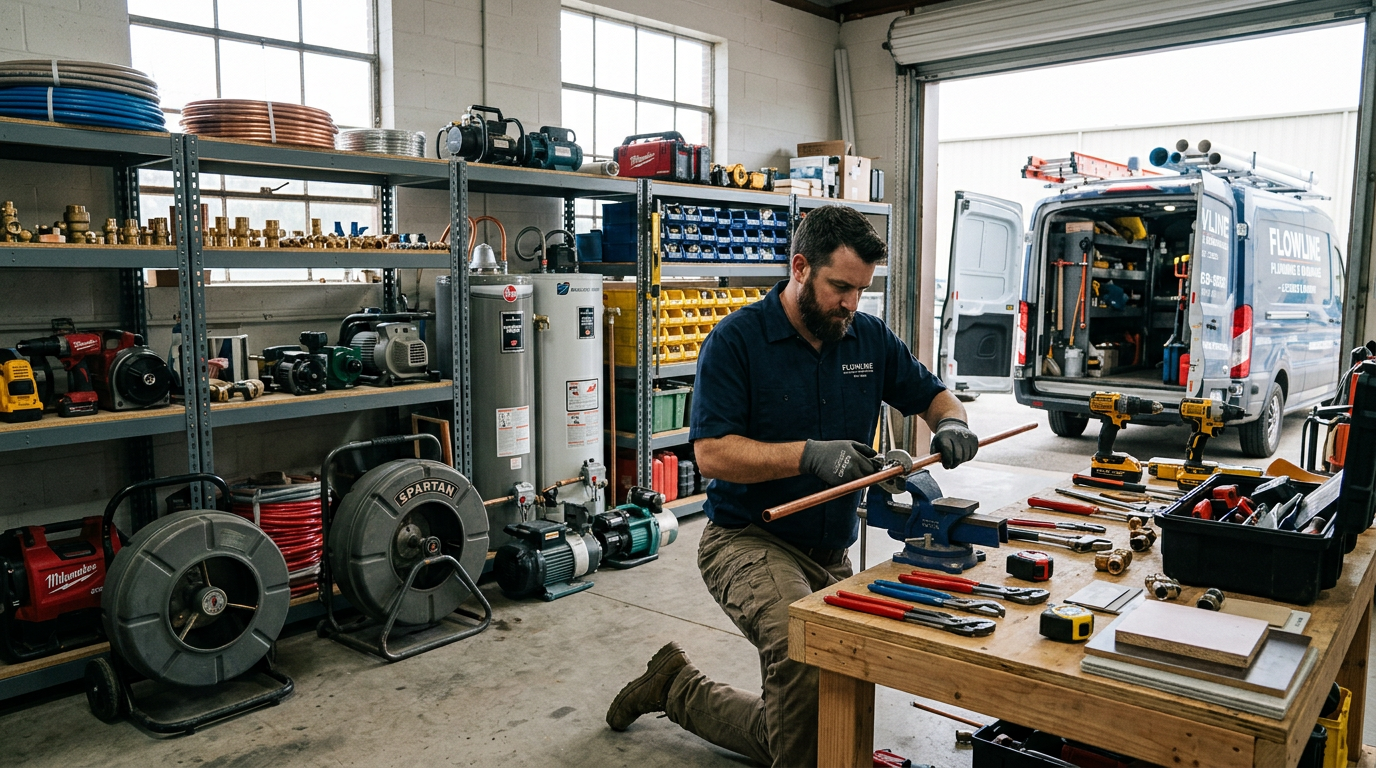
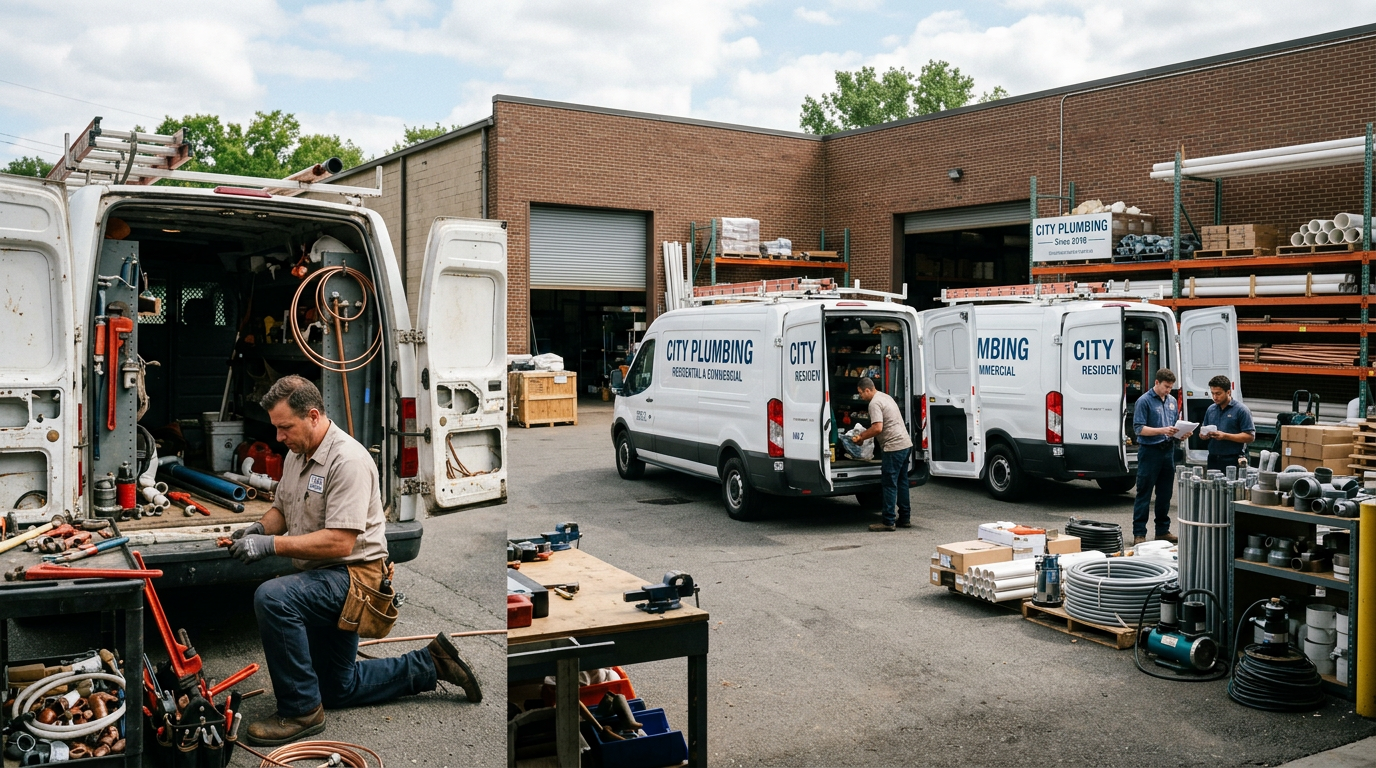
Your service vehicle is your mobile office and warehouse, making it your most significant initial investment. A reliable high-roof van like a Ford Transit 250 or Mercedes Sprinter allows you to stand upright while organizing parts, which significantly reduces physical fatigue over a 10-hour shift. Budget between $45,000 and $65,000 for a new vehicle, or look for a well-maintained used unit in the $25,000 to $35,000 range with under 100,000 miles.
Upfitting the interior with professional shelving units from brands like Adrian Steel or Weather Guard is crucial for inventory management. Expect to spend $3,000 to $5,000 on a bin system that keeps your PEX fittings, copper couplings, and PVC primers secure and visible. A disorganized van leads to 'leakage'—the hidden cost of technicians spending 20 minutes looking for a $2 part while the customer watches the clock.
Exterior branding is equally important; a professional wrap costs between $2,500 and $4,500 but serves as a 24/7 billboard. In residential plumbing, neighbors often hire the company they see parked in a driveway down the street. Ensure your wrap clearly displays your logo, your primary service (e.g., 'Emergency Drain Cleaning'), and a high-visibility phone number or website URL.
Investing in Professional Grade Tools
To compete with established firms, you need specialized equipment that allows for faster, cleaner work. A Ridgid SeeSnake Mini with TruSense technology is a must-have for sewer line inspections, costing roughly $6,000 to $9,000 but paying for itself within 10 to 15 high-margin sewer jobs. This tool allows you to show the customer the exact blockage or root intrusion, making it significantly easier to sell a $5,000 pipe burst or excavation repair.
For water line repairs, moving away from traditional soldering to a pressing system like the Milwaukee M18 Force Logic Press Tool is a game-changer. While the initial investment is approximately $3,500, it allows you to make leak-proof connections on wet lines in seconds, reducing the time spent on a standard water heater replacement by up to 45 minutes. This efficiency increases your 'calls per day' capacity, which is the primary driver of profitability in a service-based model.
Don't forget the bread-and-butter tools: a high-quality drain cleaning machine like the Ridgid K-45 for sinks and a K-400 for main lines. You should also budget for a professional-grade hydro-jetter if you plan to specialize in commercial grease traps or stubborn residential roots. Total tool investment for a fully-equipped solo truck typically lands between $15,000 and $25,000.
$15,000–$50,000
Average Solo Startup Cost
This includes your used van, basic tool kit, licensing, and first 3 months of insurance premiums.
| Category | Item | Estimated Cost |
|---|---|---|
| Vehicle | Used High-Roof Cargo Van | $25,000 - $35,000 |
| Specialized Tool | Sewer Camera (Ridgid SeeSnake) | $6,500 - $9,000 |
| Precision Tool | M18 Press Tool Kit | $3,200 - $4,000 |
| Drain Cleaning | Sectional Machine / Drum Machine | $1,500 - $3,000 |
| Inventory | Initial Stock (PEX, Copper, PVC) | $2,000 - $3,500 |
| Branding | Full Vehicle Wrap | $2,500 - $4,500 |
Initial Equipment Budget Breakdown
Developing a Profitable Plumbing Pricing Strategy

Flat Rate vs. Hourly Billing
The most successful plumbing companies in 2026 have moved away from hourly billing in favor of a flat-rate pricing model. Hourly billing penalizes you for being efficient; the faster you work, the less you get paid. Flat-rate pricing, based on industry-standard 'book times,' ensures that you are paid for your expertise and the value of the repair, not just the minutes spent on-site.
When calculating your flat rate, you must account for your 'burdened labor rate,' which includes your salary, taxes, insurance, fuel, and vehicle maintenance. A common mistake is only charging for the time spent turning a wrench. You must also factor in 'windshield time'—the 30 to 60 minutes spent driving to and from the job—as well as the time spent sourcing parts and managing the back-office tasks.
For example, a standard toilet rebuild might take 45 minutes. If your hourly rate is $150, you earn $112.50. However, a flat-rate price for a 'Toilet Restoration' might be $325, which covers the parts, labor, and a 1-year warranty. This model provides the customer with upfront transparency and protects your margins against unexpected complications that frequently arise in older homes.
Managing Emergency and After-Hours Surcharges
Emergency service calls are the highest-margin opportunities in the plumbing trade. When a basement is flooding at 2:00 AM on a Sunday, customers are less price-sensitive and more focused on immediate resolution. You should implement a standard 'Dispatch Fee' or 'Diagnostic Fee' of $89 to $149 just to show up, which can be applied toward the repair if they move forward.
For true after-hours emergencies (nights, weekends, and holidays), apply a 1.5x or 2x multiplier to your standard flat-rate labor components. This compensates you for the disruption to your personal life and the higher cost of operating outside normal business hours. Clear communication is key; always inform the customer of the emergency surcharge before dispatching a technician to avoid 'sticker shock' and payment disputes.
Tracking these calls is vital for understanding your business's demand patterns. If you find that 40% of your revenue comes from after-hours calls, it may be time to hire a dedicated night-shift technician. Utilizing a platform like Hulo can help you track these leads and ensure that every emergency call is logged, even if it comes in while you are under a sink.
Key Takeaway: Switching to flat-rate pricing typically increases gross profit margins by 20% to 35% compared to traditional T&M (Time and Materials) billing.
Modernizing Operations with Field Service Software
Streamlining Scheduling and Dispatch
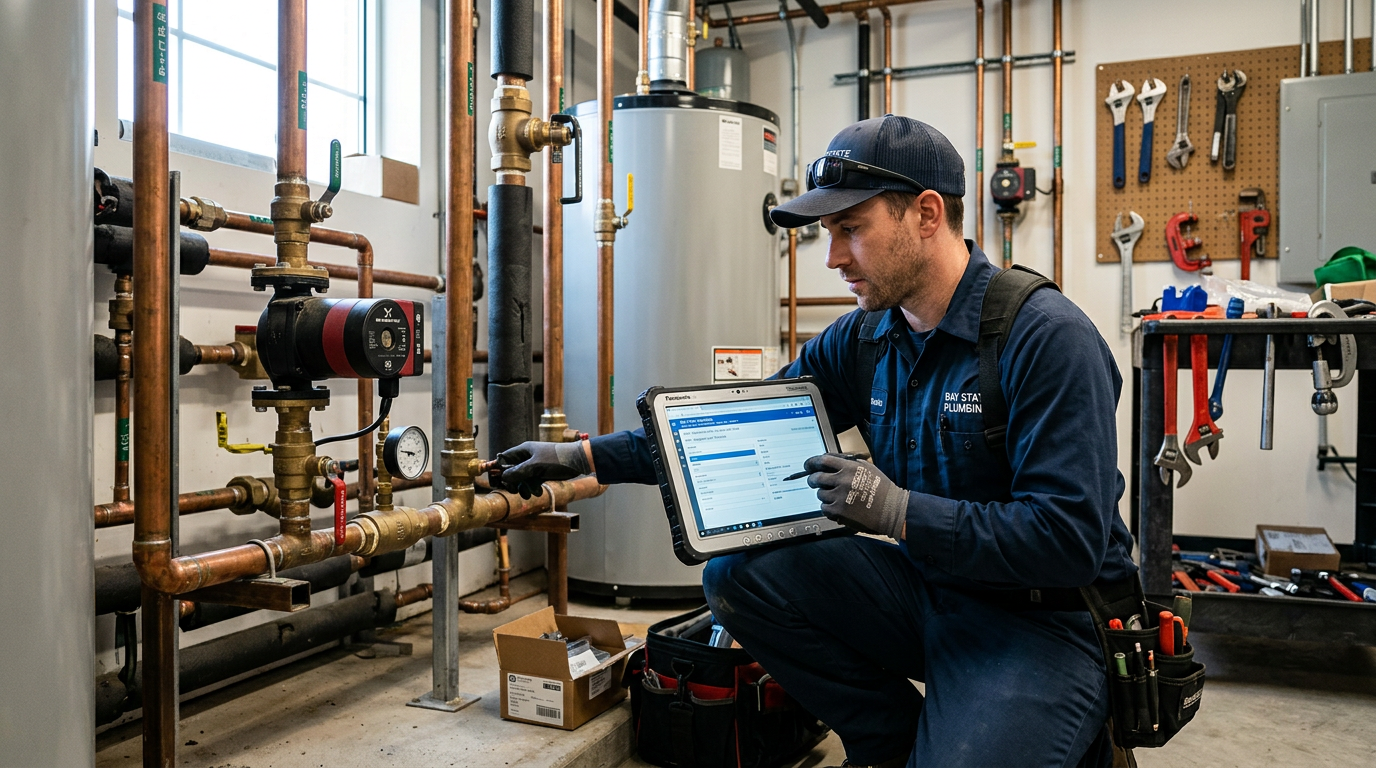
In the early days of your business, you might be tempted to use a paper calendar or a basic smartphone app to manage your jobs. However, this quickly becomes unmanageable as your call volume increases. You need a centralized system that allows you to see your entire day at a glance, including travel times between jobs and the specific details of each service request.
All-in-one platforms like Hulo combine your website, CRM, scheduling, and invoicing in one place for under $50/mo. This allows you to move from a phone call to a scheduled job in seconds, with automated text notifications sent to the customer. Providing a 'Technician is on the way' text with a photo and bio builds immediate trust and significantly reduces no-shows, which are a major drain on plumbing profitability.
Efficient dispatching also means grouping jobs geographically to minimize fuel costs and wear-and-tear on your van. By seeing all active leads on a map, you can schedule a non-urgent drain cleaning in the same neighborhood as an emergency water heater leak. This 'route density' is the secret to moving from two or three calls a day to five or six, drastically increasing your daily revenue potential.
On-Site Quoting and Instant Payments
The days of mailing paper invoices and waiting 30 days for a check are over. To maintain healthy cash flow, you must be able to provide professional, digital quotes on-site and collect payment before leaving the driveway. Using a mobile-friendly CRM allows you to build a quote with 'Good, Better, Best' options, giving the customer a choice and often leading to higher average ticket prices.
When a customer signs a digital quote on your tablet, it creates a legally binding agreement that protects you from payment disputes. Once the job is completed, the software should automatically generate an invoice that can be paid via credit card, Apple Pay, or ACH. High-performing plumbing businesses aim for a 'collection rate' of 98% or higher by making it incredibly easy for the customer to pay instantly.
Furthermore, modern software helps you track parts inventory across your service vans in real-time. When a technician uses a 3/4-inch ball valve, the system should deduct it from the van's stock and alert you when it's time to reorder. This prevents the 'forgotten part' syndrome where a technician has to leave a job site to visit a supply house, costing the company an average of $75 in lost productivity per occurrence.
Pro Tip: Offer 'Good, Better, Best' options on every quote. 30% of customers will choose the 'Best' option simply because it offers the most comprehensive long-term solution.
Ready to put this into action?
Hulo gives you everything to run your plumbing business — website, CRM, scheduling, and invoicing. Join the waitlist for V2.
Join the WaitlistBuilding a Lead Generation Machine for Residential Plumbing
Dominating Local SEO and Google Maps
When a pipe bursts, the first thing a homeowner does is search 'plumber near me' on their smartphone. To capture these high-intent leads, your business must appear in the 'Local Pack' (the top three Google Maps listings). This requires a verified Google Business Profile with a consistent name, address, and phone number (NAP) across the web.
Reviews are the currency of the plumbing industry. You should aim for at least 50 five-star reviews within your first six months. Encourage technicians to ask for reviews before leaving the job site, specifically mentioning the service provided (e.g., 'If you're happy with how we handled your water heater repair, a quick Google review would help us tremendously'). Google's algorithm prioritizes profiles with frequent, recent, and keyword-rich reviews.
Having a professional website is non-negotiable in 2026—tools like Hulo can generate one for your plumbing business in minutes. Your site needs to be mobile-responsive, load in under three seconds, and feature clear 'Call Now' and 'Book Online' buttons. In a world where 70% of plumbing leads come from mobile devices, a clunky website is the fastest way to lose business to a competitor.
Leveraging Google Local Services Ads (LSA)
For immediate lead flow, Google Local Services Ads (the 'Google Guaranteed' program) are the most effective paid marketing channel for plumbers. Unlike traditional PPC where you pay for clicks, with LSA you pay only for valid phone calls or messages. This significantly reduces wasted ad spend and ensures you are only paying for actual opportunities to book a job.
To qualify for the Google Guaranteed badge, you must pass a background check and provide proof of your plumbing license and insurance. This badge acts as a massive trust signal, often resulting in a 20-30% higher click-through rate than standard search ads. Budgeting $500 to $1,500 per month for LSA can provide a consistent stream of emergency calls while you build your organic SEO presence.
Track the 'Cost Per Lead' (CPL) for every marketing channel. If a drain cleaning lead from LSA costs $60 and your average ticket for that service is $350, your marketing cost is roughly 17%. If you can convert 50% of those leads into jobs, your customer acquisition cost remains sustainable. Constantly refining your ad settings—such as pausing ads during times you can't answer the phone—is crucial for maximizing ROI.
70%+
Mobile Search Share
Over 70% of plumbing-related searches happen on mobile devices, making a mobile-optimized website mandatory.
Scaling from a Solo Operator to a Multi-Truck Fleet
Hiring and Retaining Quality Technicians
The biggest bottleneck to scaling a plumbing business is the labor shortage. To attract top-tier journeymen, you must offer more than just a competitive hourly wage. Consider offering performance-based bonuses, such as a percentage of the upsell revenue or a 'clean van' bonus. In 2026, providing a modern work environment with updated tools and streamlined software is a major recruiting advantage.
When hiring your first employee, look for someone with strong communication skills, not just technical ability. In residential service, the technician is also a salesperson and a customer service representative. A plumber who can explain a complex sewer issue in simple terms and present pricing options clearly is worth significantly more to your bottom line than a master technician with poor 'soft' skills.
Establish a clear training program for apprentices. By bringing on 'green' helpers and training them in your specific company culture and service standards, you create a pipeline of future lead technicians. This long-term approach is often more cost-effective than constantly fighting over the small pool of existing master plumbers in your local market.
Implementing Standard Operating Procedures (SOPs)
To scale without losing quality, you must document every process in your business. This includes how to answer the phone, how to perform a multi-point plumbing inspection, and how to close out a job in your CRM. SOPs ensure that the 'Smith Plumbing' experience is the same regardless of which technician shows up at the door.
Instead of juggling separate tools for your website, client management, and invoicing, all-in-one platforms like Hulo let you run everything from a single dashboard. This centralization is critical when you have multiple trucks on the road. You can monitor job statuses, view technician locations, and track daily revenue goals without needing a full-time office manager in the early stages of growth.
Analyze your Key Performance Indicators (KPIs) weekly. Track your average ticket price, your close rate on quotes, and your callback rate (the percentage of jobs that require a return visit to fix a mistake). A high callback rate is a 'silent killer' of profits, as it costs you the labor and fuel for a second trip without any additional revenue. Aim for a callback rate of less than 3%.
Key Takeaway: Scaling requires moving from 'doing the work' to 'building the systems' that allow others to do the work profitably.
Wrapping Up
Starting a plumbing business is a challenging but incredibly rewarding path to financial independence. By focusing on professional licensing, investing in the right high-tech tools, and implementing a modern pricing strategy, you can quickly move from a solo apprentice to a successful business owner. Remember that the systems you put in place today—like using Hulo to manage your website, scheduling, and invoicing—will provide the foundation for your future growth. Stay focused on delivering exceptional customer service, and your plumbing empire will follow.
Frequently Asked Questions
How much does it cost to start a plumbing business in 2026?
A lean startup can begin with $15,000 to $20,000 if you already own a truck and basic hand tools. However, a fully-equipped professional launch with a branded high-roof van, specialized sewer cameras, and marketing capital typically requires $45,000 to $60,000.
What is the most profitable plumbing service to offer?
Emergency drain cleaning and sewer line replacements are generally the highest-margin services. These jobs often allow for premium emergency pricing and the opportunity to use high-tech equipment like hydro-jetters and trenchless pipe-bursting systems, which command higher rates than standard repairs.
Do I need separate software for scheduling, invoicing, and my website?
No—all-in-one platforms like Hulo bundle your professional website, CRM, scheduling, and invoicing into a single $49.99/mo subscription. This is far more cost-effective and efficient than paying for 3-4 separate tools that don't talk to each other.
How do I get more plumbing leads without spending a fortune on ads?
Focus on your Google Business Profile and local SEO. By consistently gathering 5-star reviews and having a fast, professional website generated by a platform like Hulo, you can rank higher in local search results and capture 'near me' searches for free.
How long does it take for a new plumbing business to become profitable?
With a strong focus on residential service and effective marketing, many plumbing businesses can reach break-even within 3 to 6 months. Profitability depends heavily on maintaining a low overhead and ensuring your flat-rate pricing accurately reflects your true operating costs.
What insurance is absolutely required for a plumber?
At a minimum, you need General Liability insurance ($1M/$2M limits) and a Surety Bond. If you have any employees, Workers' Compensation is mandatory, and Inland Marine insurance is highly recommended to protect your expensive tools from theft.
Ready to Launch Your Plumbing Business?
Get your professional website, CRM, and scheduling tools all in one place for just $49.99/mo with Hulo.
Join the WaitlistMore from the Blog
9 Simple Contractor Invoice Template Tips for Plumbers (2026)
A professional contractor invoice template for plumbers must include your business details, the client's information, a ...
7 Real Factors Determining How Much Do Plumbers Make for Business Owners (2026)
Plumbers make an average of $63,420 per year or $30.49 per hour according to 2026 labor statistics, with top-tier master...
How to Grow a Plumbing Business: Marketing, Hiring & Scaling (2026)
The plumbing industry in 2026 has evolved into a $130 billion powerhouse, yet many owners remain trapped under the weigh...