How to Start a Car Detailing Business: Step-by-Step Guide (2026)
15 min read·Updated March 12, 2026The professional car detailing industry has evolved into a $14.7 billion powerhouse, driven by a growing consumer preference for vehicle longevity and aesthetic perfection. In 2026, starting a car detailing business is no longer just about a bucket and a sponge; it requires a sophisticated blend of chemical knowledge, precision craftsmanship, and digital operational efficiency. Whether you are eyeing a high-end ceramic coating studio or a nimble mobile detailing unit, the barrier to entry remains low while the ceiling for profit is remarkably high. This guide provides a comprehensive roadmap to navigating the technical and administrative hurdles of the trade, ensuring your new venture is built on a foundation of professional-grade quality and sustainable growth.
Table of Contents
Defining Your Detailing Business Model and Niche
Mobile Detailing vs Fixed Location Studios
Choosing between a mobile unit and a brick-and-mortar shop is the most critical decision you will make in your first 30 days. Mobile detailing offers significantly lower overhead, typically requiring only $5,000 to $10,000 in initial investment for a van setup, whereas a physical lease can demand $25,000 to $50,000 upfront for deposits and shop fit-outs. Mobile operators benefit from the convenience factor, often charging a 15% to 25% premium for coming to the client’s home or office, though they must contend with weather variables and travel time logistics.
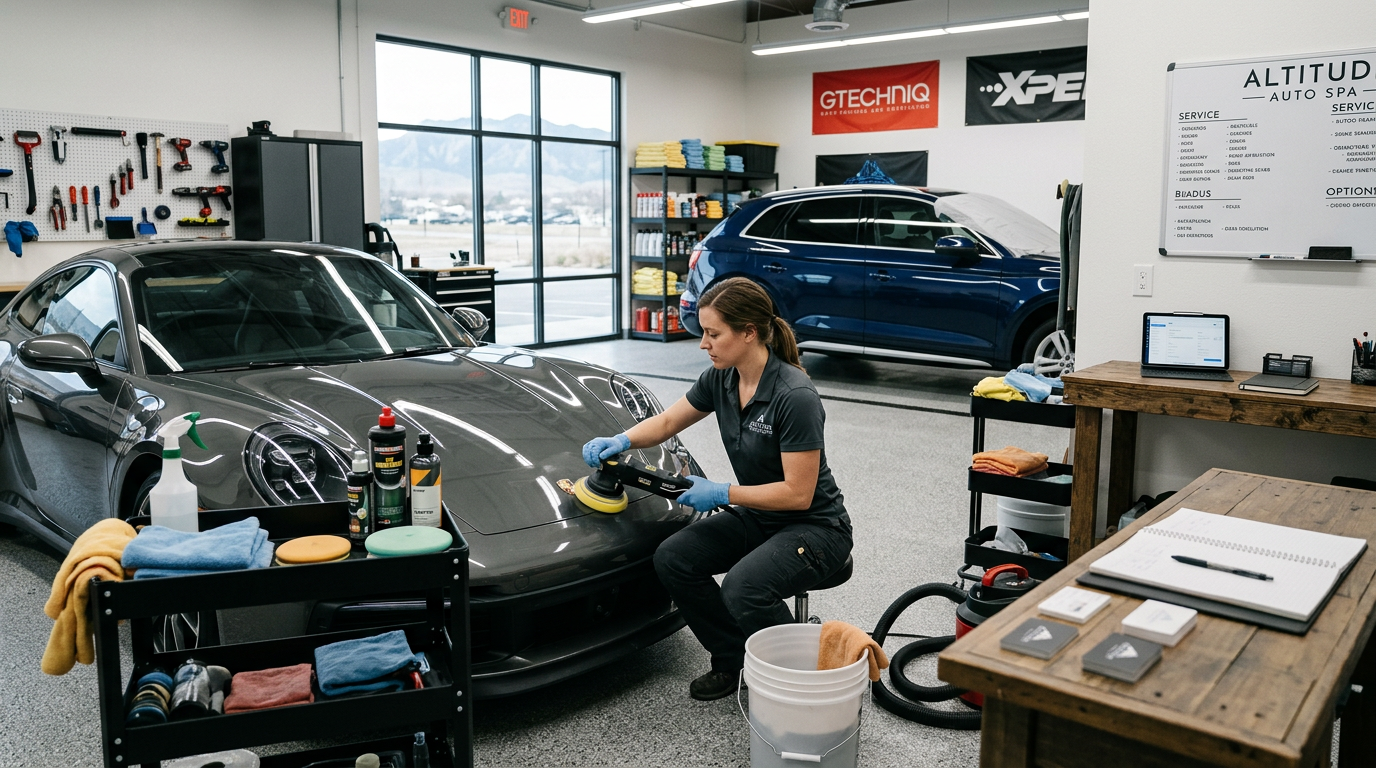
A fixed location, or 'detailing studio,' provides a controlled environment essential for high-ticket services like multi-stage paint correction and ceramic coating applications. In a shop, you can control lighting with high-CRI LED arrays and maintain a dust-free atmosphere, which is nearly impossible in a driveway. While the rent and utilities are higher, a shop allows for higher volume through multiple bays and creates a more premium brand perception that attracts owners of exotic and luxury vehicles.
Hybrid models are also gaining traction in 2026, where a detailer maintains a small studio for intensive work while running a mobile rig for maintenance washes and interior refreshes. This approach maximizes revenue streams and ensures that you never turn down a client based on their location or service needs. Regardless of the path, your business plan must account for the specific equipment and insurance needs unique to each model.
Identifying Your Target Client Personas
Success in the detailing trade requires moving beyond the 'everyone with a car' mentality and targeting specific, high-value segments. Enthusiasts who own classic cars or modern exotics are willing to pay $1,500+ for paint restoration and long-term protection, but they demand a portfolio that proves your technical mastery. These clients are less price-sensitive and more focused on the 'before and after' transformation and the safety of their investment.
Fleet accounts and dealership contracts represent the 'volume' side of the business, providing consistent weekly revenue that stabilizes your cash flow. While the per-vehicle profit is lower—often ranging from $60 to $120 per unit—the efficiency of cleaning 10 to 20 cars in a single location can be more profitable than three high-end residential jobs scattered across the city. Building relationships with local logistics companies or high-end used car lots can provide the steady work needed to hire your first employee.
Busy professionals and 'soccer moms' represent the middle-market segment, focusing on interior sanitation and general maintenance. These clients value time and cleanliness over paint perfection, making them ideal for recurring subscription packages. By offering a monthly maintenance program, you can secure predictable monthly recurring revenue (MRR), which is the holy grail of business stability in the service trades.
$14.7 Billion
Global Detailing Market Size
The industry is projected to grow at a CAGR of 4.3% through 2030.
Legal Requirements and Professional Insurance
Business Registration and Licensing
Before you touch a single orbital polisher, you must formalize your business structure to protect your personal assets. Most solo detailers opt for a Limited Liability Company (LLC), which typically costs between $50 and $500 depending on your state's filing fees. An LLC provides a legal shield between your personal savings and any business liabilities, which is crucial when you are handling vehicles valued at $50,000 to $200,000.
You will also need an Employer Identification Number (EIN) from the IRS, even if you don't plan on hiring employees immediately. This number is required to open a business bank account and to apply for wholesale accounts with chemical suppliers like P&S or CarPro. Additionally, check your local zoning laws; some municipalities have strict regulations regarding 'home-based' businesses that involve water runoff or chemical storage.
Environmental compliance is a growing concern in 2026, and many cities require a mobile wash permit or a specialized water reclamation system. If you are washing cars on-site, you must ensure that soapy water and degreasers do not enter the storm drains. Investing in a water containment mat or using rinseless wash methods like ONR (Optimum No Rinse) can help you stay compliant without expensive filtration hardware.
The Necessity of Garage Keepers Insurance
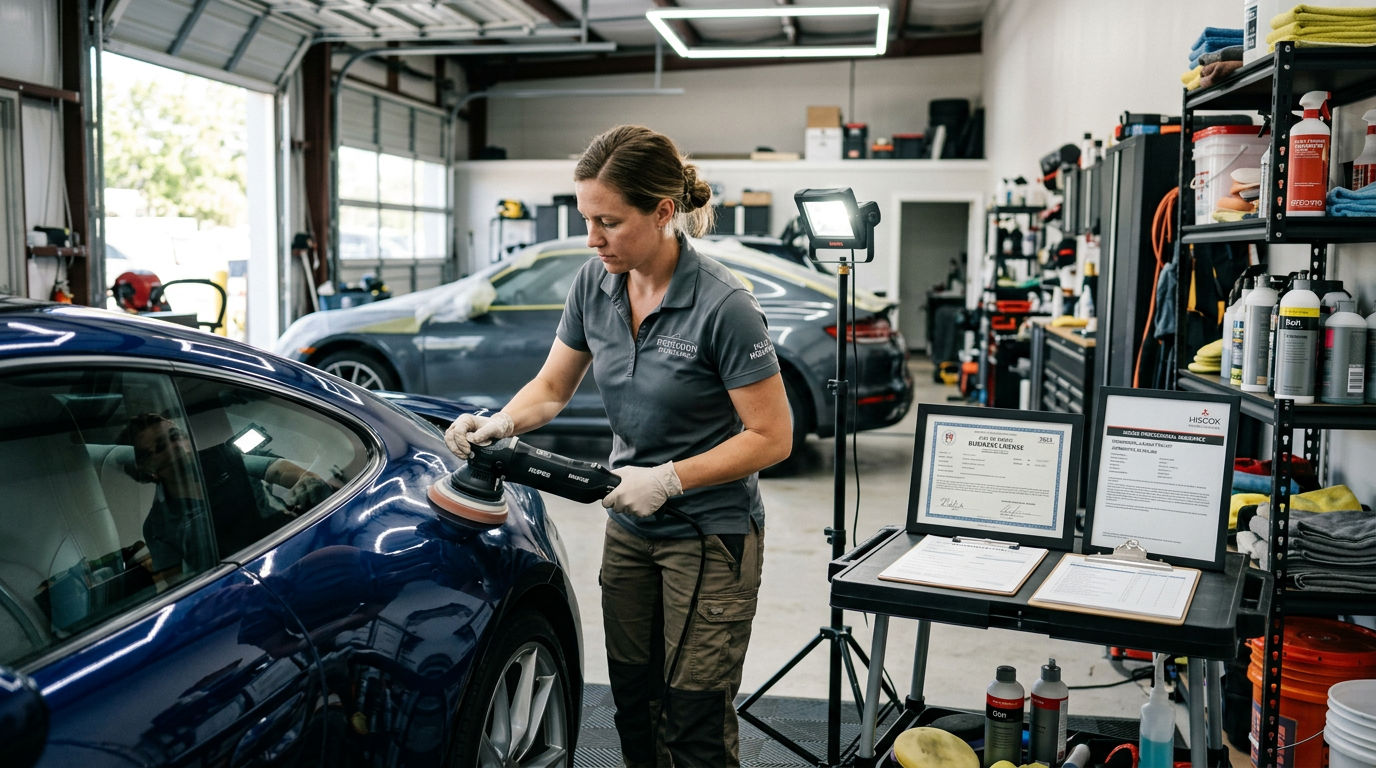
General Liability insurance is the baseline, covering you if a client trips over your pressure washer hose, but it does not cover the vehicles themselves. For that, you specifically need Garage Keepers Liability insurance, which protects you if a customer’s car is damaged while in your 'care, custody, and control.' This includes accidental scratches during polishing, chemical burns on leather, or even a total loss due to fire or theft while the car is at your shop.
A standard policy for a startup detailing business usually carries a $1,000,000 limit and costs between $1,200 and $2,500 annually. While this may seem like a steep overhead cost, it is a non-negotiable requirement for working on high-end vehicles. Many premium clients will ask for proof of insurance before handing over their keys, and being able to produce a COI (Certificate of Insurance) instantly sets you apart from 'trunk slammers' who operate under the radar.
Don't forget to include Inland Marine insurance if you are a mobile operator. This covers your expensive equipment—like your $1,200 Mytee extractor and $800 pressure washer—while they are in transit. If your van is broken into or involved in an accident, your standard auto insurance likely won't cover the professional tools inside, leaving you with a massive bill to replace your inventory.
| Item | Estimated Cost | Frequency |
|---|---|---|
| LLC Formation Filing | $50 – $500 | One-time |
| General Liability Insurance | $600 – $900 | Annual |
| Garage Keepers Insurance | $1,200 – $2,500 | Annual |
| Business License/Permits | $100 – $300 | Annual |
| Environmental/Wash Permits | $50 – $200 | Annual |
Estimated Startup Legal and Insurance Costs
Key Takeaway: Operating without Garage Keepers insurance is a gamble that can end your business with a single mistake on a high-end vehicle's clear coat.
Essential Equipment and Chemical Inventory
Professional Machine Polishers and Extractors
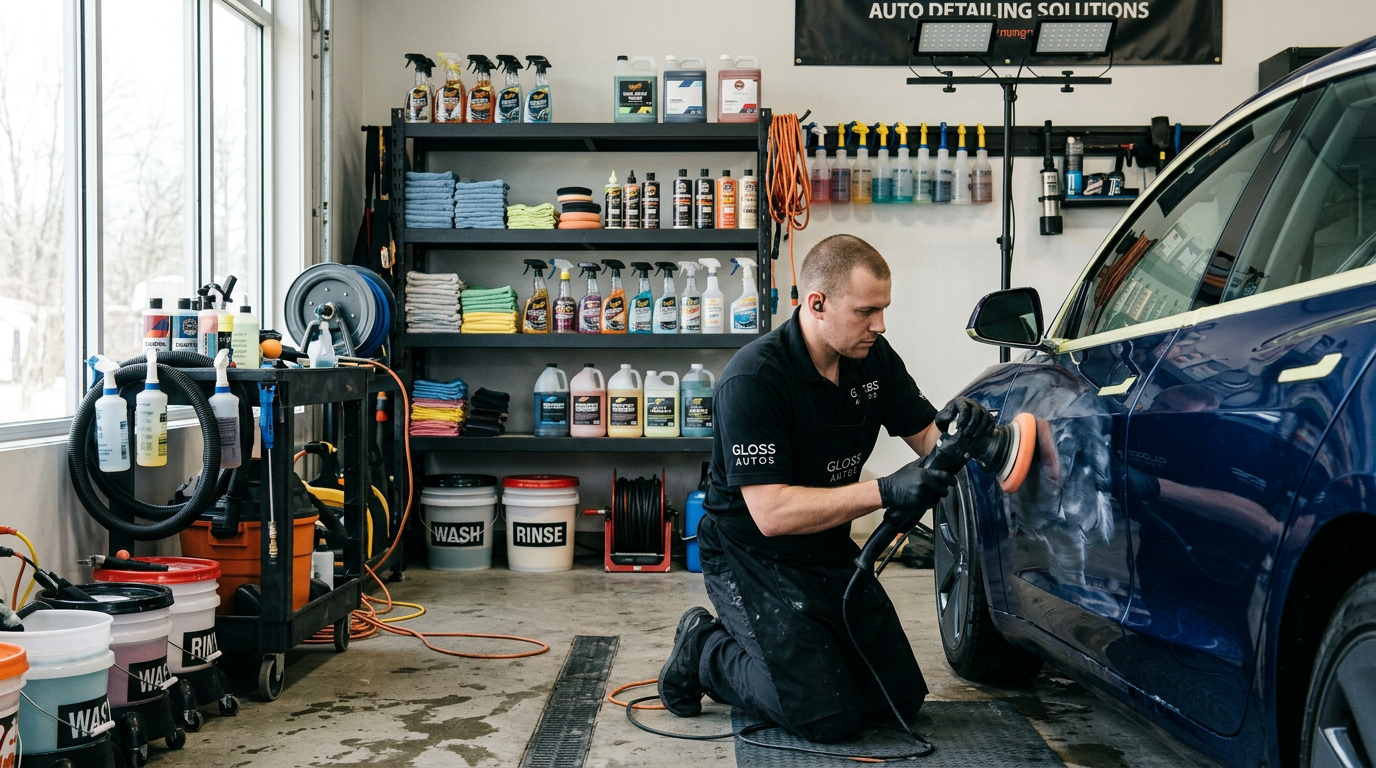
Your choice of machinery directly impacts your efficiency and the quality of your finish. For paint correction, the Rupes LHR15 Mark III or the MaxShine M15 Pro are industry standards for dual-action (DA) polishers. These machines offer the torque needed to remove heavy swirls while remaining safe enough for beginners to avoid burning through the clear coat. Expect to spend $250 to $600 per machine, and you will eventually need a smaller 3-inch polisher for tight areas like pillars and bumpers.
Interior detailing requires a heavy-duty heated extractor to remove deep-seated dirt and stains from carpets and upholstery. The Mytee 8070 Lite Heated Carpet Extractor is a favorite among professionals for its reliability and 1,000-watt heater. For delicate surfaces and sanitization, a commercial-grade steamer like the McCulloch MC1385 or a Dupray Neat can reach temperatures of 200°F+, effectively killing bacteria and loosening grime without over-saturating the fabric.
Don't overlook the importance of lighting in your equipment budget. A high-quality inspection light, such as the Scangrip Multimatch R, is essential for identifying micro-marring and high spots in ceramic coatings that are invisible to the naked eye. Investing in a set of tripod-mounted LED work lights will ensure you can see every defect, whether you're working in a dimly lit garage or under the mid-day sun.
The Mobile Detailing Setup: Water and Power
If you are going the mobile route, you must solve the 'water and power' problem. While some detailers use the client’s utilities, true professionals are self-contained. A 50-gallon to 100-gallon water tank paired with a 12V demand pump allows you to wash cars anywhere. Combine this with a high-efficiency pressure washer like the Kranzle K1122TST, which is prized for its longevity and 'total stop' feature that saves the motor from unnecessary wear.
Powering your polishers, vacuums, and extractors requires a quiet, reliable inverter generator. The Honda EU2200i is the gold standard in the industry because it produces 'clean' power that won't fry your tool’s electronics and operates at a decibel level low enough to avoid annoying the client’s neighbors. For a more eco-friendly 2026 approach, many detailers are switching to large-scale lithium power stations like the EcoFlow Delta Pro, which can run a full day of detailing on a single charge.
Organization in your van or truck is just as important as the tools themselves. Use a modular shelving system or custom-built wooden racks to secure your spray bottles, gallon jugs, and microfiber towels. A cluttered van leads to lost time and damaged products; a professional setup like the ones from Mytee or specialized van upfitters communicates to the client that you are a high-end specialist, not a hobbyist.
| Category | Recommended Model | Price Range |
|---|---|---|
| DA Polisher | Rupes LHR15 Mark III | $450 – $550 |
| Pressure Washer | Kranzle K1122TST | $1,100 – $1,300 |
| Carpet Extractor | Mytee 8070 Lite | $1,000 – $1,200 |
| Steam Cleaner | McCulloch MC1385 | $200 – $250 |
| Generator | Honda EU2200i | $1,100 – $1,300 |
| Inspection Light | Scangrip Multimatch R | $150 – $200 |
Professional Equipment Checklist
Pro Tip: Always carry at least 50 high-quality microfiber towels in three different colors: one for paint, one for interiors, and one for wheels/engines to prevent cross-contamination.
Pricing Strategies and Service Menu Design
Tiered Detailing Packages
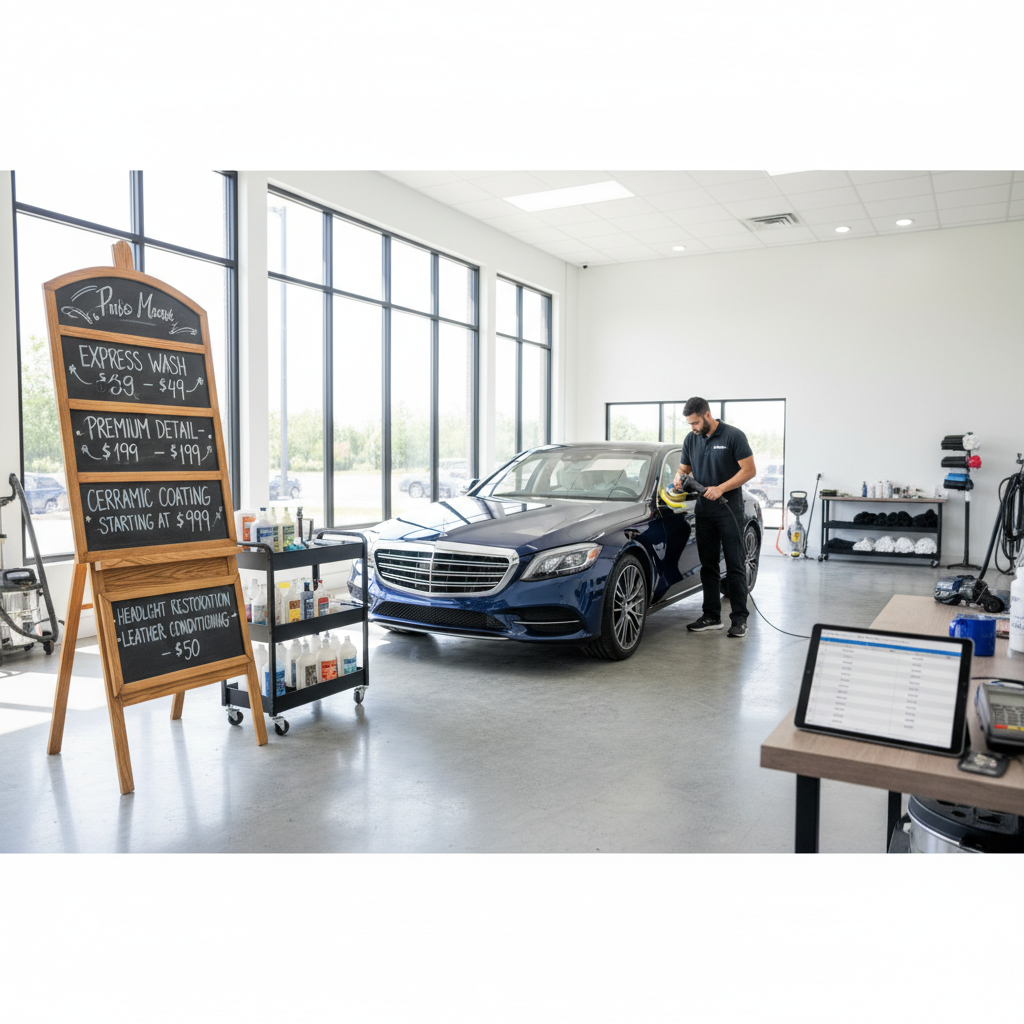
Standardizing your services into clear tiers helps clients understand what they are paying for and simplifies your sales process. A basic 'Express Detail' might include a foam bath, wheel cleaning, and a vacuum/wipe-down, priced between $100 and $175. This serves as an entry point for new customers who may eventually upgrade to more intensive services once they see the quality of your work.
Your 'Full Detail' or 'Restoration' package should be your bread and butter, typically priced at $300 to $600 depending on vehicle size. This should include clay bar decontamination, an iron remover bath, a single-stage machine polish to enhance gloss, and a deep interior extraction. Clearly list the inclusions on your website so clients can see the value difference between your $400 service and the $20 local car wash.
In 2026, the real profit lies in ceramic coatings and paint correction. These services should be quoted individually but generally start at $1,000 and can go up to $3,000+ for multi-year protection. By positioning these as 'investments' rather than 'cleanings,' you shift the conversation from price to value, allowing you to earn more while working on fewer cars.
Calculating Your Hourly Rate and Overhead
Many new detailers fail because they price based on what the guy down the street charges rather than their own costs. You must calculate your 'Break-Even' point, which includes your insurance, chemical costs (roughly 5-10% of the job price), fuel, and equipment depreciation. If your overhead is $2,000 a month and you want to pay yourself $5,000, you need to generate $7,000 in revenue, which means charging at least $75 to $100 per labor hour.
Factor in the 'Mobile Tax' if you are traveling to clients. A job that takes 3 hours of labor but requires 1 hour of total driving time is actually a 4-hour commitment. If you don't charge a mobile fee or build that time into your package price, your effective hourly rate drops by 25%. Modern scheduling tools can help you group jobs by neighborhood to minimize this travel time and maximize your billable hours.
Upselling is the most effective way to increase your average ticket size without finding new customers. Offer 'add-ons' like engine bay cleaning ($50), headlight restoration ($75), or fabric ceramic protection ($100). When these are offered at the time of booking, they can easily turn a $300 job into a $500 job with only an extra 45 minutes of labor.
Key Takeaway: Never price by the car; price by the hour and the condition of the vehicle to ensure you aren't losing money on 'trashed' interiors.
Ready to put this into action?
Hulo gives you everything to run your car detailing business — website, CRM, scheduling, and invoicing. Join the waitlist for V2.
Join the WaitlistBuilding a Digital Presence and Customer Management
Professional Website and Local SEO
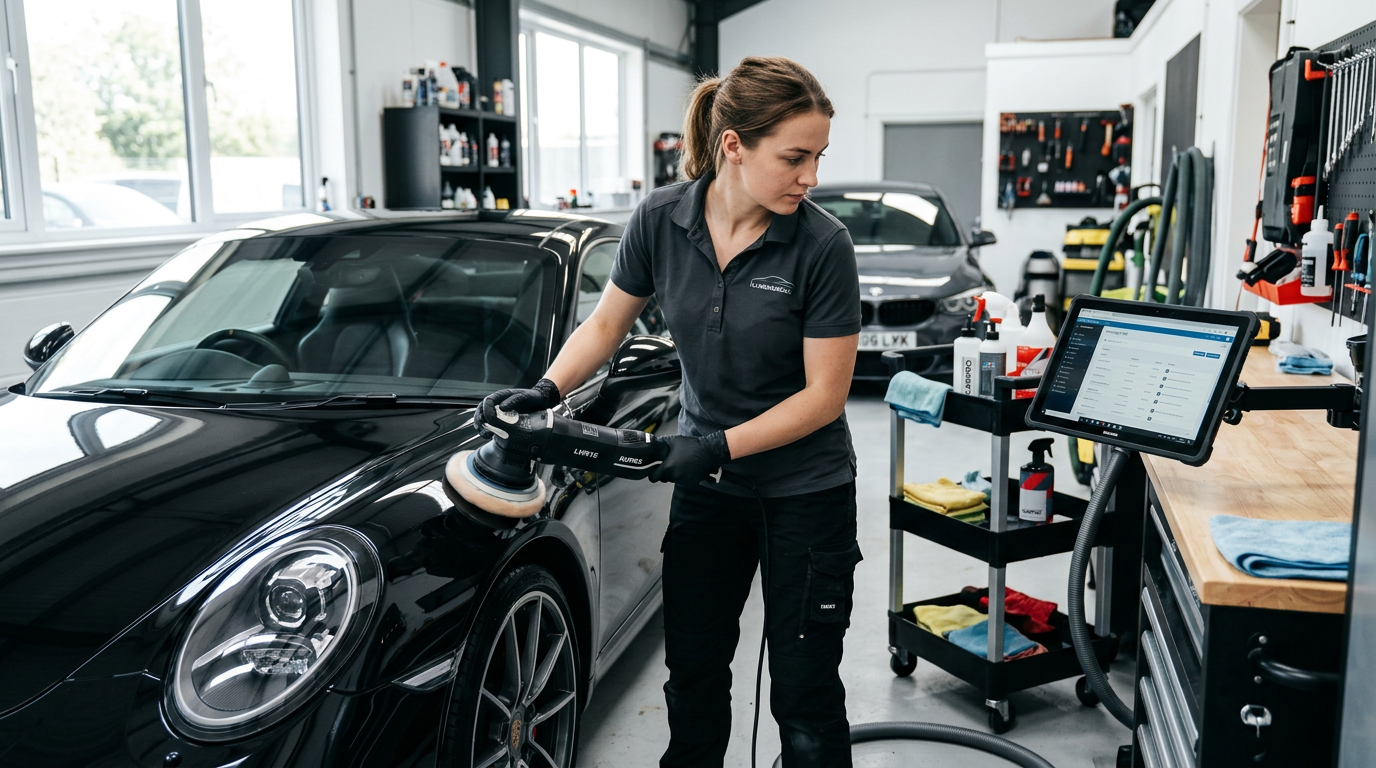
In the detailing world, your website is your digital storefront. It needs to be mobile-responsive, as over 70% of detailing searches happen on smartphones while people are looking at their dirty cars. High-resolution 'Before and After' galleries are mandatory; potential clients want to see that you can handle the specific type of vehicle and condition they currently have.
Local SEO is the primary driver of new leads. Ensure your Google Business Profile is optimized with your service area, hours, and a steady stream of 5-star reviews. Using keywords like 'ceramic coating [Your City]' or 'best mobile detailer near me' in your website copy will help you outrank competitors who only rely on social media word-of-mouth.
Instead of juggling separate tools for your website, client management, and invoicing, all-in-one platforms like Hulo let you run everything from a single dashboard. Having a professional website that integrates directly with your booking calendar allows clients to schedule their own appointments at 10 PM, capturing leads while you sleep and reducing the back-and-forth of phone calls.
Automating Scheduling and Invoicing
Administrative tasks are the silent killer of detailing businesses. If you spend three hours a day answering texts and sending manual invoices, you are losing $300 in potential labor revenue. Automation is the solution. By using a CRM (Customer Relationship Management) system, you can store client preferences, vehicle history, and gate-codes, ensuring every visit is seamless and personalized.
No-shows and last-minute cancellations can devastate a small detailing operation. Implementing a deposit system—where clients pay $50 or 20% upfront to hold their spot—drastically reduces flakes. Platforms like Hulo provide these scheduling and invoicing features for just $49.99/mo, making it affordable for startups to look as professional as established franchises from day one.
Once a job is complete, your system should automatically trigger a professional invoice and a review request. Automated follow-ups 30 days later asking 'How is the shine holding up?' keep your brand top-of-mind and encourage repeat bookings. This 'set it and forget it' approach to customer retention is what separates a hobbyist from a scalable business owner.
70%+
Mobile Search Volume
The majority of detailing customers find and book services via their smartphones.
Marketing and Customer Acquisition Strategies
Leveraging Social Proof and Transformations
Detailing is a highly visual trade, making Instagram and TikTok your most powerful marketing tools. Don't just post a finished car; post a 'half-and-half' shot of a hood being polished or a video of a filthy carpet being extracted. These 'oddly satisfying' videos have high viral potential and demonstrate your technical process to skeptical customers.
User-generated content is another goldmine. Encourage your clients to tag you in their Instagram stories after a fresh detail in exchange for a $10 discount on their next service. This puts your work in front of their local network of friends and family, which is far more effective than any paid advertisement you could run yourself.
Join local Facebook groups for car enthusiasts, luxury neighborhoods, and business networking. Avoid being 'spammy'; instead, offer free advice on how to remove bird droppings or maintain a wax finish. Positioning yourself as an expert rather than a salesman builds trust, so when they finally need a professional, you are the first person they call.
Referral Programs and Fleet Networking
Word-of-mouth is the lifeblood of the detailing industry. Create a formal referral program where existing clients get a free 'Express Detail' or a $50 credit for every new customer they send your way. This turns your best clients into a volunteer sales force and lowers your overall customer acquisition cost (CAC).
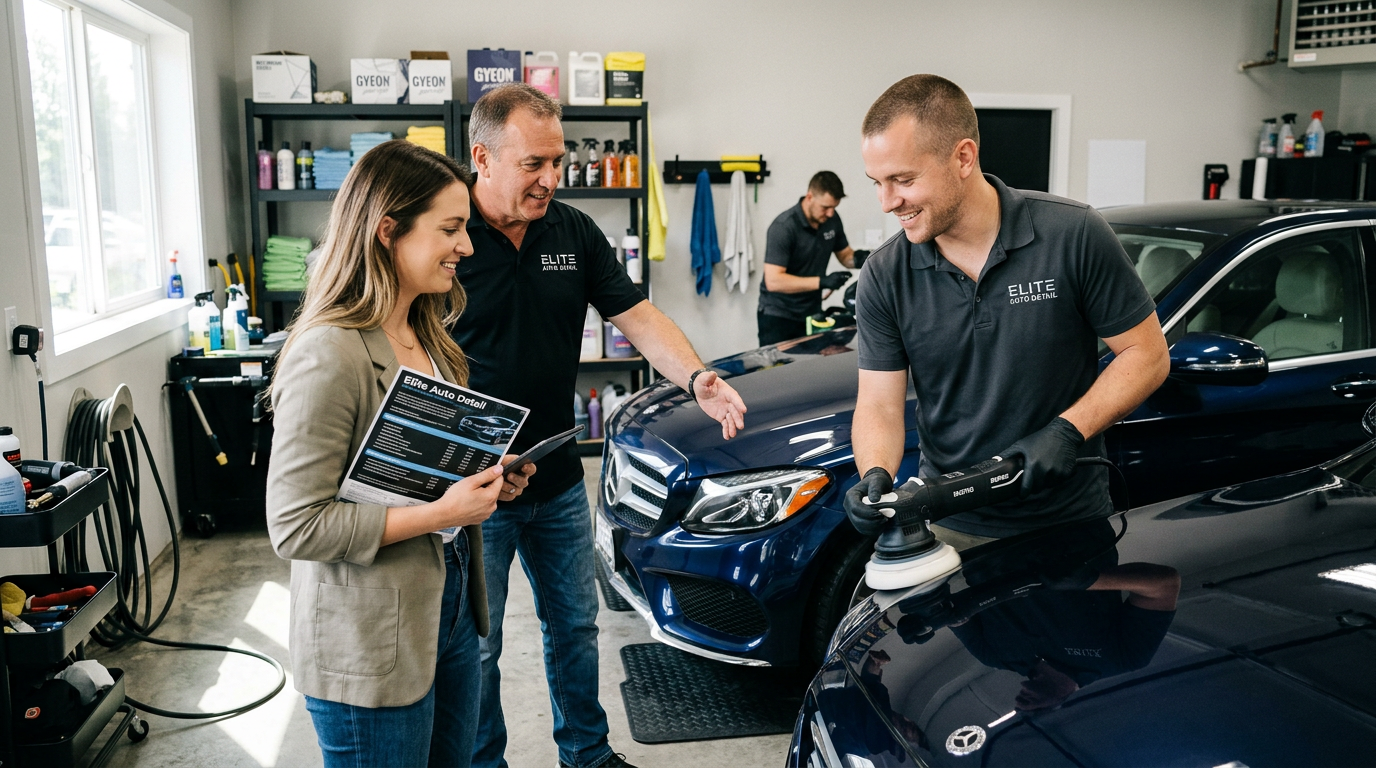
For fleet and dealership work, you need to pound the pavement. Visit local real estate offices, plumbing companies, and high-end used car lots with a professional flyer and a clear pricing sheet for multi-vehicle discounts. Offering to do a 'demo' on one of their dirtiest vehicles for free can often secure a contract worth thousands of dollars in recurring monthly revenue.
Strategic partnerships with related businesses can also drive growth. Talk to local window tinters, paint protection film (PPF) installers, or mechanic shops that don't offer detailing. You can set up a reciprocal referral system where you send them clients for mechanical work and they send you clients for aesthetic restoration, creating a win-win ecosystem.
Pro Tip: Use a high-quality DSLR or a modern smartphone with a polarizing lens filter to remove glare from car windows and paint in your portfolio photos.
Operational Efficiency and Managing Growth
Route Optimization and Time Management
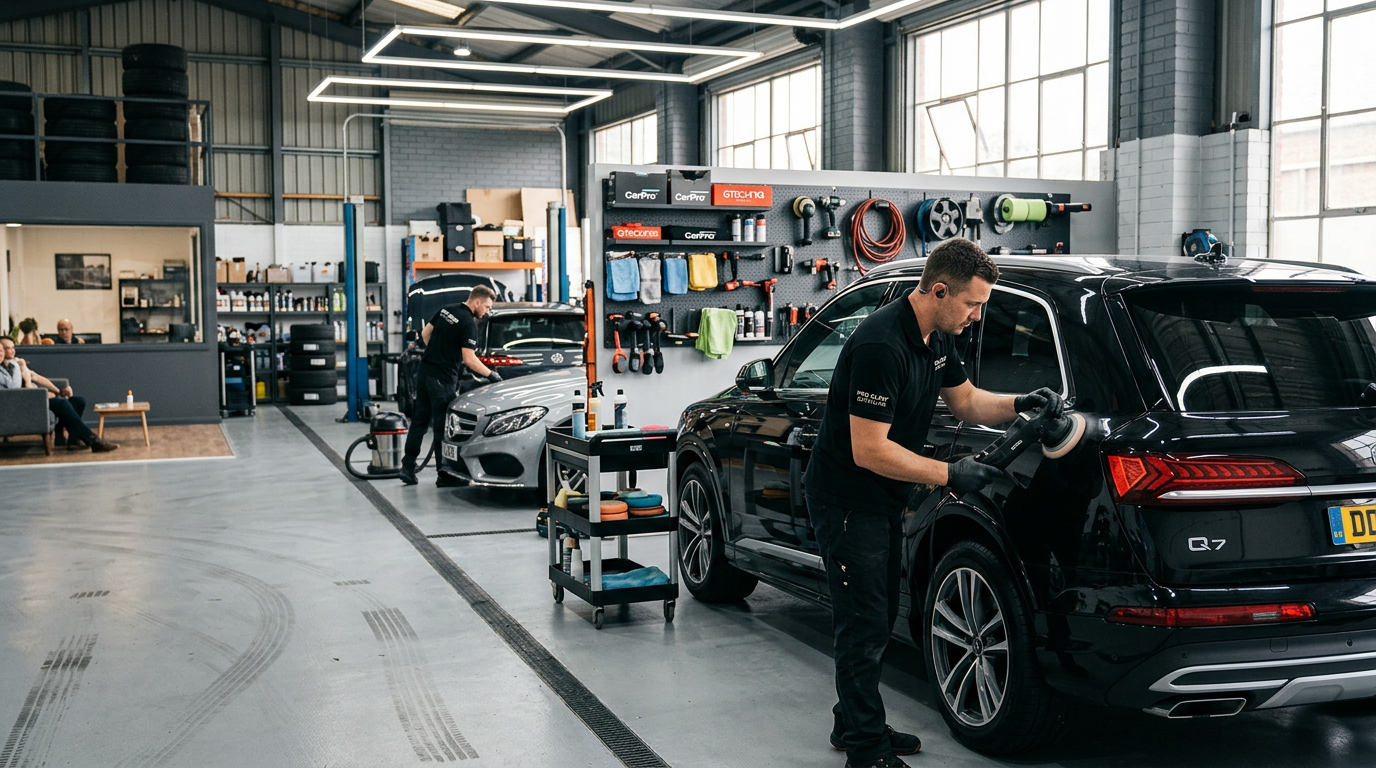
For mobile detailers, travel time is the greatest source of lost profit. If you are driving 45 minutes between every job, you are losing 2-3 hours of billable time per day. Use route optimization software or features within your CRM to cluster appointments geographically. For example, only book clients in the 'North Side' on Tuesdays and 'South Side' on Thursdays.
Standard Operating Procedures (SOPs) are essential as you prepare to hire your first employee. Document exactly how you want a car washed, which chemicals to use on which surfaces, and how to perform a final walk-through. This ensures quality remains consistent even when you aren't the one holding the polisher, protecting your brand's reputation.
Managing your schedule effectively also means accounting for 'buffer time.' Cars are often in worse condition than the client describes, and a '3-hour' detail can easily turn into 5 hours. Tools like Hulo allow you to set specific durations for services and add automatic padding between appointments, preventing you from running late and frustrating your afternoon clients.
Scaling with High-Ticket Services
As your skills improve, you should transition your business toward high-margin services like ceramic coatings and paint correction. While a standard wash might net you $40 an hour after expenses, a ceramic coating job can net $150 to $200 an hour. This shift allows you to work less while making more, reducing the physical toll that detailing takes on your body over time.
Investing in certification from major coating brands (like Gtechniq, Ceramic Pro, or IGL) can give you access to 'pro-only' products that offer 5-year to 9-year warranties. These certifications also allow you to list your business on the manufacturer’s 'Authorized Installer' map, which is a significant source of high-intent leads who are specifically looking for those premium products.
Eventually, scaling means moving from 'doing the work' to 'managing the business.' This involves hiring a lead detailer and a junior technician, allowing you to focus on marketing, high-level sales, and quality control. At this stage, having a robust software stack becomes non-negotiable to track employee hours, manage multiple mobile rigs, and monitor your profit margins across different service types.
| Service Type | Avg. Price | Labor Time | Profit Margin |
|---|---|---|---|
| Maintenance Wash | $75 | 1 Hour | 30% |
| Interior Detail | $250 | 3 Hours | 55% |
| 1-Stage Correction | $500 | 5 Hours | 65% |
| Ceramic Coating | $1,200 | 8 Hours | 75% |
| Fleet (5+ Cars) | $400 total | 4 Hours | 45% |
Service Margin Comparison
Key Takeaway: Scaling is about moving from labor-intensive cleaning to high-margin protection and restoration services.
Wrapping Up
Starting a car detailing business in 2026 is an incredible opportunity for those willing to combine technical skill with professional business practices. By choosing the right niche, investing in quality equipment like Rupes polishers and Mytee extractors, and protecting yourself with Garage Keepers insurance, you set the stage for long-term success. Remember that the 'business' side of detailing is just as important as the 'dirty' side; managing your time and reputation is what leads to a six-figure income. To simplify your journey, consider using an all-in-one platform like Hulo to handle your website, scheduling, and invoicing for just $49.99/mo, allowing you to focus on what you do best: making cars look like they just rolled off the showroom floor.
Frequently Asked Questions
How much does it cost to start a car detailing business in 2026?
A basic mobile detailing setup typically costs between $5,000 and $10,000, covering a reliable van, pressure washer, extractor, and initial chemical stock. If you are opening a fixed location, expect to invest $25,000 to $50,000 to cover lease deposits, shop fit-outs, and high-end lighting.
Do I need a special license to detail cars?
While most states only require a general business license (LLC), some municipalities require specific mobile wash permits or environmental drainage permits. Always check with your local city hall regarding water runoff regulations and chemical disposal laws to avoid heavy fines.
What is the best software for managing a detailing business?
For new and growing businesses, all-in-one platforms like Hulo are ideal because they combine your professional website, CRM, scheduling, and invoicing into one $49.99/mo subscription. This is significantly more cost-effective than paying for separate tools like Square, Wix, and Jobber individually.
How do I price my detailing services?
You should aim for a labor rate of $75 to $125 per hour. Calculate your overhead (insurance, chemicals, fuel) and add your desired profit margin; most professionals use tiered packages starting at $150 for basic work and $1,000+ for ceramic coatings.
Is a car detailing business profitable?
Yes, car detailing is highly profitable with margins often exceeding 50% for interior work and 70% for ceramic coatings. Success depends on minimizing travel time between mobile jobs and upselling maintenance clients into high-ticket protection services.
How do I prevent no-shows and cancellations?
The most effective way to prevent no-shows is to require a non-refundable deposit at the time of booking. Platforms like Hulo allow you to automate this process, sending reminders to clients and collecting deposits through your website to ensure your schedule stays full and protected.
Ready to Launch Your Detailing Empire?
Get your professional website, CRM, and scheduling tools all in one place with Hulo for just $49.99/mo.
Join the WaitlistMore from the Blog
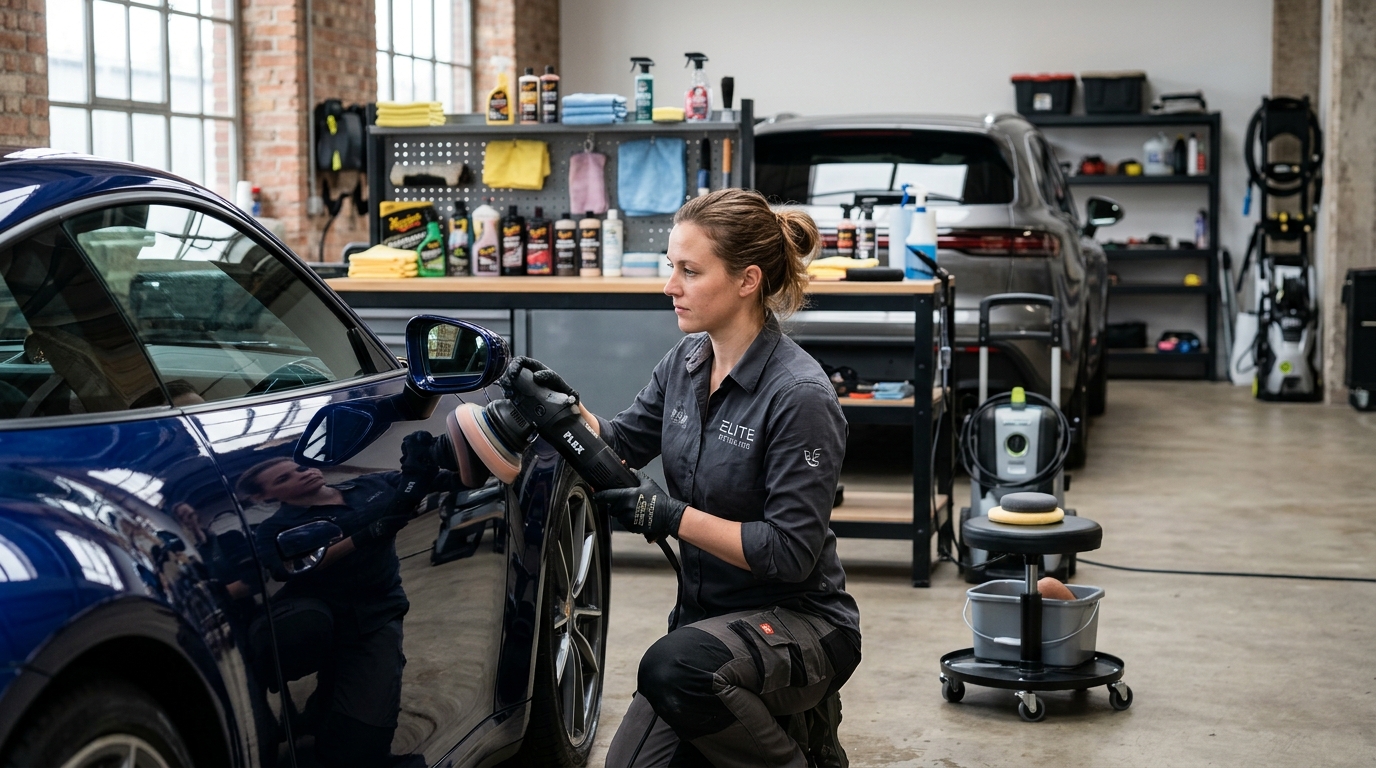
How to Price Car Detailing Services: Complete Pricing Guide (2026)
The car detailing industry is projected to exceed $15.7 billion by 2026, creating a massive opportunity for professional...
9 Simple Contractor Invoice Template Tips for Plumbers (2026)
A professional contractor invoice template for plumbers must include your business details, the client's information, a ...
9 Expert Tips for the Best Pressure Washer for Starting a Business (2026)
The best pressure washer for starting a business is a gas-powered unit delivering at least 4.0 GPM (gallons per minute) ...