9 Expert Tips for the Best Pressure Washer for Starting a Business (2026)
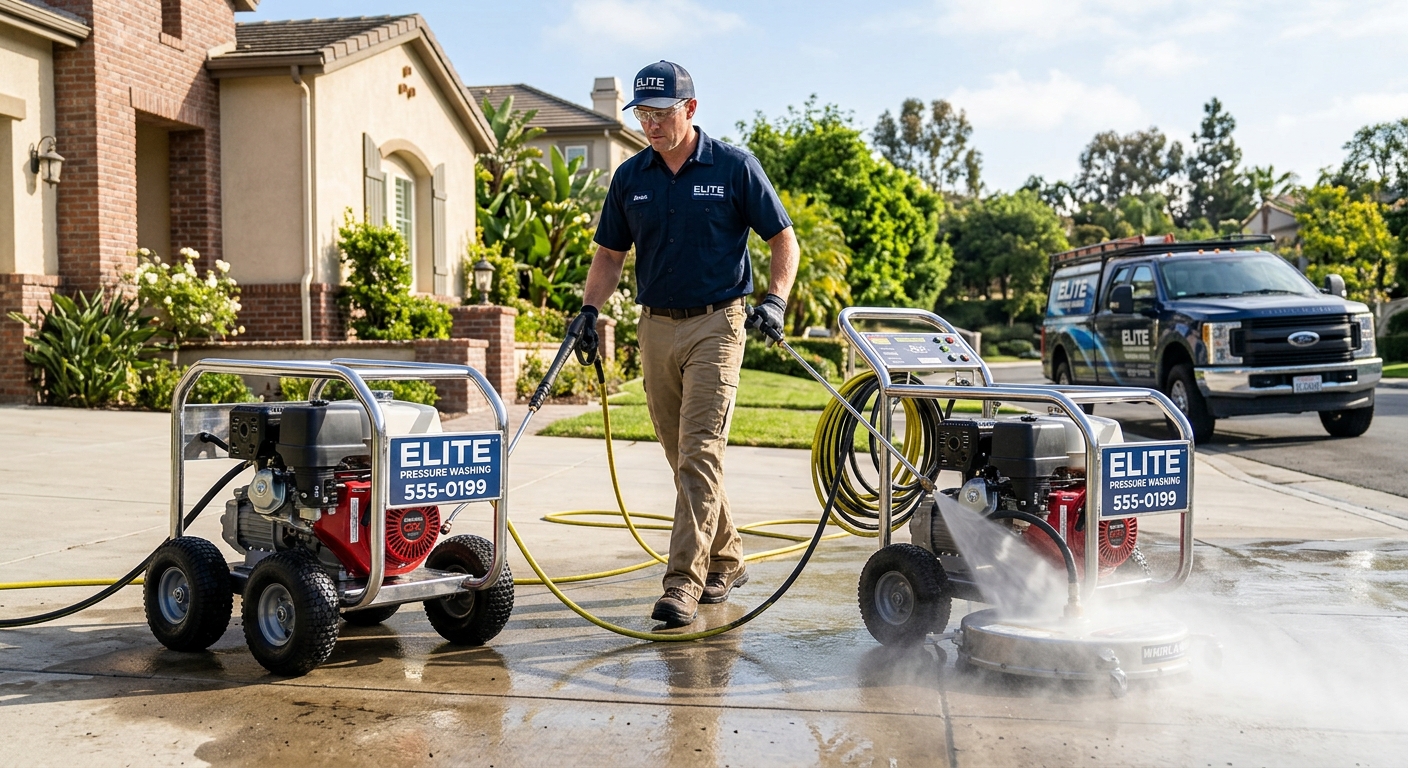
20 min read·Updated April 4, 2026The best pressure washer for starting a business is a gas-powered unit delivering at least 4.0 GPM (gallons per minute) and 3,500 PSI to handle residential and light commercial tasks efficiently. Professional contractors should prioritize engines like the Honda GX390 paired with a triplex plunger pump from brands like General Pump or Cat Pumps to ensure a lifespan exceeding 2,000 operating hours. Choosing the wrong equipment can lead to expensive downtime and slow production rates that eat into your 20% to 40% profit margins. This guide provides a technical breakdown of the essential machinery you need to launch a profitable exterior cleaning company this year.
Table of Contents
How to best pressure washer for starting a business: equipment buying guide?
Understanding the GPM vs PSI Power Balance
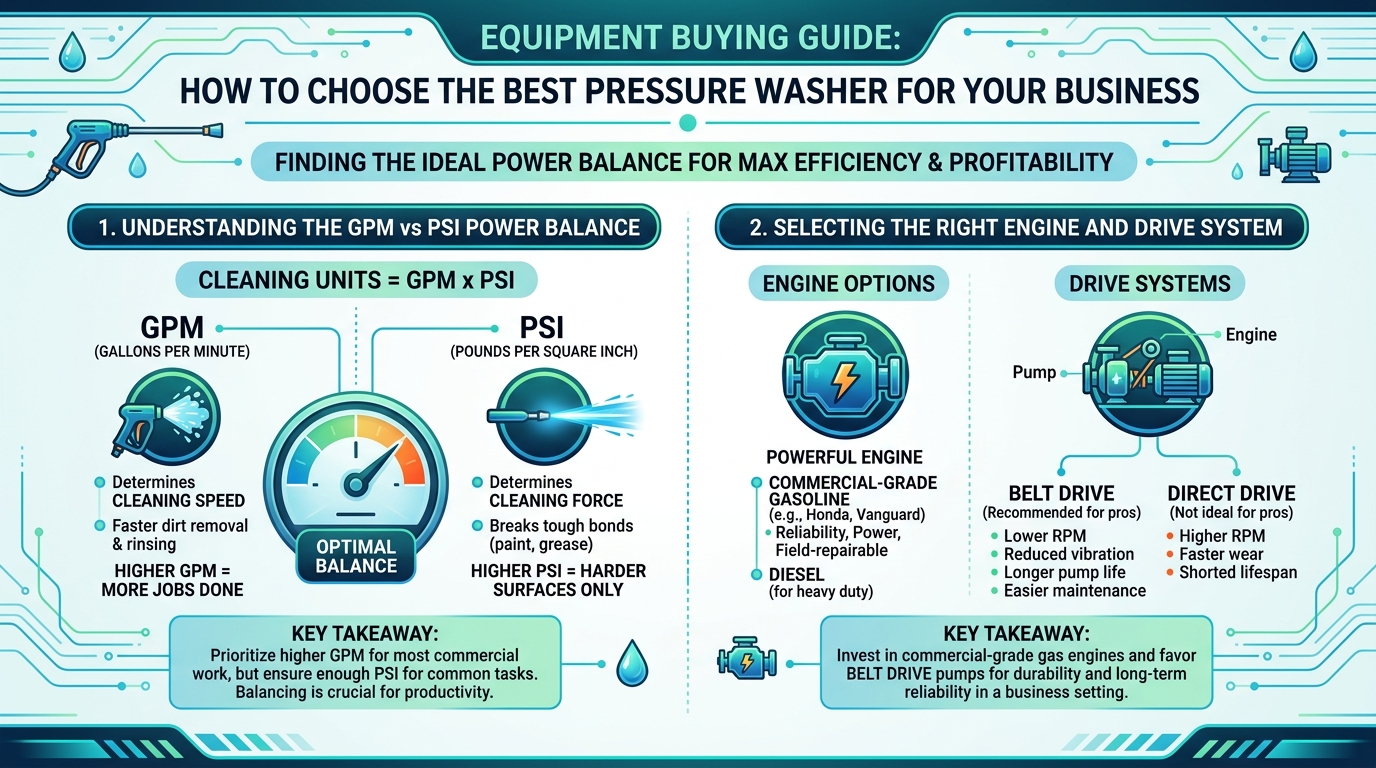
When you are searching for the best pressure washer for starting a business, you must understand that Gallons Per Minute (GPM) is significantly more important than Pounds Per Square Inch (PSI). While a 3,000 PSI machine can strip paint, a 4.0 GPM machine allows you to rinse away debris twice as fast as a standard 2.0 GPM consumer unit. Most professional residential jobs require a minimum of 4.0 GPM to effectively use a 16-inch surface cleaner without leaving 'zebra stripes' on the driveway. If you plan to scale into commercial work, you will eventually need to upgrade to 8.0 GPM units which can cost between $3,500 and $6,000 but increase your cleaning speed by 100%.
Cleaning Units (CU) is a metric calculated by multiplying GPM by PSI, and for a startup, you should aim for a CU of at least 14,000. For example, a 4.0 GPM machine at 3,500 PSI gives you exactly 14,000 CU, which is the industry 'sweet spot' for balancing equipment cost and job site efficiency. Higher PSI levels above 4,000 are rarely necessary for wood or vinyl and can actually cause permanent damage to a client's property if not handled with professional care. You should focus your budget on maximizing the flow rate rather than chasing the highest pressure numbers found on big-box store labels.
Efficiency in this business is measured by how many square feet you can clean per hour, and a 4.0 GPM setup typically allows for 1,000 to 1,500 square feet of surface cleaning per hour. If you drop down to a 2.5 GPM consumer-grade unit, that same driveway will take you three hours instead of one, effectively cutting your hourly rate from $150 down to $50. Before purchasing, verify that your water source—usually a residential spigot—can provide the required GPM, as most homes output between 5 and 8 GPM. Investing in a small 35-gallon buffer tank can prevent pump cavitation if the home's water flow is inconsistent or lower than your machine's intake requirement.
Selecting the Right Engine and Drive System
The engine is the heart of your operation, and the Honda GX390 remains the gold standard for contractors starting a pressure washing business due to its reliability and ease of repair. These engines are designed to run for 8 hours a day, 5 days a week, provided you change the 10W-30 oil every 50 to 100 operating hours. You will find that most local small engine repair shops stock parts for Honda GX series engines, which minimizes your downtime to 24-48 hours compared to weeks for off-brand Chinese engines. Expect to pay a premium of $300 to $500 for a Honda-powered unit, but the resale value and longevity make it a mandatory investment for a serious professional.
You must also choose between a direct-drive and a belt-drive system, which dictates how the engine transfers power to the high-pressure pump. Direct-drive units are more compact and affordable, typically costing $1,200 to $1,800, but the pump spins at the same high RPM as the engine, leading to more heat and vibration. Belt-drive systems allow the pump to spin at a lower RPM (usually around 1,400 to 1,700 RPM), which significantly extends the life of the pump seals and ceramic plungers. For a full-time business, a belt-drive system is superior because it can pull water from a buffer tank more effectively than a direct-drive unit, which usually requires a pressurized feed.
Gear-drive systems offer a middle ground, providing the compact footprint of a direct-drive with the lower pump RPM benefits of a belt-drive setup. While gear-drive units are becoming more popular in 2026, they require specific gear lube maintenance and can be slightly louder during operation. Regardless of the drive type, ensuring your engine has an electric start feature can save your shoulder from repetitive strain over a long season of 200+ jobs. If you are operating on a tight budget, a recoil start is acceptable, but you should plan to upgrade to an electric start model once you have completed your first 20 residential house washes.
4.0 GPM
Minimum Flow Rate
Required for professional surface cleaners and efficient residential rinsing.
Key Takeaway: Prioritize GPM over PSI for faster cleaning speeds and choose a Honda GX390 engine for maximum long-term reliability.
What is the best pressure washer for starting a business: equipment buying guide for beginners?
Essential Pump Technology for Professionals
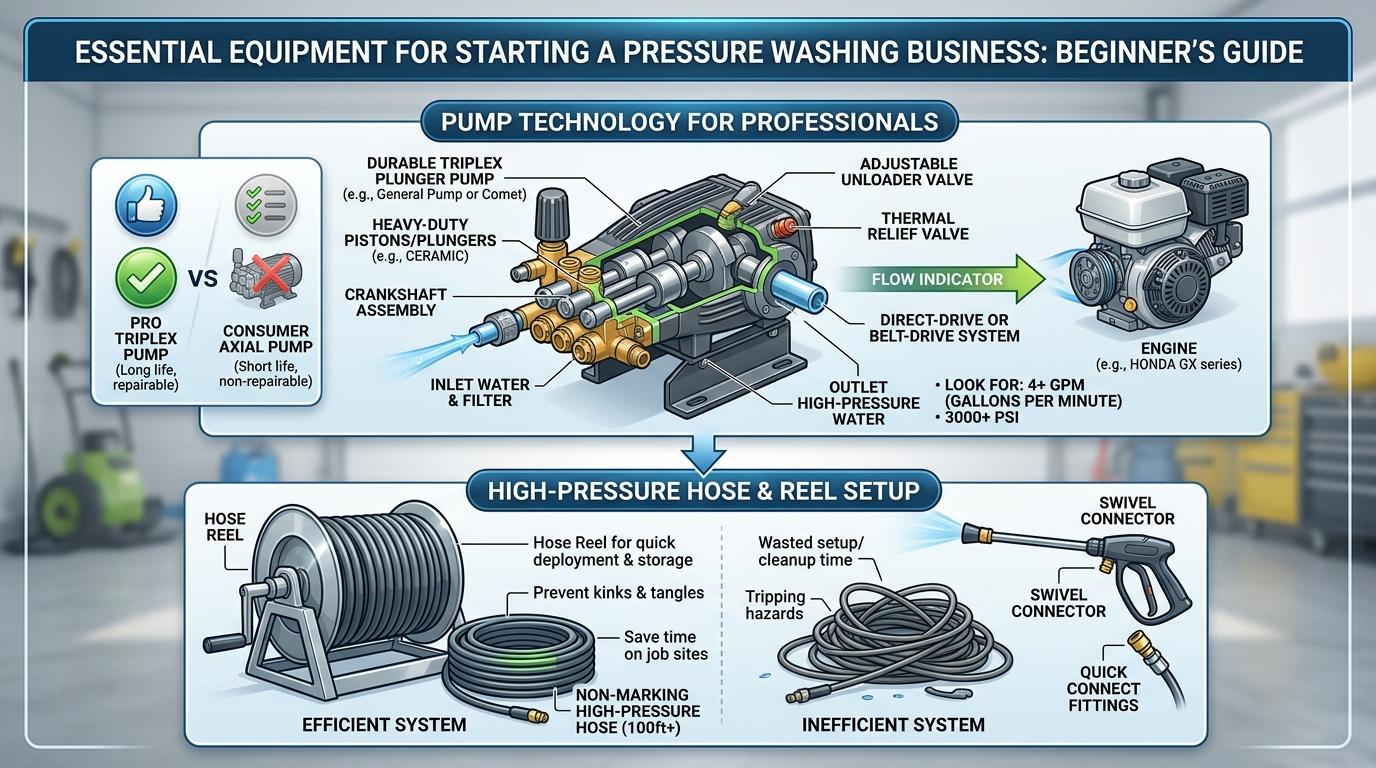
The pump is where the actual work happens, and as a beginner, you must avoid axial pumps found on $400 residential machines at all costs. Professional contractors use triplex plunger pumps, which feature three ceramic plungers that provide a smoother flow and higher durability than any other design. Brands like General Pump, Cat Pumps, and AR (Annovi Reverberi) are the industry leaders, with a General Pump TS2021 being a legendary choice for 4-5 GPM setups. A high-quality triplex pump can be rebuilt for $150 to $300, whereas an axial pump is a 'throwaway' component that must be entirely replaced when it fails.
Thermal relief valves are a critical safety component you must check for when buying your first professional-grade pump setup. These valves release hot water from the pump head if you leave the machine running without pulling the trigger for more than 2-3 minutes. If the water inside the pump reaches 145 degrees Fahrenheit, it can warp the seals and crack the ceramic plungers, leading to a $500 repair bill. Many beginners bypass this by installing a 'bypass line' that sends the water back to a buffer tank, which allows the machine to run indefinitely without overheating the pump head.
You should also look for a pump with an external unloader valve rather than an internal one integrated into the pump manifold. An external unloader allows you to adjust the pressure for delicate surfaces like wood decks and makes it much easier to replace if the valve gets stuck due to calcium buildup. External unloaders like the VRT3 or the Pulsar 3 are standard on high-end commercial builds and offer better pressure regulation. Maintaining your pump involves changing the pump oil (specifically non-detergent 30W) after the first 50 hours of 'break-in' use and every 300 hours thereafter to ensure the internal crankcase remains lubricated.
The High-Pressure Hose and Reel Setup
Your pressure washer is only as good as the hose that delivers the water, and beginners often make the mistake of using the stiff, plastic hoses that come in the box. You need a 3/8-inch diameter, non-marking, steel-braided rubber hose, typically in 50-foot or 100-foot sections. A 100-foot hose allows you to reach all sides of a standard 2,000-square-foot ranch home without moving your heavy machine from the driveway. Look for hoses rated for 4,000 PSI and 250 degrees Fahrenheit, even if you are only running cold water, as the higher rating ensures the hose won't burst under the constant pressure spikes of daily use.
Hose reels are not a luxury; they are a fundamental piece of equipment for a professional image and physical longevity. Lugging 100 feet of pressurized hose across a yard is exhausting and leads to kinks that can damage the hose's inner lining over time. Brands like Hannay Reels or Coxreels offer manual or electric rewind options that mount directly to your truck bed or trailer. By using a reel, you can deploy and retract your hose in under 60 seconds, which saves you approximately 15 minutes per job site. Over a 200-job season, that equates to 50 hours of saved labor, which pays for the $300 reel investment many times over.
Quick-connect fittings (QC) are the final piece of the hose puzzle, and you should standardize all your equipment on 3/8-inch stainless steel QCs. Brass fittings are cheaper but will deform and leak after just a few months of heavy use, especially if you are using corrosive chemicals like sodium hypochlorite. Standardizing your fittings allows you to swap between your spray gun, surface cleaner, and foam cannon in seconds. Always keep a spare kit of O-rings and a few extra couplers in your truck, as a $0.50 O-ring failure can shut down your entire operation for the day if you don't have a replacement on hand.
Pro Tip: Standardize all fittings to 3/8-inch stainless steel quick-connects to prevent leaks and speed up equipment transitions between jobs.
Which models are the best pressure washer for starting a business: equipment buying guide 2026?
Top-Rated Gas Units for New Contractors
In 2026, the Simpson SuperPro Roll Cage series remains a top contender for new business owners due to its balance of price and professional components. Specifically, the model featuring the Honda GX390 and a AAA Triplex pump offers 4.0 GPM at 4,400 PSI for approximately $1,400 to $1,600. While the AAA pump is considered an entry-level professional pump, the roll cage frame protects the engine during transport in a truck bed. This unit is ideal for contractors who are still working out of the back of a pickup truck before investing in a dedicated trailer or skid mount system.
For those with a slightly higher budget of $2,500, the Mi-T-M Job Pro series offers a significant upgrade in component quality and frame durability. These units often come with General Pump triplex systems and a powder-coated steel frame that resists corrosion from the chemicals used in house washing. The Mi-T-M units are known for their vibration-dampening engine mounts, which reduce the fatigue on both the machine and the operator during 6-hour cleaning days. If you can afford the extra $800 upfront, the Mi-T-M will likely last 2-3 years longer than the entry-level Simpson models under heavy daily use.
Landa and Hotsy are the premium options if you are looking for hot water pressure washers, which are essential if you plan to target commercial kitchen grease or heavy equipment cleaning. A hot water unit like the Landa PGHW can cost between $6,000 and $12,000, but it allows you to melt oil and grease that cold water simply can't touch. Most residential contractors start with cold water and add a heater (or 'hot box') later as their commercial client base grows. However, if your business plan focuses on gas stations or drive-thrus, starting with a hot water Landa unit is the only way to ensure you can meet the cleaning standards required by those clients.
Electric and Battery-Powered Alternatives
While gas remains king for high-flow applications, 2026 has seen a surge in professional-grade electric pressure washers for specific niche markets. Units from brands like Kranzle are favored by high-end car detailers because they offer consistent pressure and can run indoors without exhaust fumes. A Kranzle K1122TST delivers 2.1 GPM at 1,400 PSI, which is perfect for delicate automotive paint but insufficient for cleaning a 4-car concrete driveway. These units start around $1,200 and are built with brass pump heads and ceramic-coated stainless steel pistons, making them incredibly durable for their size.
Battery-powered units are still primarily in the 'prosumer' category, but companies like Milwaukee and Ryobi are pushing the limits of what 18V and 40V systems can do. Currently, battery units are best reserved for 'punch list' items or cleaning small balconies where dragging a gas hose is impractical. They typically max out at 1.2 to 2.0 GPM and have a runtime of 20-30 minutes per charge on high-capacity batteries. For a primary business machine, battery technology is not yet a viable replacement for gas engines due to the massive power requirements of moving 4+ gallons of water per minute at high pressure.
If you choose an electric unit for specialized work, you must ensure you have a dedicated 20-amp circuit available at the job site, as these machines draw significant power. Using a long, thin extension cord will cause a voltage drop that can burn out the electric motor within weeks. Always use a 10-gauge or 12-gauge extension cord no longer than 50 feet to maintain the integrity of the motor. For most starting their business, gas is the only logical choice for the primary machine, with electric units serving as a secondary tool for interior or noise-sensitive environments.
$1,400 - $2,500
Startup Equipment Cost
Average price range for a professional 4.0 GPM gas-powered pressure washer.
What are the best pressure washer for starting a business: equipment buying guide tips?
Downstream Injectors and Chemical Management
One of the most important tips for a new pressure washing business is to master the 'downstream injection' method for applying cleaning chemicals. A downstream injector is a small $20 brass component that sits after the pump and draws soap into the water stream using the Venturi effect. This allows you to apply professional-grade cleaners like Sodium Hypochlorite (SH) without the chemicals ever touching your expensive pump internals. Because the chemical is introduced at low pressure, you can use a 'soap nozzle' to spray the mixture up to 30 feet onto the side of a two-story house, eliminating the need for ladders.
Managing your chemical ratios is the difference between a clean house and a dead lawn, so you must understand 'draw rates.' Most downstream injectors have a fixed ratio of 1:10, meaning for every 10 gallons of water, one gallon of chemical is pulled from your bucket. If you are using 12.5% industrial-strength bleach, a 1:10 draw rate results in a 1.25% SH solution hitting the siding, which is the industry standard for killing mold and mildew. Always pre-wet any surrounding vegetation with fresh water before and after applying chemicals to prevent 'plant burn' and potential liability claims from homeowners.
Platforms like Hulo can help you track your chemical inventory and costs per job, ensuring you are actually pricing your services for profit. By logging your chemical usage in a centralized CRM, you can see if you are over-applying product on certain types of siding or roof materials. Hulo's integrated invoicing also allows you to add 'environmental disposal' or 'chemical surcharges' to your bills automatically. This level of data tracking prevents the common mistake of 'guesstimating' your overhead and helps you maintain a consistent 30% net profit margin as you grow.
Surface Cleaners: The Ultimate Speed Tool
A surface cleaner is a circular attachment with rotating nozzles that allows you to clean flat concrete surfaces 5 to 10 times faster than a standard wand. The 'rule of thumb' for sizing a surface cleaner is 4 inches of diameter for every 1.0 GPM of your machine's output. Therefore, a 4.0 GPM pressure washer should be paired with a 16-inch surface cleaner like the Whisper Wash Ultra Clean or a BE Whirl-A-Way. If you try to use a 20-inch cleaner with a 4.0 GPM machine, the rotation will be too slow, and you will be forced to walk at a snail's pace to get a clean result.
Using a surface cleaner also provides a much more uniform finish, preventing the 'wand marks' or 'tiger stripes' that occur when a contractor manually swings a spray tip back and forth. For beginners, a stainless steel or heavy-duty plastic housing is preferred over aluminum, which can dent if you hit a raised edge of concrete. You should also look for models with 'greasable' swivels, as the swivel is the part most likely to fail due to high-speed rotation and grit infiltration. A high-quality 16-inch surface cleaner will cost between $350 and $550 and is the single most important accessory for residential driveway cleaning.
Maintenance for your surface cleaner includes checking the nozzles for clogs and ensuring the spray bar is balanced. If one nozzle is partially blocked, the bar will vibrate violently, which can destroy the internal bearings of the swivel in a matter of hours. You should always use a 'tip filter' at the inlet of your surface cleaner to catch any debris that might have entered the hose during setup. Replacing the nozzles every 50 to 100 hours of use is also recommended, as the high-pressure water slowly erodes the orifice, changing the spray pattern and reducing cleaning effectiveness.
| Machine GPM | Recommended Surface Cleaner Size | Cleaning Speed (Sq Ft/Hr) |
|---|---|---|
| 2.5 GPM | 10-12 Inches | 400 - 600 |
| 4.0 GPM | 16 Inches | 1,000 - 1,500 |
| 5.5 GPM | 20 Inches | 1,800 - 2,200 |
| 8.0 GPM | 24-30 Inches | 3,000+ |
Surface Cleaner Sizing Chart
Key Takeaway: Master downstream injection to protect your pump and use a surface cleaner sized to your GPM to drastically increase your speed.
Ready to put this into action?
Hulo gives you everything to run your pressure washing business — website, CRM, scheduling, and invoicing. Join the waitlist for V2.
Join the WaitlistWhy does pump selection matter for your pressure washing equipment buying guide?
The Lifecycle of Professional Triplex Pumps
The choice of pump directly impacts your business's uptime and the total cost of ownership over a five-year period. A triplex plunger pump is designed with a crankcase that houses oil, which lubricates the movement of the pistons and ceramic plungers. Unlike consumer-grade axial pumps that often fail after 50 to 100 hours of use, a well-maintained triplex pump from General Pump or Cat Pumps can last 2,000 to 3,000 hours. This means that while you pay $500 more upfront, your cost per operating hour drops from $5.00 to less than $0.50, making it the more economical choice for a growing business.
Cavitation is the number one killer of professional pumps and occurs when the pump is 'starved' for water, creating air bubbles that implode with enough force to pit the metal surfaces inside the pump. To prevent this, you must ensure your supply hose is at least 3/4-inch in diameter and that your water source provides at least 20% more GPM than your pump requires. Many professionals use a buffer tank—a large plastic water reservoir—to ensure the pump always has a steady head of water. If you hear a 'marbles in a blender' sound coming from your pump, shut it down immediately and check your water supply to avoid a $600 replacement cost.
Investing in a pump with a 'nickel-plated manifold' or a 'brass manifold' is essential for contractors who plan to do a lot of soft washing or use corrosive detergents. While downstreaming protects the pump, some contractors choose to 'run soap through the pump' (upstream), which requires specialized seals and manifolds that won't corrode. However, the industry consensus is that downstreaming is safer and keeps your pump in peak condition for longer. Always check the manufacturer's warranty on the pump, as some brands like Cat Pumps offer a 5-year limited warranty, which provides significant peace of mind for a new business owner.
Bypass Systems and Thermal Management
When you release the trigger on your spray gun, the unloader valve diverts the water flow away from the nozzle and back into the pump's inlet or a buffer tank. This is known as 'bypass mode,' and it is the most dangerous time for your pump because the water is trapped in a small loop and quickly heats up due to friction. A 'closed-loop' bypass (back to the pump inlet) can reach dangerous temperatures in under three minutes, leading to seal failure. An 'open-loop' bypass (back to a large buffer tank) allows the water to stay cool for hours because it is being mixed with a larger volume of ambient temperature water.
For beginners without a buffer tank, installing a thermal relief valve is a non-negotiable safety feature that costs less than $20. This valve will automatically pop open and dump hot water onto the ground, allowing cool water from the garden hose to enter the pump and lower the temperature. You should test this valve once a month by letting the machine run in bypass for a few minutes to ensure it triggers correctly. If you find yourself frequently triggering the thermal relief, it is a sign that you need to adjust your workflow to spend less time with the engine running and the trigger closed.
Using a 'K7' unloader or a similar 'zero-pressure' unloader can also reduce the strain on your pump and engine during bypass mode. These unloaders drop the pressure in the high-pressure hose to near zero when the trigger is released, making it much easier to restart the engine if it stalls. Standard 'pressure-trapping' unloaders keep the hose pressurized at 3,500+ PSI, which creates backpressure that can make the pull-start cord nearly impossible to tug. Upgrading your unloader is a common 'pro tip' that many contractors do within their first year to improve the user experience and reduce mechanical wear.
Pro Tip: Always route your bypass line back to a buffer tank rather than the pump inlet to prevent overheating and extend seal life by 50%.
How to manage your pressure washing business operations in 2026?
Streamlining Quotes and Invoicing
Once you have the best pressure washer for starting a business, you need a system to manage the cash flow it generates. Many new contractors lose 10-15% of their potential revenue because they take too long to send quotes or forget to follow up on unpaid invoices. Using an all-in-one platform like Hulo allows you to generate professional quotes on-site from your smartphone, which increases your 'close rate' by up to 30%. When a client receives a digital quote with a 'click to accept' button while you are still standing in their driveway, they are much more likely to book the job immediately.
Automated invoicing is another critical feature for the 2026 contractor, as it eliminates the need for manual data entry at the end of a long 10-hour workday. Systems like Hulo can automatically send a text-to-pay link the moment you mark a job as complete, which often results in getting paid before you even leave the neighborhood. In the pressure washing industry, where residential jobs range from $250 to $800, maintaining a fast 'time-to-payment' is essential for covering your daily fuel and chemical expenses. Digital payments also provide a clear audit trail for tax season, which is much safer than carrying large amounts of cash from residential job sites.
Customer Relationship Management (CRM) tools also allow you to store 'before and after' photos directly in the client's profile, which is vital for defending against false damage claims. If a homeowner claims your pressure washer cracked their siding, you can pull up the high-resolution photo from your CRM showing the crack existed before you started. This level of documentation not only protects your business but also builds trust with your clients, leading to more 5-star reviews on Google and Yelp. In 2026, a professional digital presence is just as important as the PSI of your machine when it comes to winning high-end residential contracts.
Scheduling and Route Optimization
Fuel costs and drive time can quickly erode your profits, making route optimization a top priority for any mobile service business. If you are crisscrossing the city to perform three different $300 house washes, you might spend 2 hours in traffic and $40 in gas, significantly lowering your effective hourly rate. Modern scheduling software allows you to 'cluster' your jobs by neighborhood, ensuring you spend more time cleaning and less time driving. By grouping three jobs in the same zip code on a Tuesday, you can increase your daily revenue by 25% without adding any additional labor hours.
Professional scheduling also allows you to send automated 'on-the-way' texts to your clients, which reduces the number of 'no-shows' or blocked driveways that can delay your start time. If a client forgets you are coming and leaves their cars in the driveway, it can take 30 minutes to track them down and move the vehicles, throwing off your entire day's schedule. An automated reminder sent 24 hours in advance ensures the property is ready for your arrival, allowing you to get straight to work. This level of communication is what separates a 'guy with a pressure washer' from a professional exterior cleaning company.
Finally, tracking your equipment maintenance schedule within your business software ensures you never miss an oil change or a pump service. You can set reminders based on the number of jobs completed or hours worked, preventing the catastrophic engine failures that happen when maintenance is neglected. Hulo and similar platforms can track these operational details alongside your financials, giving you a 'bird's eye view' of your business health. As you scale from one truck to three, having these systems in place from day one makes the transition much smoother and prevents the owner-operator burnout common in the trades.
30%
Quote Close Rate Increase
Average improvement when using digital quoting and immediate on-site follow-ups.
Wrapping Up
Choosing the best pressure washer for starting a business requires balancing flow rate, engine reliability, and pump durability. By investing in a 4.0 GPM machine with a Honda GX390 engine and a triplex pump, you set your business up for long-term success and high efficiency. Remember that your equipment is only half the battle; using professional management software will ensure your operation remains profitable and organized as you scale.
Frequently Asked Questions
How much does a professional pressure washing setup cost in 2026?
A basic professional setup including a 4.0 GPM gas machine, 100 feet of hose, a 16-inch surface cleaner, and a downstream injector typically costs between $2,500 and $3,500. If you add a dedicated trailer, 100-gallon buffer tank, and professional hose reels, your startup costs will range from $6,000 to $10,000. It is recommended to start with the $3,000 setup and use your first 10-15 jobs to fund the trailer and tank upgrades.
What's the difference between a belt-drive and a direct-drive pressure washer?
Direct-drive units have the pump bolted directly to the engine's drive shaft, making them compact and cheaper but prone to more heat and vibration. Belt-drive units use a pulley system to run the pump at a lower RPM, which stays cooler and lasts significantly longer under heavy daily use. For a business, belt-drive is superior because it can also pull water from a tank more reliably than a direct-drive unit.
Do I need a license to start a pressure washing business?
Most states require a general business license, but some areas also require a specialized 'environmental' or 'wastewater' permit to ensure you aren't dumping chemicals into storm drains. You should check with your local city hall and state licensing board for specific requirements regarding 'Clean Water Act' compliance. Additionally, obtaining a certification from organizations like the PWNA (Power Washers of North America) can help you secure lower insurance rates and higher-paying commercial contracts.
How long does it take to pressure wash a standard 2,000 sq ft house?
Using a professional 4.0 GPM machine and the downstream 'soft wash' method, a 2,000 sq ft house typically takes 1.5 to 2.5 hours to complete. This includes setup time, pre-wetting plants, applying soap, rinsing, and packing up your equipment. A beginner using a lower-flow consumer machine or working solely from ladders may take 4 to 6 hours for the same sized property.
What certifications do I need for professional Pressure Washing?
While not legally required in all states, the most recognized certifications are through the PWNA (Power Washers of North America) and the UAMCC (United Association of Mobile Contract Cleaners). These organizations offer courses in roof cleaning, wood restoration, and environmental wash-water recovery. Having these certifications allows you to market yourself as a 'Certified Professional,' which justifies charging $50-$100 more per job than uncertified competitors.
How do I get paid faster as a Pressure Washing contractor?
The fastest way to get paid is to offer digital payment options like credit card, Apple Pay, or ACH transfers through a system like Hulo. By sending a 'Text-to-Pay' link immediately upon job completion, you can often secure payment before you even drive away from the client's home. Avoid relying on paper checks, which can take 7-10 days to clear and require a physical trip to the bank, delaying your access to essential cash flow.
Is a hot water pressure washer worth the extra $4,000 for a startup?
A hot water unit is only worth the investment if you plan to focus on commercial work like parking garages, restaurant drive-thrus, or heavy machinery degreasing. For 90% of residential work (siding, decks, and driveways), a cold water machine paired with the right chemicals is perfectly sufficient. Most contractors start with cold water and only buy a hot water unit once they have secured a recurring commercial contract that requires grease removal.
What is the '4-inch rule' for surface cleaners?
The 4-inch rule states that you should have 4 inches of surface cleaner diameter for every 1.0 gallon per minute (GPM) of your pressure washer's output. For example, a 4.0 GPM machine works best with a 16-inch surface cleaner, while an 8.0 GPM machine can handle a 32-inch cleaner. Exceeding this ratio will result in the spray bar spinning too slowly to clean effectively, leading to uneven results and 'zebra stripping' on the concrete.
Ready to Professionalize Your Pressure Washing Business?
Hulo helps new contractors manage quotes, invoicing, and scheduling for under $50/month. Start your 14-day free trial and see how easy it is to get paid faster in 2026.
Join the WaitlistMore from the Blog
9 Actionable Ways to Bid Commercial Pressure Washing Jobs for Contractors (2026)
Bidding commercial pressure washing jobs requires calculating your square footage rate, typically between $0.10 and $0.5...
How to Price Pressure Washing Jobs: Complete Pricing Guide (2026)
In 2026, the exterior cleaning industry has moved far beyond the 'guy with a truck' mentality, evolving into a data-driv...
How to Start a Pressure Washing Business: The $50K Side Hustle Guide (2026)
In 2026, the demand for exterior maintenance has reached an all-time high as homeowners prioritize curb appeal and prope...