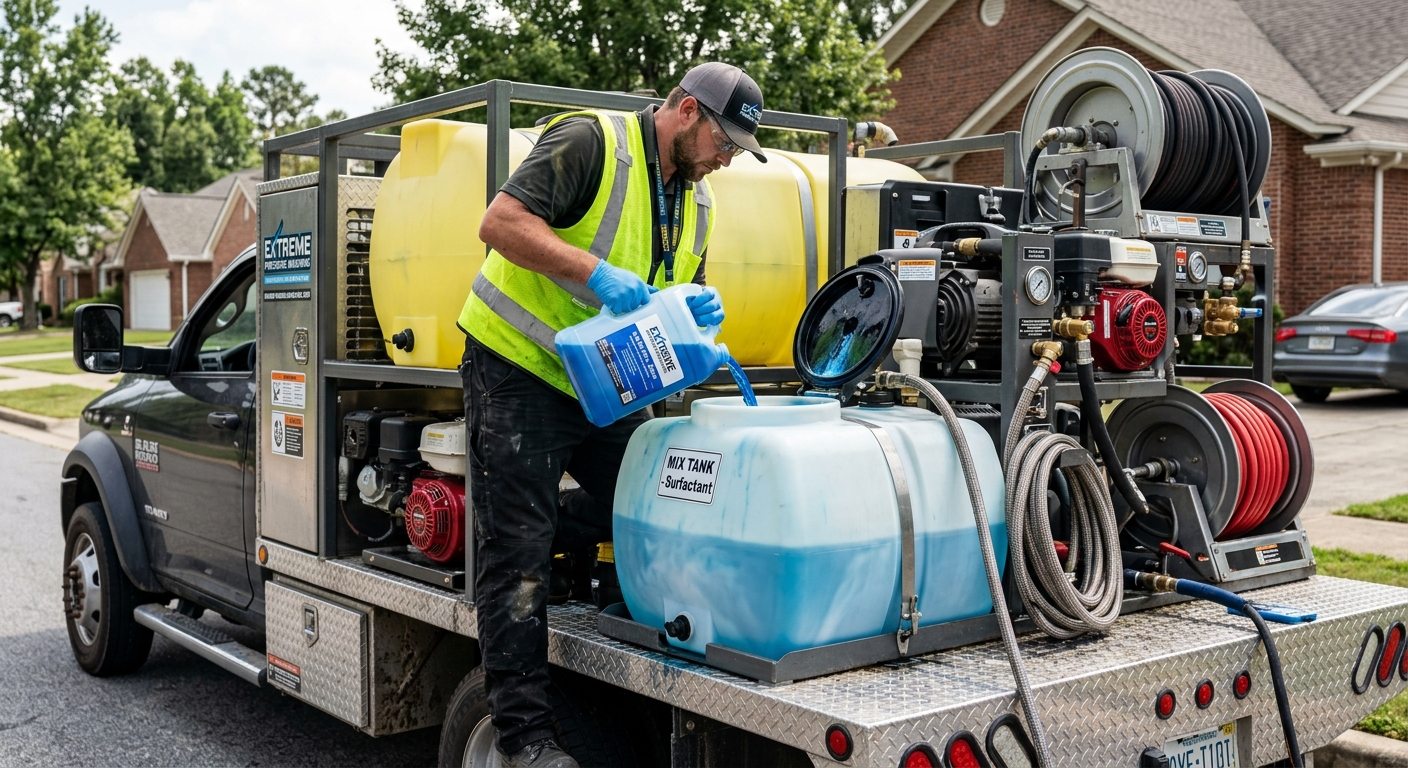
9 Complete Pressure Washing Chemicals for Beginners (2026 Guide)
17 min read·Updated April 3, 2026Pressure washing chemicals for beginners primarily include sodium hypochlorite for organic stains and surfactants to improve surface tension and dwell time. Most residential contractors should budget $250–$600 for an initial inventory to effectively clean vinyl, concrete, and wood. In this guide, you will learn the exact chemical concentrations, safety protocols, and environmental regulations required to launch a professional cleaning operation in 2026.
Table of Contents
Step-by-Step Overview
- 1
Assess the Surface Material
Before selecting a chemical, identify if the substrate is vinyl siding, porous concrete, or delicate wood. Vinyl requires a 1-2% sodium hypochlorite (SH) mix, while concrete may need 3-4% SH for deep mold. Incorrect identification can lead to permanent oxidation or wood fiber damage, potentially costing you $500-$2,000 in property damage claims.
- 2
Select Your Chemical Base
Choose between Sodium Hypochlorite (SH) for organics or Sodium Hydroxide for oils and greases. SH is the industry standard for 90% of residential jobs, typically purchased in 12.5% concentrations for roughly $5-$8 per gallon. Ensure you are using 'pool grade' or professional strength rather than 6% household bleach to maintain cleaning efficiency and profit margins.
- 3
Calculate Your Dilution Ratio
Determine your application method, such as a 10:1 downstream injector or a dedicated 12V soft wash system. For a standard 1% house wash mix using a 10:1 injector, you will need to put 100% SH in your bucket to achieve the desired strength at the nozzle. Always account for 'draw rates' to ensure you aren't wasting $50 of product per hour.
- 4
Add a Professional Surfactant
Mix in a surfactant like Elemonator or Gain at a rate of 1-2 ounces per 5 gallons of mix. Surfactants act as a 'clinging agent' that prevents the chemical from drying too quickly on vertical surfaces like siding. This step reduces chemical consumption by 15% and ensures the active ingredients stay in contact with the dirt for the full dwell time.
- 5
Pre-Wet and Protect Vegetation
Saturate all nearby grass, shrubs, and flowers with fresh water for 5-10 minutes before applying chemicals. This fills the plant's vascular system with water, preventing it from absorbing the SH and dying, which is a common $300 mistake for beginners. For high-value landscaping, consider using a neutralizer like Agent Halt to stabilize the soil pH after the job.
- 6
Apply and Monitor Dwell Time
Apply the chemical mix from the bottom up to prevent streaking, then allow it to dwell for 5-15 minutes. Watch for the 'green to brown' color change on algae, which indicates the chemical has successfully oxidized the organic matter. Never let the chemical dry on the surface, as this can cause permanent white salt deposits or 'tiger stripes' on gutters.
- 7
Rinse and Post-Treat
Rinse the surface thoroughly from the top down using low pressure (under 500 PSI) for soft washing. For concrete driveways, consider a post-treatment of 3% SH left to dry, which keeps the surface clean for 20-30% longer. Finalize the job by rinsing all windows and plants one last time to remove any residual chemical film or 'overspray' spots.
What are the Best Pressure Washing Chemicals for Beginners in 2026?
Sodium Hypochlorite (SH) for Organic Growth
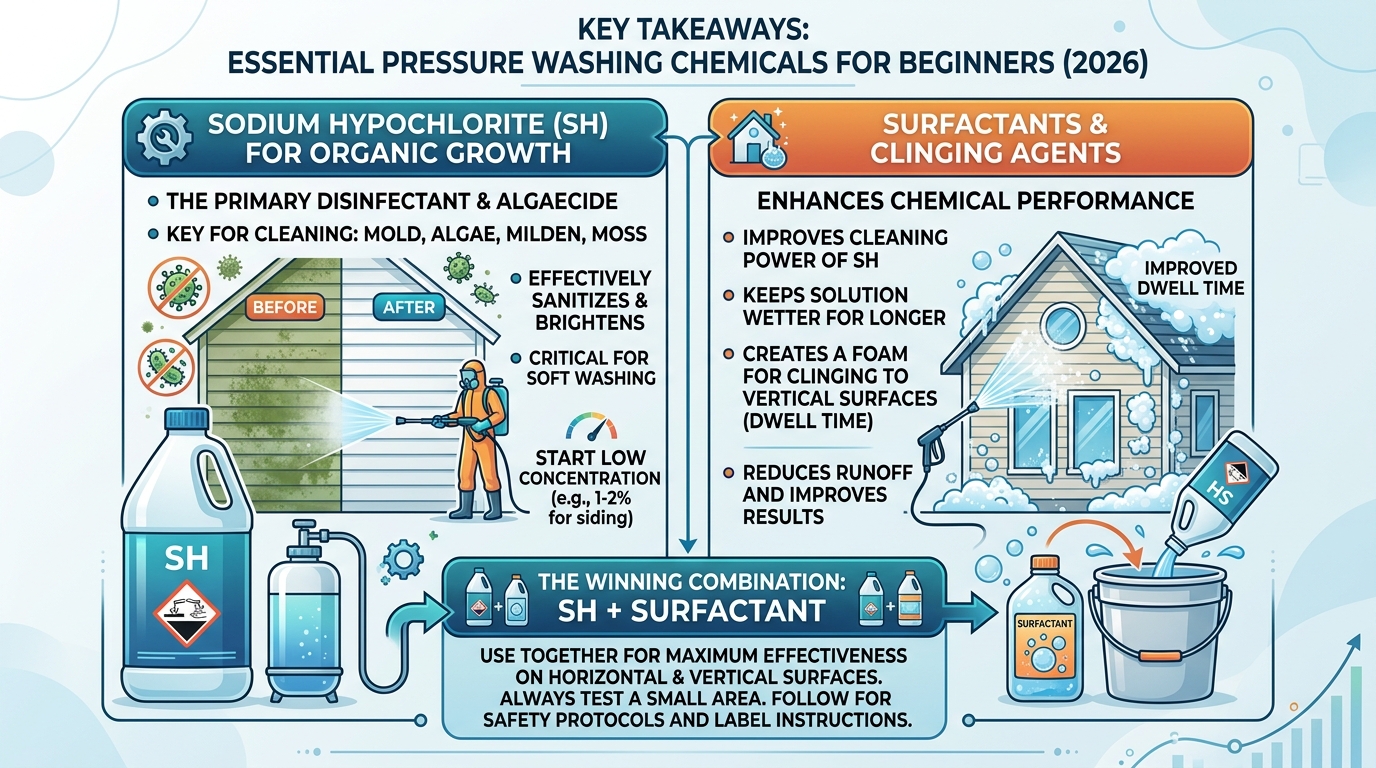
Sodium Hypochlorite is the undisputed king of the pressure washing industry, accounting for nearly 90% of all residential cleaning applications. Beginners should source 12.5% industrial-strength SH from local chemical suppliers or pool stores, where it typically costs between $4.50 and $7.00 per gallon when bought in bulk. This chemical is highly effective at killing mold, mildew, algae, and moss on vinyl siding, roofs, and concrete surfaces.
When using SH, it is vital to understand that its shelf life is relatively short, often losing 50% of its potency within 3 to 6 months if stored in direct sunlight. Most professional contractors aim for a 'hit' at the nozzle of 1% for house washing and 3% to 4% for roof cleaning to ensure complete organic eradication. Using household bleach (6% SH) is often a mistake for beginners because it requires double the volume to achieve the same cleaning power, drastically increasing your labor time.
Safety is the primary concern when handling SH, as it is a strong oxidizer that can cause chemical burns or respiratory distress if mishandled. Always wear chemical-resistant gloves, such as 15-mil nitrile options, and wrap-around safety goggles to prevent eye contact from high-pressure blowback. Platforms like Hulo help contractors track these safety equipment expenses and chemical inventory levels, ensuring you never run out of stock in the middle of a $1,200 commercial contract.
Surfactants and Clinging Agents
Surfactants are essential additives that break the surface tension of water, allowing your cleaning solution to 'wet' the surface more effectively. For a beginner, a professional surfactant like Elemonator or Slo-Mo costs approximately $45 per gallon but is highly concentrated, requiring only 1-2 ounces per 5-gallon batch. These agents prevent your mix from running off vertical surfaces, which increases the dwell time and reduces the total amount of chemical needed by up to 20%.
Beyond cleaning efficiency, surfactants often include 'scent masks' like cherry or lemon to hide the harsh smell of bleach, which improves the customer experience significantly. Many beginners attempt to use dish soap like Dawn, but this can be a mistake because Dawn is not 'bleach stable' and will neutralize the SH, rendering your mix ineffective. Stick to professional-grade surfactants that are specifically formulated to remain stable when mixed with high concentrations of sodium hypochlorite.
Using a surfactant also provides a visual aid during application, as the light foam allows you to see exactly where you have applied the chemical. This prevents 'holidays' or missed spots on large siding jobs, which can lead to costly callbacks and negative reviews. In a competitive 2026 market, achieving a uniform clean on the first pass is the fastest way to build a 5-star reputation and justify higher premium pricing.
90%
Market Dominance
Percentage of residential exterior cleaning jobs that rely primarily on Sodium Hypochlorite.
Key Takeaway: Sodium Hypochlorite (12.5%) and a bleach-stable surfactant are the two most critical chemicals for any beginner starting a pressure washing business.
How to Pressure Washing Chemicals for Beginners: Complete Guide to Soft Washing?
The Science of Low-Pressure Cleaning
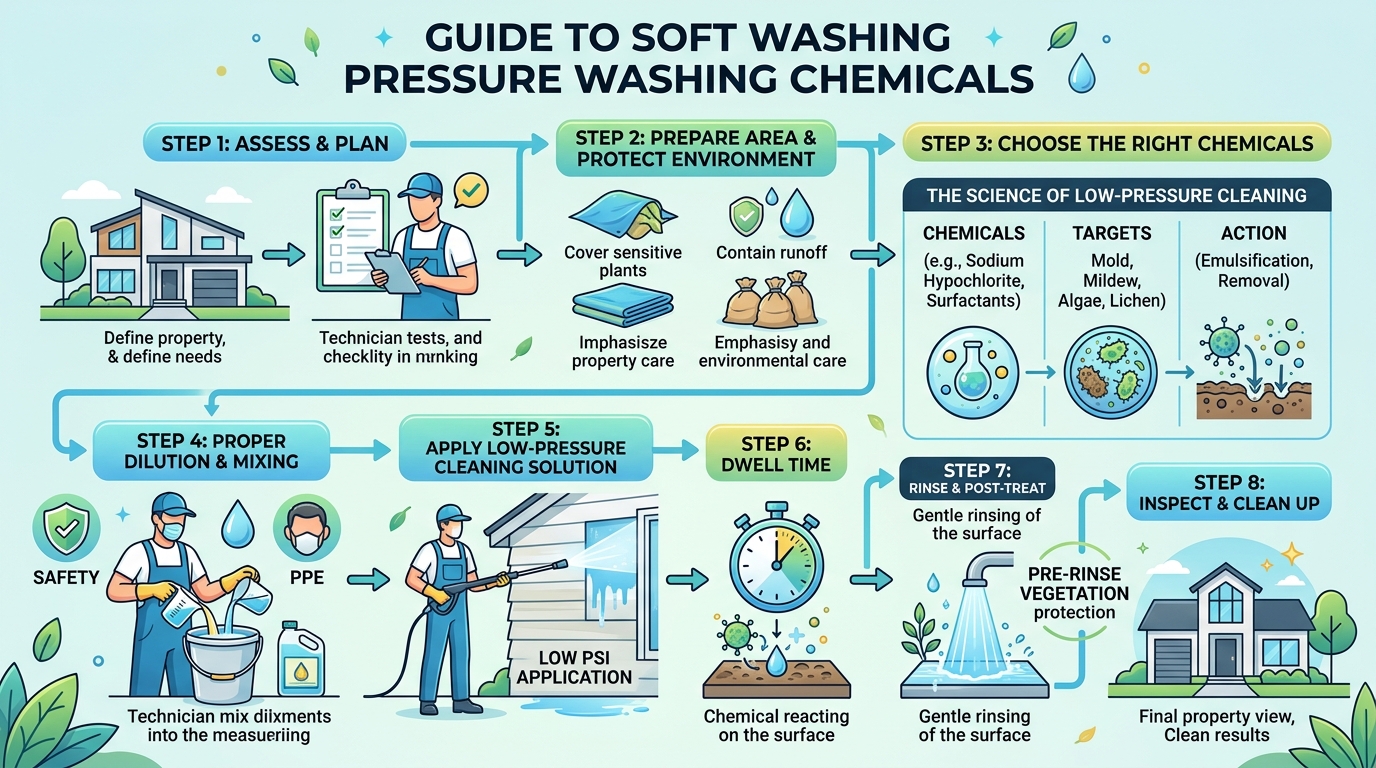
Soft washing is a technique that relies on chemical strength rather than mechanical pressure to clean delicate surfaces like vinyl, stucco, and asphalt shingles. For beginners, this means using a pressure of less than 500 PSI, which is roughly the same force as a garden hose with a specialized nozzle. This approach eliminates the risk of 'etching' concrete or forcing water behind siding, which are common $1,500 insurance claims for inexperienced operators.
The core of soft washing is the 'dwell time,' which typically ranges from 10 to 15 minutes depending on the temperature and the severity of the organic growth. In 2026, professional rigs often use 12-volt or air-diaphragm pumps to apply these chemicals, which can cost anywhere from $1,500 to $5,000 to build or buy. Beginners can start more affordably by using a 'downstream injector' on their pressure washer, which pulls chemical into the line after the pump for about $30 to $50.
Understanding the 'kill ratio' is critical; if you apply a 1% SH mix and the algae doesn't turn brown within 5 minutes, you likely need to increase your concentration. However, exceeding a 2% mix on vinyl siding can lead to oxidation removal, which creates permanent white chalky streaks that are nearly impossible to fix without expensive restoration chemicals. Always test a small, inconspicuous area before committing to a full-strength application on a high-visibility wall.
Protecting the Property and Environment
Property protection is the most overlooked aspect of soft washing for beginners, specifically regarding landscaping and runoff. Sodium hypochlorite is a salt-based oxidizer, meaning it can quickly dehydrate and kill plants if it is allowed to dry on their leaves or soak into the root system. You must assign a 'ground man' or use a dedicated watering system to keep all vegetation saturated before, during, and after the chemical application process.
Environmental regulations under the EPA Clean Water Act Section 301 prohibit the discharge of wash water containing chemicals into storm drains, which lead directly to local waterways. To stay compliant in 2026, you should use 'block and divert' methods, such as sandbags or drain covers, to capture runoff or redirect it to a grassy area where it can naturally filter. Fines for illegal discharge can exceed $10,000 per day, making environmental compliance a non-negotiable part of your business plan.
Furthermore, you should consider using 'neutralizers' like Sodium Thiosulfate at the end of a job to safely break down any residual bleach into harmless salt water. This extra step costs about $5 per job but provides immense peace of mind for homeowners with expensive landscaping or pets. Demonstrating this level of care allows you to market yourself as an 'eco-conscious' contractor, a niche that often commands a 15-20% price premium over 'splash and dash' competitors.
Pro Tip: Always pre-wet windows and frames; if SH dries on glass in direct sunlight, it can leave 'tin etch' marks that require professional glass polishing to remove.
What is the Pressure Washing Chemicals for Beginners: Complete Guide Guide to Mixing?
Mastering Downstream Injection Ratios
Downstream injection is the most common mixing method for beginners because it prevents harsh chemicals from passing through and damaging your expensive $1,000+ high-pressure pump. Most standard injectors have a fixed ratio of 10:1, meaning for every 10 gallons of water coming out of the gun, 1 gallon of chemical is pulled from your bucket. To achieve a 1% house wash mix at the nozzle using a 10:1 injector, you would mix approximately 1 gallon of 12.5% SH with 1.5 gallons of water in your chemical tank.
It is vital to perform a 'bucket test' to determine your injector's actual draw rate, as factors like hose length and nozzle orifice size can change the ratio. To do this, place your chemical pickup tube in a measured gallon of water and time how long it takes to empty while spraying through your typical soap nozzle. If it takes 60 seconds to pull a gallon, and your machine puts out 5 gallons per minute (GPM), your actual ratio is 5:1, which is much stronger than the factory rating.
Using the wrong ratio is the leading cause of chemical waste and property damage in the pressure washing industry. If your mix is too weak, you will spend twice as much time on the job; if it is too strong, you risk killing a $5,000 Japanese Maple tree. Modern software like Hulo can help you log these test results and standard operating procedures, so your technicians always use the correct mix for every surface type.
Batch Mixing vs. Proportional Systems
Batch mixing involves pre-mixing your chemicals in a large tank (typically 35 to 100 gallons) before you arrive at the job site. This method is highly accurate and ensures a consistent cleaning strength, but it has the disadvantage of 'locking' you into one concentration for the entire day. If you batch mix a 3% solution for a roof but then need a 1% solution for a house wash, you are forced to dilute the entire tank or waste expensive chemicals.
In contrast, proportional systems (like the Blend Manifold or Proportioner) allow you to adjust your chemical ratios on the fly using individual valves for water, SH, and surfactant. While these systems cost between $800 and $1,500, they can save a high-volume contractor over $2,000 per year in chemical waste alone. For a beginner, starting with batch mixing in a 55-gallon drum is the most cost-effective way to learn the chemistry before investing in complex plumbing.
Regardless of the mixing method, always add your water to the tank first, then add the chemical to prevent splashing and dangerous fumes. This 'acid to water' (or in this case, bleach to water) safety rule is a fundamental part of OSHA 1910.1200 hazard communication standards. Keeping a digital log of your mix ratios for every job provides a 'paper trail' that can protect you during insurance audits or customer disputes regarding surface damage.
| Surface Type | Target SH % | Mixing Instructions (12.5% SH) |
|---|---|---|
| Vinyl Siding | 1.0% - 1.5% | 1 part SH to 9 parts water |
| Concrete (Dirty) | 3.0% - 4.0% | 1 part SH to 3 parts water |
| Asphalt Shingles | 4.0% - 6.0% | 1 part SH to 1 part water |
| Wood Decks | 0.5% - 1.0% | 1 part SH to 12 parts water |
Common Chemical Dilution Ratios for Residential Jobs
What are the Pressure Washing Chemicals for Beginners: Complete Guide Tips for Concrete?
Degreasers and Oil Stain Removal
Concrete cleaning often requires more than just sodium hypochlorite, especially when dealing with oil leaks, tire marks, or grease in driveways and garages. For these tasks, beginners should look for high-pH degreasers containing Sodium Hydroxide or Potassium Hydroxide, which cost around $25 to $40 per gallon. These chemicals work through 'saponification,' a process that turns fats and oils into soap, making them easy to rinse away with high pressure.
When treating an oil stain, apply the degreaser at full strength and agitate it with a stiff-bristled broom for 2 to 5 minutes before allowing it to dwell. In 2026, many pros are moving toward 'bio-remediation' cleaners which use oil-eating bacteria to clean concrete over several weeks, though these are typically more expensive ($60+/gal). For immediate results on a standard residential driveway, a hot water pressure washer paired with a butyl-based degreaser is the industry gold standard.
Be aware that high-pH degreasers can etch polished concrete or damage painted garage floors if left to dry. Always have a neutralizing acid, like Citric Acid, on hand to bring the surface pH back to neutral (7.0) after cleaning. This prevents 'white bloom' or efflorescence from appearing weeks later, which is a common complaint from homeowners who hire uneducated contractors.
Post-Treating for a Professional Finish
Post-treating concrete is the secret technique that separates professional contractors from weekend warriors with a rental machine. After you have pressure washed the driveway, apply a light 3% SH solution over the entire surface and leave it to dry without rinsing. This chemical stays in the pores of the concrete, killing any microscopic spores that were missed and preventing the 'striping' look that occurs when a surface cleaner is moved too quickly.
A post-treatment typically costs less than $10 in chemicals for a standard 2-car driveway but can add 6 to 12 months to the lifespan of the clean. Homeowners are often willing to pay an extra $50 for a 'Clean Guarantee' that includes this post-treatment, significantly boosting your profit per man-hour. This practice also reduces the physical labor required, as the chemical does the 'final detail' work for you while you are packing up your equipment.
However, you must warn the homeowner that the driveway will have a slight 'chlorine' smell for a few hours and may appear slightly white until the first rain. Providing a professional 'After-Care' flyer that explains this process builds trust and reduces confused phone calls later that evening. Using a platform like Hulo to send automated post-job instructions via SMS ensures your customers are informed and happy before you even leave the driveway.
Key Takeaway: Always post-treat concrete with a 3% SH mix to eliminate 'tiger stripes' and keep the surface clean for 30% longer.
Ready to put this into action?
Hulo gives you everything to run your pressure washing business — website, CRM, scheduling, and invoicing. Join the waitlist for V2.
Join the WaitlistHow to Follow the Pressure Washing Chemicals for Beginners: Complete Guide for Beginners Safety Protocol?
Personal Protective Equipment (PPE) Requirements
Handling high-concentration chemicals like 12.5% SH or Sodium Hydroxide requires a strict PPE protocol to prevent lifelong injuries. At a minimum, beginners must invest in a pair of PVC or Nitrile gloves ($15), a full-face shield ($25), and a chemical-resistant apron or 'wet suit' ($60). Standard work boots are insufficient; you need over-the-boot rubber 'shrimper' boots to prevent chemicals from soaking into your socks and causing 'bleach burns' on your feet.
Respiratory protection is also vital, especially when working in confined areas or spraying roofs where 'misting' occurs. A half-face respirator with organic vapor cartridges (P100 rating) costs approximately $40 and is the only way to safely breathe around high-strength bleach fumes. Many beginners ignore this until they develop a 'bleach cough' at the end of a long day, which is a sign of acute lung irritation and long-term damage.
In 2026, OSHA is increasingly inspecting small trade businesses for compliance with Safety Data Sheet (SDS) accessibility. You are legally required to have a binder or digital folder containing the SDS for every chemical on your truck, from SH to simple dish soap. Failing to produce these during a random stop can result in fines starting at $1,200, making a digital document storage solution like Hulo a critical safety tool for your business.
First Aid and Emergency Response
Every pressure washing truck should be equipped with a dedicated 15-minute emergency eyewash station and a 5-gallon 'clean water' bucket for immediate skin rinsing. If SH makes contact with your eyes, you have less than 30 seconds to begin rinsing to prevent permanent corneal scarring. You should also carry a bottle of white vinegar or a specialized acid-neutralizer to stop the reaction if high-pH degreasers get on your skin.
Understanding the 'Danger' vs. 'Warning' labels on your chemical jugs is essential for proper emergency response. 'Danger' indicates that the product can cause irreversible eye damage or skin burns, while 'Warning' suggests a lower but still significant hazard level. Always keep your local poison control number (1-800-222-1222) saved in your phone and ensure all employees are trained on the specific first-aid steps for bleach inhalation.
Finally, never mix chemicals unless you are 100% certain they are compatible; for example, mixing bleach with an acid-based wheel cleaner creates toxic chlorine gas. This gas can be fatal in minutes and has led to the evacuation of entire neighborhoods in high-profile contractor accidents. A 'No-Mix' rule for beginners is the safest policy: only mix SH with water and professional, bleach-stable surfactants until you have completed a certified training course from the PWNA.
$500
Safety Investment
The average cost for a complete, professional-grade PPE kit for a new pressure washing owner.
What are the Pressure Washing Chemicals for Beginners: Complete Guide 2026 Environmental Rules?
Clean Water Act and Storm Drain Compliance
The EPA's Clean Water Act is the primary federal law governing where your wash water can go, and it strictly prohibits 'non-stormwater discharges' into storm sewers. For pressure washing beginners, this means you cannot allow soapy water or bleach runoff to enter the street drains, as these lead directly to local lakes and rivers without treatment. In 2026, many municipalities have hired 'Environmental Rangers' specifically to fine contractors caught washing chemicals into the gutter.
To stay compliant, you must implement 'Best Management Practices' (BMPs), which include using berms to direct water onto the customer's lawn or using a vacuum recovery system to suck up the water. A basic 'Silt Sock' or drain dam costs about $80 and can save you from a $5,000 fine on your very first commercial job. Many cities now require a 'Wash Water Discharge Permit,' which can cost between $100 and $500 annually, depending on your location and volume.
If you are cleaning a commercial parking lot with heavy oil and grease, you are often required to treat the water before discharge or haul it away to a treatment facility. This is why commercial pressure washing jobs are priced significantly higher—to account for the extra labor and equipment needed for environmental protection. Beginners should focus on residential work where 'on-site infiltration' (letting water soak into the grass) is generally accepted as long as the chemicals are properly diluted.
Biodegradability and 'Green' Marketing
In 2026, consumer demand for 'eco-friendly' services is at an all-time high, with 65% of homeowners stating they would pay more for a green cleaning service. While Sodium Hypochlorite is technically biodegradable (it breaks down into salt and water), it is not 'green' in its concentrated form. To market yourself as a green business, you should look for chemicals that carry the EPA 'Safer Choice' label, which identifies products with safer chemical ingredients.
Alternatives like Hydrogen Peroxide-based cleaners or Sodium Percarbonate (oxygen bleach) are excellent for wood cleaning and are much safer for the environment than chlorine. However, these alternatives often require longer dwell times and higher mechanical pressure, which can increase your labor costs by 30-40%. Balancing environmental impact with cleaning efficiency is the hallmark of a successful, modern pressure washing professional.
Regardless of the chemicals you use, always document your environmental protection steps in your job notes. Taking a photo of your drain covers or your pre-wetting process provides a 'compliance record' that can be invaluable if a neighbor reports you to the local environmental board. Using Hulo to store these photos alongside your client invoices creates a professional audit trail that protects your business's reputation and bottom line.
Pro Tip: Check with your local POTW (Publicly Owned Treatment Works) to see if they allow 'sanitary sewer' discharge for your wash water, which is often a cheaper alternative to vacuum hauling.
How Much Should Beginners Budget for Chemicals in 2026?
Initial Inventory Costs
For a beginner starting a pressure washing business in 2026, an initial chemical budget of $400 to $700 is realistic for the first month of operation. This should include 50 gallons of 12.5% Sodium Hypochlorite ($300), 2 gallons of professional surfactant ($90), 5 gallons of heavy-duty degreaser ($125), and 1 gallon of Oxalic Acid for rust removal ($40). Buying in 5-gallon pails or 55-gallon drums rather than 1-gallon jugs will save you approximately 25% on your total chemical spend.
You must also account for the 'hidden' costs of chemical storage, such as vented caps, secondary containment pallets, and transfer pumps. A basic chemical transfer pump costs around $60 and prevents you from spilling expensive product while trying to pour from a heavy 5-gallon pail. In 2026, shipping costs for hazardous materials (HAZMAT) have risen by 15%, so sourcing your chemicals from a local distributor is the most effective way to keep your overhead low.
Tracking your 'Chemical Cost Per Job' is the only way to ensure your pricing is accurate and profitable. On average, a standard 2,000-square-foot house wash should consume about $15 to $25 in chemicals; if you are spending $50, your mix is likely too strong or your application technique is inefficient. Software like Hulo allows you to track these expenses against your revenue, giving you a clear picture of your actual profit margins on every single invoice.
Ongoing Overhead and Bulk Discounts
As your business grows, moving to bulk chemical delivery can reduce your costs by up to 50%, with SH prices dropping as low as $2.50 per gallon for 500-gallon deliveries. However, this requires a dedicated shop space with proper ventilation and spill kits, which adds to your fixed monthly overhead. Most contractors make the switch to bulk once they are consistently billing over $8,000 per month in residential services.
Don't forget to budget for 'specialty' chemicals that can command high margins, such as Gutter Grenade for removing 'tiger stripes' or F9 BARC for professional rust removal. These products are expensive—often $50 per gallon—but allow you to charge $150 for a 20-minute 'add-on' service that most competitors can't handle. A beginner who masters these specialty chemicals can easily increase their average ticket price from $350 to over $500 per property.
Finally, always keep a 'chemical reserve' fund of at least $500 to handle unexpected price spikes or supply chain disruptions. In 2026, the cost of raw materials for surfactants has been volatile, making it wise to stock up when prices are low. By managing your chemical inventory with the same precision as your scheduling, you ensure that your pressure washing business remains a high-margin, sustainable operation for years to come.
15-20%
Profit Increase
Average margin boost achieved by switching from retail household bleach to industrial 12.5% SH bulk purchases.
Wrapping Up
Mastering pressure washing chemicals for beginners is the difference between a struggling side hustle and a professional, high-margin exterior cleaning company. By investing in 12.5% SH, professional surfactants, and the proper PPE, you can safely deliver 5-star results while protecting your clients' property and the environment. Start small with downstreaming, track your costs in Hulo, and scale your chemistry as your expertise grows.
Frequently Asked Questions
How much do pressure washing chemicals cost per job?
For a standard 2,000 sq. ft. house wash, expect to spend $15 to $30 in chemicals, including sodium hypochlorite and surfactants. Roof cleaning is more expensive due to higher concentrations, typically costing $50 to $100 per job. Using a downstream injector is the most cost-effective application method for beginners to minimize waste.
What is the difference between SH and Sodium Hydroxide?
Sodium Hypochlorite (SH) is a bleach-based oxidizer used primarily for killing organic growth like mold and algae. Sodium Hydroxide is a high-pH caustic degreaser used for breaking down oils, greases, and heavy carbon stains on concrete. You should never mix the two, as they serve entirely different cleaning purposes and require different safety protocols.
Do I need a license to use pressure washing chemicals?
While most states do not require a specific 'chemical license' for residential pressure washing, you must comply with EPA Clean Water Act regulations regarding runoff. Some states, like California or Florida, may require a specialized contractor's license or a pesticide applicator license if you are treating roofs for moss. Always check with your local Department of Agriculture or environmental board for 2026 requirements.
How long does the chemical dwell time take?
Standard dwell time for a house wash is 5 to 15 minutes, depending on the ambient temperature and the severity of the stains. Roof cleaning requires a longer dwell time of 20 to 30 minutes to ensure the chemical reaches the roots of the Gloeocapsa Magma algae. Never allow chemicals to dry on the surface, as this can cause permanent damage or difficult-to-remove salt crystals.
What certifications do I need for Pressure Washing?
While not legally required, obtaining a 'Certified Cleaner' designation from the PWNA (Power Washers of North America) or the UAMCC (United Association of Mobile Contract Cleaners) adds significant credibility. These certifications cost between $200 and $500 and cover essential topics like environmental compliance, wood restoration, and roof safety. In 2026, many commercial property managers require these certifications before awarding contracts.
How do I get paid faster as a Pressure Washing contractor?
The fastest way to get paid is to use an automated invoicing system that allows for on-site credit card payments and 'Click-to-Pay' email links. Platforms like Hulo enable you to send the invoice automatically once the job is marked complete, reducing your 'Days Sales Outstanding' (DSO) from 15 days to under 48 hours. Offering a 3% discount for immediate payment or 'auto-pay' for recurring commercial clients also drastically improves cash flow.
Is a 12V soft wash system worth it for small businesses?
A 12V soft wash system is worth the $1,500 investment if you plan to do more than two roof cleanings per month. It allows for much higher chemical concentrations (up to 6% SH) than a downstream injector, which is necessary for killing thick moss and lichen. However, for a beginner focused solely on siding and driveways, a $50 downstream injector is more than sufficient to start generating revenue.
What is the best surfactant for pressure washing beginners?
Elemonator by Pressure Tek is widely considered the best surfactant for beginners due to its high concentration, bleach stability, and pleasant lemon scent. It costs roughly $45 per gallon but treats over 100 house washes, making the cost-per-job negligible. Avoid using household soaps, as they often contain ammonia or other compounds that react dangerously with bleach.
Ready to Professionalize Your Pressure Washing Business?
Hulo helps you manage your chemical inventory, schedule jobs, and get paid faster—all for less than $50/month. Start your free trial today and join the top 1% of trade contractors in 2026.
Join the WaitlistMore from the Blog
9 Expert Tips for the Best Pressure Washer for Starting a Business (2026)
The best pressure washer for starting a business is a gas-powered unit delivering at least 4.0 GPM (gallons per minute) ...
9 Actionable Ways to Bid Commercial Pressure Washing Jobs for Contractors (2026)
Bidding commercial pressure washing jobs requires calculating your square footage rate, typically between $0.10 and $0.5...
How to Price Pressure Washing Jobs: Complete Pricing Guide (2026)
In 2026, the exterior cleaning industry has moved far beyond the 'guy with a truck' mentality, evolving into a data-driv...