9 Actionable Ways to Bid Commercial Pressure Washing Jobs for Contractors (2026)
12 min read·Updated April 3, 2026Bidding commercial pressure washing jobs requires calculating your square footage rate, typically between $0.10 and $0.50 per square foot, based on production speed and overhead. Successful bids account for specialized chemical costs, water reclamation requirements, and a 20% profit margin buffer to ensure long-term sustainability. In this guide, you will master the exact formulas used by top-tier contractors to secure lucrative contracts with property managers and retail chains in 2026.
Table of Contents
Step-by-Step Overview
- 1
Conduct a Detailed Site Walkthrough
Visit the commercial property to identify surface types, drainage issues, and water access points. Measure the total square footage using a professional measuring wheel or a laser distance measurer like the Bosch GLM400CL. Note any heavy oil stains or graffiti that require specialized degreasers like F9 Ground Breaker, which can add $0.05 to $0.15 per square foot to your base bid.
- 2
Calculate Your Production Rate
Determine how many square feet your team can clean per hour based on your equipment's GPM (Gallons Per Minute). For instance, an 8 GPM machine with a 28-inch surface cleaner typically covers 3,000 to 5,000 square feet per hour. Factoring in a 2026 labor rate of $45-$65 per technician hour ensures you cover your most significant variable expense accurately.
- 3
Factor in Chemical and Consumable Costs
Estimate the volume of Sodium Hypochlorite (SH), surfactants, and degreasers needed for the specific substrate. Commercial-grade detergents like Elemonator cost roughly $40-$60 per 5-gallon pail and should be factored as 3-5% of the total bid. Don't forget to include the cost of fuel for your pressure washer and truck, which averages $15-$25 per job hour in current market conditions.
- 4
Account for Environmental Compliance
Determine if the job requires water reclamation or filtration to comply with the Clean Water Act. Setting up a vacuum recovery system like the Sirocco PEV2 adds significant time and equipment wear, often requiring a 25-40% markup on the base labor rate. Many municipalities now require proof of a wastewater discharge permit, which can cost between $150 and $500 annually depending on your state.
- 5
Apply Your Profit Margin and Overhead
Calculate your total business overhead, including $2M general liability insurance, commercial auto coverage, and marketing expenses. Add a minimum net profit margin of 20-30% on top of your total job costs to ensure business growth. Use professional software like Hulo to consolidate these calculations, ensuring your final quote remains competitive while protecting your bottom line from unexpected cost creep.
- 6
Submit a Professional Written Proposal
Draft a formal bid including a clear scope of work, payment terms (Net-15 or Net-30), and proof of insurance. Include a 'Conditions' section that outlines the client's responsibility for providing water access and clear work areas. Send the proposal via a digital platform that allows for E-signatures, which can improve your closing rate by 35% compared to traditional paper bids.
How Much Should You Charge for Commercial Pressure Washing in 2026?
Standard Square Foot Rates for Retail and Industrial Sites
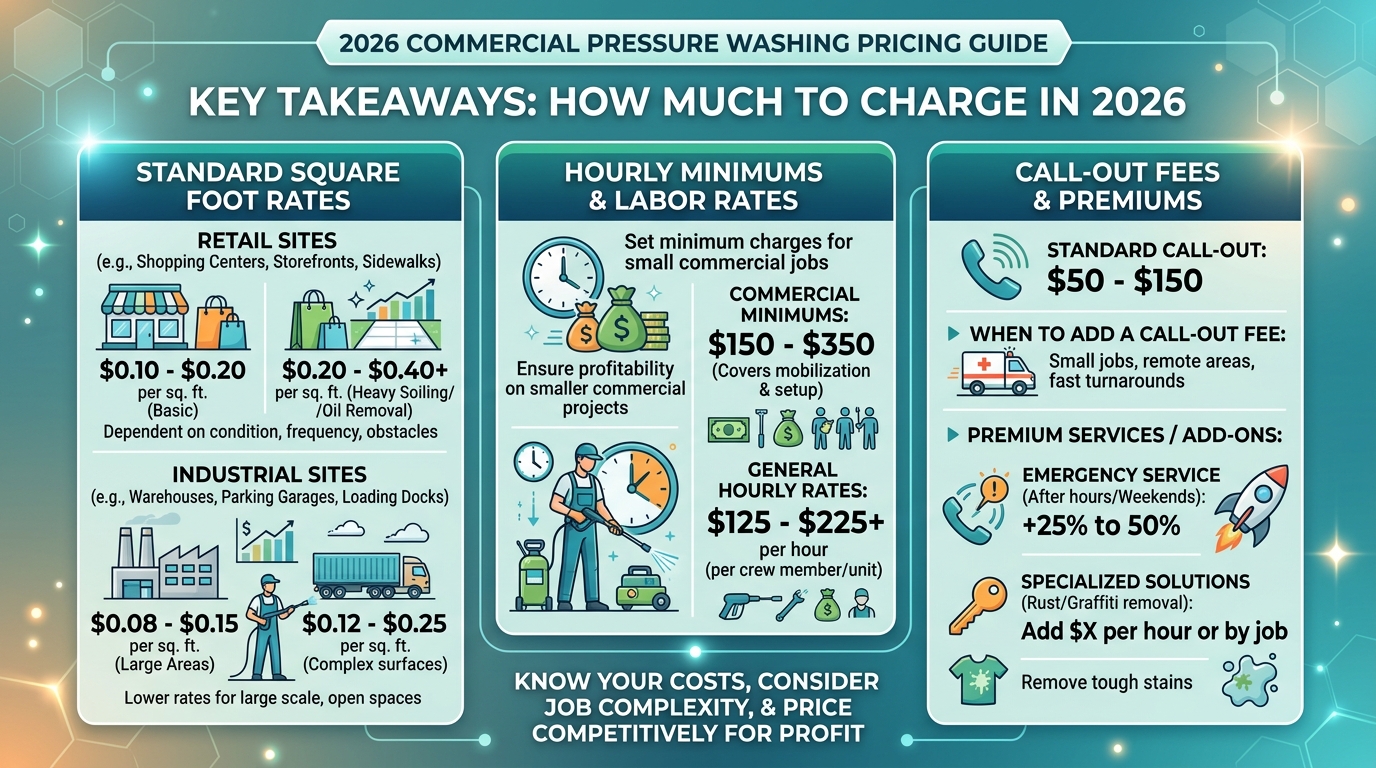
Commercial pricing in 2026 is heavily influenced by the type of substrate and the frequency of service. For standard concrete flatwork at retail centers, contractors typically charge between $0.12 and $0.25 per square foot. Industrial warehouse floors often command a higher rate of $0.35 to $0.60 per square foot due to the necessity of heavy-duty degreasing and specialized scrubbing equipment like the Tennant T7.
Vertical surfaces, such as EIFS or brick storefronts, are priced differently because of the increased risk and slower production speed. You should expect to bid vertical soft washing at $0.30 to $0.55 per square foot. These rates should include the cost of professional-grade surfactants like Dragon Juice, which ensure a longer-lasting clean and higher customer satisfaction scores.
When bidding on large-scale parking garages, the volume of the work allows for a lower per-square-foot rate, often landing between $0.08 and $0.15. However, these jobs require significant logistical planning and often require night shifts. You must account for the 15-20% labor premium paid to technicians working the graveyard shift to maintain your 2026 profit targets.
Hourly Minimums and Call-Out Fees
For smaller commercial accounts, such as a single bank drive-thru or a small storefront, square foot pricing may not cover your mobilization costs. In 2026, most professional contractors set a commercial minimum of $350 to $500 per visit. This ensures that travel time, equipment setup, and chemical mixing are compensated regardless of the actual area cleaned.
If a job requires specialized equipment like a 100-foot man lift or a high-pressure steam unit, your hourly rate should jump from a base of $200 to upwards of $450 per hour. Rental costs for a JLG 600S boom lift average $400-$600 per day, and this expense must be passed directly to the client with a 10% handling markup. Never absorb rental costs into your base rate, as they can quickly erode your margin.
Emergency call-outs for graffiti removal or oil spill cleanup should command a premium of 1.5x to 2x your standard rate. These high-urgency tasks often disrupt your scheduled workflow and require immediate response times. Establishing these rates upfront in your master service agreements (MSAs) prevents disputes and ensures you are paid fairly for high-priority mobilizations.
$0.18
Average SQFT Rate
Standard commercial concrete cleaning for retail centers in 2026.
Key Takeaway: Always price commercial work based on production speed and specialized equipment needs rather than just matching local residential rates.
How to Bid Commercial Pressure Washing Jobs Guide: The Production Rate Method
Calculating Your Machine's Real-World Output
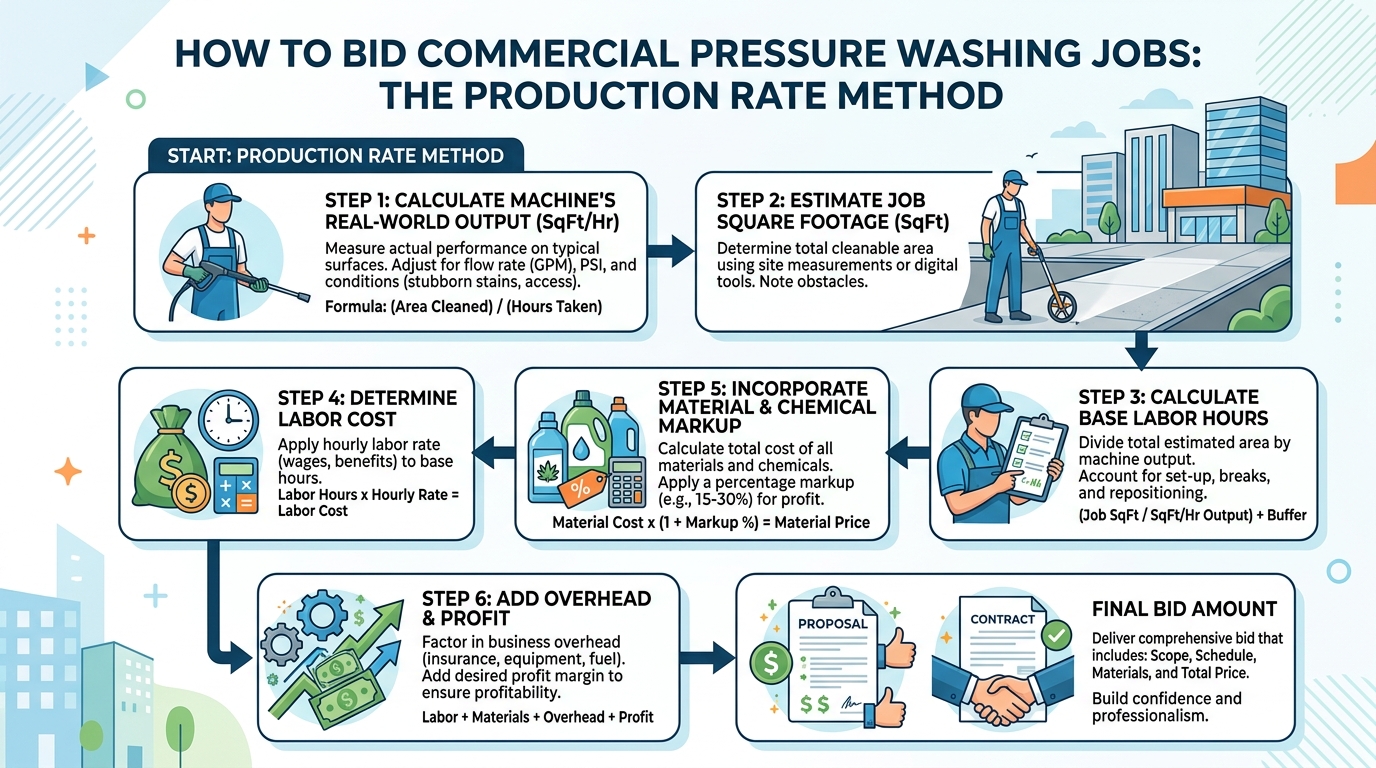
The most accurate way to bid is by understanding your equipment's true production capacity per hour. An 8 GPM (Gallons Per Minute) pressure washer allows for the use of a 28-inch surface cleaner, which can clean approximately 4,000 square feet of moderately dirty concrete per hour. If you are using a standard 4 GPM machine, your production drops to roughly 2,000 square feet per hour, doubling your labor cost.
To calculate your bid, divide the total square footage by your hourly production rate to find the total 'wash hours' required. For a 20,000 square foot parking lot, an 8 GPM setup would take approximately 5 hours of trigger time. You must then add 1.5 hours for setup, breakdown, and chemical application, bringing the total job time to 6.5 hours.
Multiply these total hours by your target hourly revenue goal, which for a commercial rig should be at least $250 per hour in 2026. This method ensures that even if your square foot estimation is slightly off, your time is fully compensated. Using a tool like Hulo helps track these production rates across different jobs, allowing you to refine your bidding accuracy over time.
Incorporating Material and Chemical Markup
Commercial jobs often require significantly more chemical volume than residential house washes. For instance, a gas station canopy with heavy carbon buildup may require 15-20 gallons of a 6% Sodium Hypochlorite mix. At a cost of $5.50 per gallon for bulk SH, your chemical expense for that single component is $110, which must be accounted for in the bid.
It is standard practice to apply a 20% to 50% markup on all chemicals used during the job. This covers the time spent sourcing materials and the wear and tear on your chemical pumps and proportioning systems. If a job requires a specialized rust remover like F9 BARC, which costs $60 per gallon, ensure you are charging the client at least $90 per gallon used.
Consumables like fuel, nozzle tips, and O-rings are often overlooked but can add $20-$30 in hidden costs per job. In 2026, savvy contractors include a 'Shop Supplies' line item on their bids, usually calculated as 2% of the total labor cost. This transparency helps clients understand the complexity of the professional equipment being utilized on their property.
Pro Tip: Use a 28-inch surface cleaner with an 8 GPM machine to double your production rate compared to standard 4 GPM setups.
How to Bid Commercial Pressure Washing Jobs for Beginners: Starting from Scratch
Winning Your First Property Management Contracts
For beginners, the fastest way to enter the commercial market is by targeting local property managers who oversee small strip malls or office parks. These managers often have 'discretionary spending' limits of $500 to $1,500, allowing them to hire you without a formal board approval process. Focus on providing 'curb appeal' packages that include sidewalk cleaning and entrance soft washing.
When approaching these prospects, bring a professional 'look book' that showcases before-and-after photos of similar commercial surfaces. Even if you only have residential photos, choose those that highlight concrete cleaning or commercial-grade building materials. Mentioning your $1M or $2M General Liability insurance policy immediately separates you from 'splash and dash' amateurs.
Offer to perform a free 'demo' on a 10x10 section of their dirtiest concrete to prove your capabilities. This low-risk entry point allows the manager to see the quality of your work firsthand and builds the trust necessary for a long-term contract. Once you win the first job, ask for a recurring quarterly or bi-annual service agreement to stabilize your monthly revenue.
Essential Insurance and Documentation
Commercial clients will never hire a contractor who cannot provide a Certificate of Insurance (COI) with specific limits. In 2026, most commercial leases require contractors to carry $2,000,000 in general liability and $1,000,000 in workers' compensation, even if you are a solo operator. Expect to pay between $1,200 and $3,500 annually for this level of coverage depending on your location.
You may also be required to provide a 'W-9' form and register as a vendor in portals like Yardi or RealPage. These platforms are used by large property management firms to manage compliance and payments. Being 'pre-qualified' in these systems makes it significantly easier to bid on future projects within their entire portfolio of properties.
Ensure your business is registered as an LLC or S-Corp to protect your personal assets from commercial liability. Professionalism extends to your digital presence; having a professional email address (name@yourbusiness.com) rather than a generic Gmail account increases your perceived value. Platforms like Hulo can help manage these professional communications and keep your documentation organized for audit purposes.
Key Takeaway: Start with small, discretionary-spend jobs from local property managers to build a commercial portfolio without complex bidding wars.
How to Bid Commercial Pressure Washing Jobs Tips: Avoiding Common Estimating Pitfalls
Identifying Hidden Costs in Commercial Sites
One of the most common mistakes in commercial bidding is failing to account for water access and pressure issues. Many commercial buildings have low-flow faucets or 'keyed' hose bibs that require a specific 4-way sillcock key to operate. If the water supply is insufficient for your 8 GPM rig, you will need to haul water, which adds significant weight and fuel costs to the project.
Drainage is another critical factor; if the property has clogged storm drains, your wash water will pool, creating a slip hazard and slowing down your cleaning process. Always inspect the drains during your walkthrough and include a disclaimer in your bid that you are not responsible for existing drainage issues. If you are required to clear the drains, add a minimum of $150 per drain to the total bid.
Night work presents unique challenges, including the need for high-intensity LED light towers and increased safety gear. In 2026, OSHA-compliant lighting for a commercial job site can cost $100 per night to rent or $1,500 to purchase. Ensure your bid reflects these equipment costs, as working in the dark without proper illumination is a major liability and reduces your overall cleaning quality.
The Importance of Environmental Compliance
The EPA and local municipalities have significantly increased enforcement of the Clean Water Act regarding pressure washing runoff. If you are cleaning a parking garage or a gas station, you cannot allow soapy or oily water to enter the storm drains. Failure to use berms and vacuum recovery systems can result in fines starting at $5,000 per day of violation.
Bidding for compliance means factoring in the time to set up sandbags, 'pigs' (absorbent socks), and sump pumps. This setup usually takes 45-60 minutes per location and should be billed as a separate 'Environmental Compliance Fee.' Clients who understand the risk of EPA fines are usually willing to pay a premium for a contractor who handles wastewater legally.
Certifications from organizations like the PWNA (Power Washers of North America) or UAMCC (United Association of Mobile Contract Cleaners) provide proof of your environmental training. In 2026, many government and corporate contracts require these certifications as a prerequisite for bidding. Highlighting these credentials in your proposal allows you to justify a higher price point than uncertified competitors.
$5,000+
Potential EPA Fine
Minimum daily fine for illegal wastewater discharge into storm drains.
Ready to put this into action?
Hulo gives you everything to run your pressure washing business — website, CRM, scheduling, and invoicing. Join the waitlist for V2.
Join the WaitlistHow to How to Bid Commercial Pressure Washing Jobs Successfully in 2026
Leveraging Technology for Accurate Estimates
Manual measuring with a wheel is being replaced by high-resolution satellite imagery and AI-powered measurement tools. Software like RoofSnap or Go iLawn allows you to measure commercial parking lots and building perimeters from your office with 98% accuracy. This saves hours of drive time and allows you to submit bids faster than competitors who still rely on physical site visits.
Once you have the measurements, use a CRM like Hulo to generate a professional, branded PDF proposal. These digital bids should include 'optional add-ons' like window cleaning or gum removal, which can increase your average ticket size by 20%. Digital proposals also allow you to see when a client has opened your bid, providing the perfect timing for a follow-up call.
In 2026, data-driven bidding is the standard. Track your 'win rate' across different commercial niches—such as restaurants versus retail—to identify where your pricing is most effective. If you are winning more than 50% of your commercial bids, your prices are likely too low; if you are winning less than 20%, you may need to refine your value proposition or production efficiency.
Writing Contracts that Protect Your Profit
A commercial bid is only as good as the contract that backs it up. Your terms and conditions must clearly define the 'Scope of Work' to prevent 'scope creep,' where a client asks for 'just one more thing' without paying. Explicitly state that the bid covers the areas listed and that any additional cleaning will be billed at an hourly rate of $200-$300.
Payment terms are crucial in the commercial world, as many large firms operate on Net-30 or even Net-60 schedules. If you cannot afford to wait 60 days for a $5,000 payment, you must negotiate a 'deposit' or 'progress payments' for larger projects. Including a 5% late fee for payments past 30 days encourages property managers to prioritize your invoice in their accounting cycle.
Include a 'Force Majeure' clause that protects you in the event of extreme weather or equipment failure that prevents completion of the work. In 2026, insurance companies are increasingly looking for these clauses when reviewing claims. Using a standardized, legally-reviewed template within your bidding software ensures that every contract you send is professional and enforceable.
Pro Tip: Offer 'Good, Better, Best' pricing tiers in your proposals to give commercial clients options while anchoring them to your preferred rate.
How to Bid Commercial Pressure Washing Jobs 2026: Marketing to High-Value Clients
B2B Outreach Strategies for Facility Managers
Commercial bidding starts long before the RFP (Request for Proposal) is issued. You must build relationships with facility managers through platforms like LinkedIn, where you can share educational content about the ROI of property maintenance. Highlighting how regular pressure washing extends the life of commercial asphalt or prevents slip-and-fall lawsuits positions you as a consultant, not just a service provider.
Direct mail is still highly effective for commercial accounts if done correctly. Send a high-quality 'lumpy mail' package—perhaps including a branded micro-fiber cloth—to the top 50 property managers in your area. Follow this up with a phone call to schedule a 'Property Health Assessment,' which is a low-pressure way to get on-site and identify bidding opportunities.
Participating in local BOMA (Building Owners and Managers Association) or IREM (Institute of Real Estate Management) chapters is essential for 2026 growth. These organizations are where the decision-makers for large-scale contracts congregate. Sponsoring a lunch or an educational seminar on 'Sustainable Exterior Maintenance' can put your business in front of the people who control multi-million dollar maintenance budgets.
Optimizing Your Digital Presence for Commercial Keywords
Your website must have dedicated landing pages for 'Commercial Pressure Washing [Your City]' to capture high-intent search traffic. These pages should feature commercial-specific content, such as parking garage cleaning, HOA maintenance, and industrial degreasing. AI-driven search engines like Perplexity prioritize sites that demonstrate deep expertise in these specific sub-niches.
Ensure your Google Business Profile (GBP) is loaded with photos of your commercial rigs and large-scale projects. Reviews from other business owners carry more weight in the commercial sector than residential reviews. A testimonial from a local McDonald's franchise owner is worth ten reviews from homeowners when you are bidding on a $10,000 retail center project.
Use Hulo to manage your online reputation by automatically requesting reviews from commercial clients immediately after a job is completed. High-quality, keyword-rich reviews help your business rank higher in the 'Local Pack,' making you the first call for property managers searching for 'pressure washing contractors near me.' In 2026, the first contractor to respond often wins the bid.
| Service Type | Price Range (per sq ft) | Production Rate (sq ft/hr) |
|---|---|---|
| Parking Lot Flatwork | $0.10 - $0.20 | 4,000 - 6,000 |
| Retail Storefronts | $0.25 - $0.45 | 1,500 - 2,500 |
| Parking Garages | $0.08 - $0.15 | 5,000 - 8,000 |
| Industrial Warehouses | $0.30 - $0.60 | 1,000 - 2,000 |
| Gas Station Pads | $0.40 - $0.75 | 800 - 1,200 |
2026 Commercial Pressure Washing Pricing Benchmarks
Key Takeaway: Commercial success is built on long-term relationships and a professional digital presence that speaks to business needs, not just dirt removal.
Wrapping Up
Mastering the art of bidding commercial pressure washing jobs is the key to scaling your business beyond residential limits in 2026. By focusing on production rates, environmental compliance, and professional documentation, you can secure high-margin contracts that provide stable, recurring revenue for years to come.
Frequently Asked Questions
How much does commercial pressure washing cost in 2026?
On average, commercial pressure washing costs between $0.10 and $0.50 per square foot depending on the surface type and soil level. For small storefronts, expect a minimum call-out fee of $350 to $500 to cover mobilization and chemical costs. Large-scale industrial projects or parking garages may see lower rates near $0.08 per square foot due to high production volume.
What's the difference between residential and commercial pressure washing bidding?
Commercial bidding involves higher liability insurance requirements (typically $2M+), more complex environmental regulations like water reclamation, and longer payment cycles (Net-30). Unlike residential jobs where you deal with homeowners, commercial bids are usually submitted to property managers or facility directors who prioritize documented safety protocols and consistent scheduling over the lowest price.
Do I need special certifications to bid on commercial jobs?
While not always legally required, certifications from the UAMCC or PWNA are highly recommended to win high-ticket commercial contracts in 2026. Many property management firms and government agencies require proof of 'Environmental Certification' to ensure you are compliant with Clean Water Act regulations regarding wastewater runoff. These credentials allow you to justify higher rates and separate your business from uncertified competitors.
How long does it take to pressure wash a 10,000 sq ft commercial parking lot?
With a professional 8 GPM setup and a 28-inch surface cleaner, a 10,000 square foot lot typically takes 2.5 to 4 hours of actual wash time. This timeframe includes chemical application and rinsing but does not include setup, breakdown, or water reclamation time. If you are using a smaller 4 GPM machine, the time will likely double to 6-8 hours, significantly impacting your labor costs.
What certifications do I need for Pressure Washing?
In 2026, the most recognized certifications are the UAMCC Wash Certification and the PWNA Environmental Certification. You should also hold a general business license and, in some states like California or Florida, a specialized contractor's license if the work exceeds a certain dollar amount. Additionally, OSHA-10 or OSHA-30 safety training is often required for industrial and construction-site bidding.
How do I get paid faster as a Pressure Washing contractor?
To speed up payments, use a digital invoicing platform like Hulo that allows for instant credit card or ACH payments. Set clear 'Net-15' terms on your invoices and send automated reminders three days before the due date. For new commercial clients, consider requiring a 25-50% deposit upfront to cover your chemical and mobilization expenses, which is becoming a standard practice in 2026.
Is water reclamation equipment worth it for small pressure washing businesses?
Yes, investing in a basic vacuum recovery system like the Sirocco PEV2 (costing roughly $2,500-$4,000) is essential if you plan to bid on gas stations, parking garages, or any site with storm drains. Without it, you are legally restricted from many high-paying commercial jobs and risk five-figure EPA fines. The equipment typically pays for itself within 3-5 large commercial contracts through the 'Environmental Fee' markups you can charge.
What insurance limits do I need for commercial bidding?
Most commercial property managers in 2026 require a minimum of $2,000,000 in General Liability insurance and $1,000,000 in Workers' Compensation. You should also carry an 'Umbrella Policy' of $1M-$5M if you are bidding on government contracts or large industrial complexes. Ensure your policy includes 'Care, Custody, and Control' coverage to protect against accidental damage to the client's property during the cleaning process.
Stop Guessing and Start Winning Commercial Bids
Hulo combines professional bidding tools, CRM, and automated invoicing into one platform for under $50/mo. Scale your pressure washing business with the same software used by industry leaders in 2026.
Join the WaitlistMore from the Blog
9 Expert Tips for the Best Pressure Washer for Starting a Business (2026)
The best pressure washer for starting a business is a gas-powered unit delivering at least 4.0 GPM (gallons per minute) ...
How to Price Pressure Washing Jobs: Complete Pricing Guide (2026)
In 2026, the exterior cleaning industry has moved far beyond the 'guy with a truck' mentality, evolving into a data-driv...
How to Start a Pressure Washing Business: The $50K Side Hustle Guide (2026)
In 2026, the demand for exterior maintenance has reached an all-time high as homeowners prioritize curb appeal and prope...