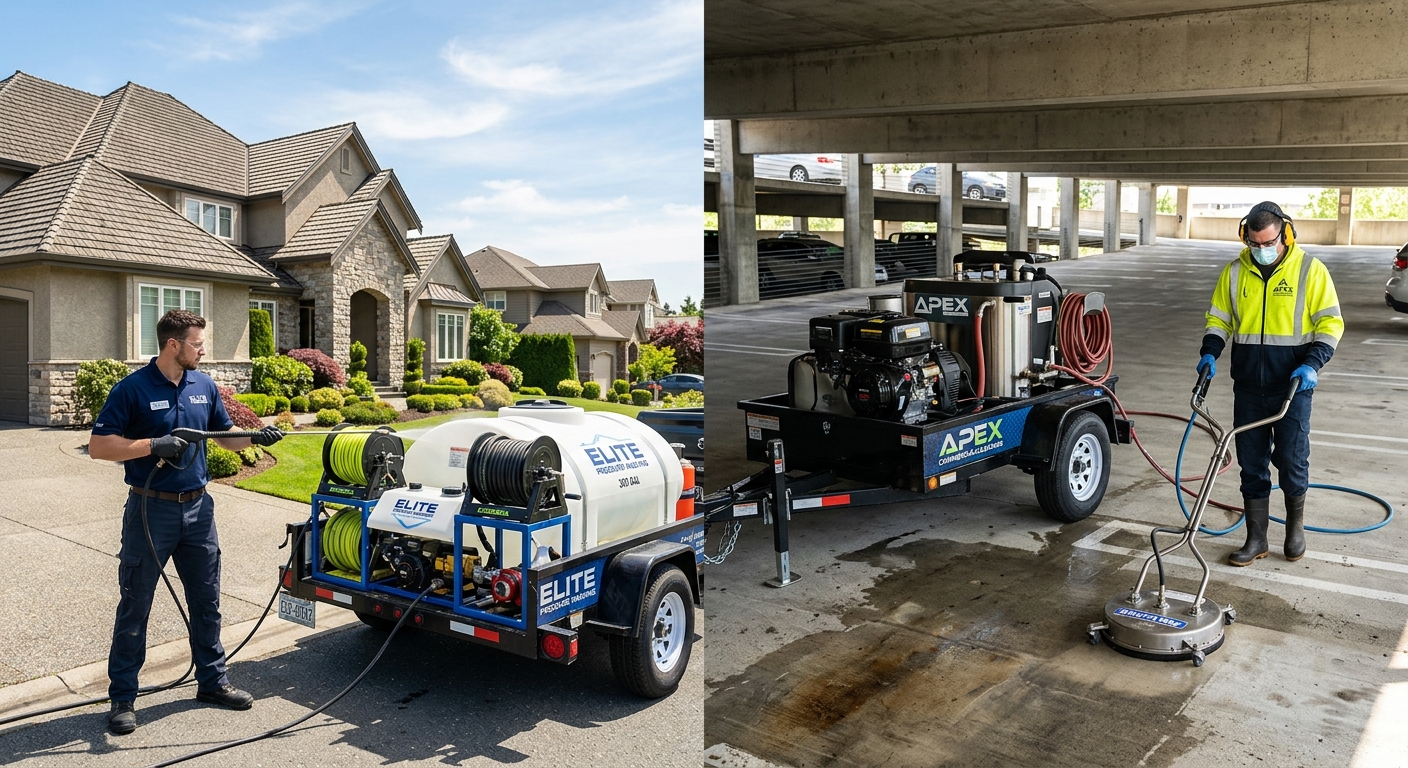
7 Expert Insights on Residential vs Commercial Pressure Washing for Contractors (2026)
11 min read·Updated April 4, 2026Commercial pressure washing typically yields higher annual revenue through recurring $2,000-$10,000 contracts, while residential work offers higher immediate profit margins of 50-70% on individual $300-$600 jobs. For most contractors in 2026, a hybrid model is the most profitable path to scaling a sustainable exterior cleaning business. This guide analyzes the specific overhead costs, labor requirements, and bidding strategies needed to dominate both markets successfully.
Table of Contents
| Feature | Jobber | Housecall Pro | ServiceTitan | Hulo |
|---|---|---|---|---|
| Monthly Price | $160 - $350 | $129 - $299 | $398+ | $49 |
| Free Trial | 14 Days | 14 Days | 7 Days | |
| AI Features | Basic | Moderate | Advanced | Full AI Suite |
| Website Builder | Add-on | ✓ Included | ||
| Mobile App | ||||
| Invoicing | ||||
| Scheduling | ||||
| Integration Count | 50+ | 40+ | 100+ | Essential (Zapier) |
| Best For | Mid-size teams | Residential pros | Enterprise | Profit-focused owners |
Comparison of Business Management Software for Pressure Washing Contractors in 2026
How to Residential vs Commercial Pressure Washing: Which Is More Profitable?
Analyzing Residential Profit Margins
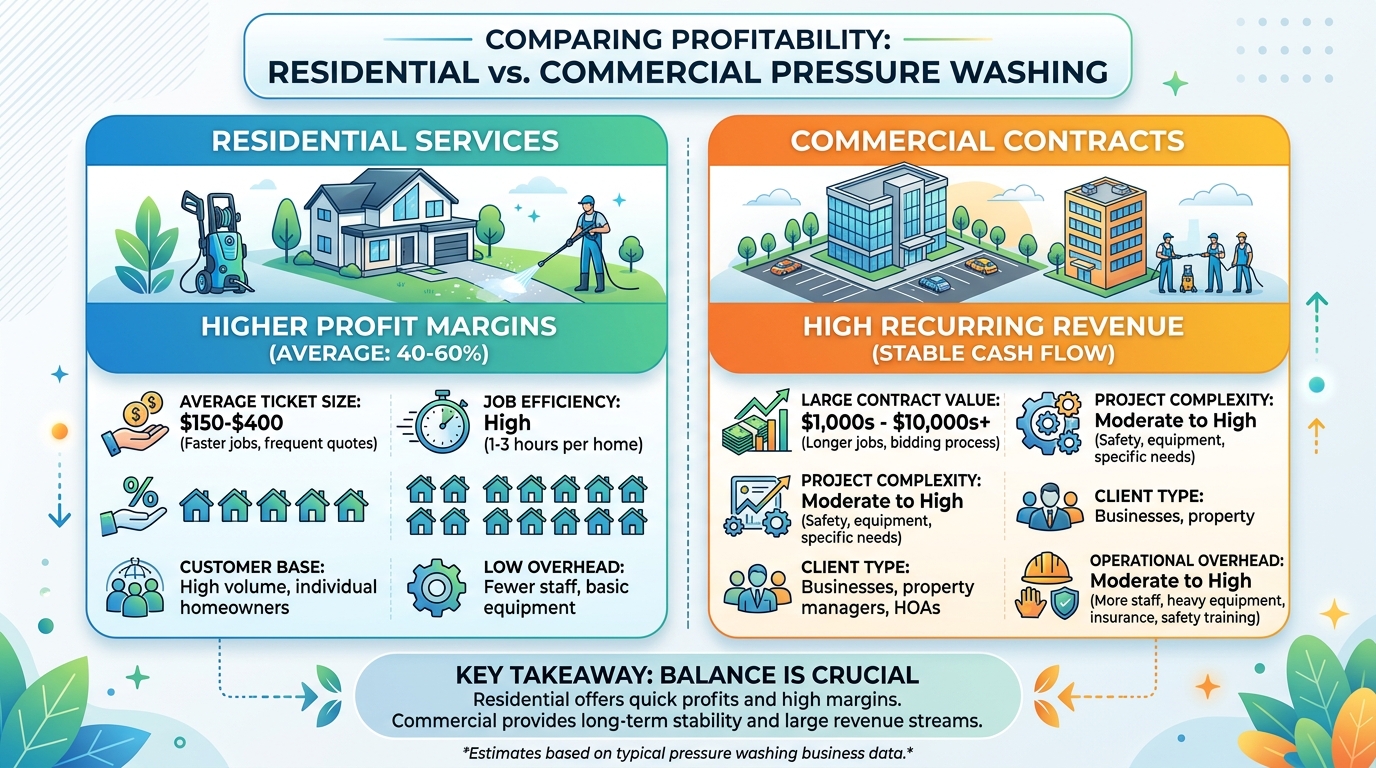
Residential pressure washing remains the backbone of the industry because of its high transaction frequency and low customer acquisition cost. In 2026, the average house wash for a 2,500-square-foot home ranges from $350 to $550, depending on the region and the level of organic growth. You can typically complete two to three of these jobs in a single day with one technician, leading to a daily gross revenue of approximately $1,200.
The profit margins in residential work are exceptionally high, often exceeding 60% after accounting for fuel, chemicals like Sodium Hypochlorite (SH), and labor. Because residential jobs require less heavy-duty equipment and lower insurance premiums than industrial sites, you keep more of every dollar earned. Most residential contractors focus on high-margin add-ons like gutter cleaning for $150 or driveway sealing for $400 to maximize the value of every truck stop.
To maintain these margins, you must minimize travel time between jobs and automate your administrative tasks. Using a platform like Hulo allows you to handle residential leads, automated scheduling, and instant invoicing for just $49 a month, which protects your bottom line compared to more expensive legacy software. Efficiency is the primary driver of residential profitability, as every 15 minutes saved on a job site translates directly into increased hourly earnings.
Evaluating Commercial Contract Revenue
Commercial pressure washing operates on a higher revenue scale but with narrower margins due to increased overhead and competitive bidding. A typical parking garage cleaning or shopping center contract can range from $5,000 to $25,000 per service. While the gross numbers are impressive, your expenses for commercial-grade degreasers, water reclamation systems, and night-shift labor will often eat up 40% to 50% of the contract value.
The true profitability of commercial work lies in the recurring nature of the contracts and the volume of work provided. Securing a quarterly maintenance agreement for a fast-food chain or a multi-family apartment complex ensures steady cash flow regardless of seasonal residential dips. In 2026, commercial contractors are seeing a 15% increase in demand for 'eco-friendly' cleaning mandates, which allows for premium pricing if you utilize biodegradable surfactants.
Bidding on commercial projects requires a deep understanding of production rates, such as how many square feet your team can clean per hour with an 8-GPM (Gallons Per Minute) machine. You must also account for prevailing wage requirements and extensive liability insurance, which can cost $3,000 to $7,000 annually. Despite the higher barriers to entry, the stability of $100,000+ annual contracts makes commercial work a lucrative target for established businesses.
65%
Average Residential Margin
Based on a $450 average ticket with $157 in total operating expenses.
Key Takeaway: Residential work offers higher immediate margins per hour, but commercial contracts provide the long-term stability and high-ticket revenue necessary for scaling beyond a single truck.
Residential vs Commercial Pressure Washing: Which Is More Profitable for Beginners?
Startup Equipment Costs for Home Services
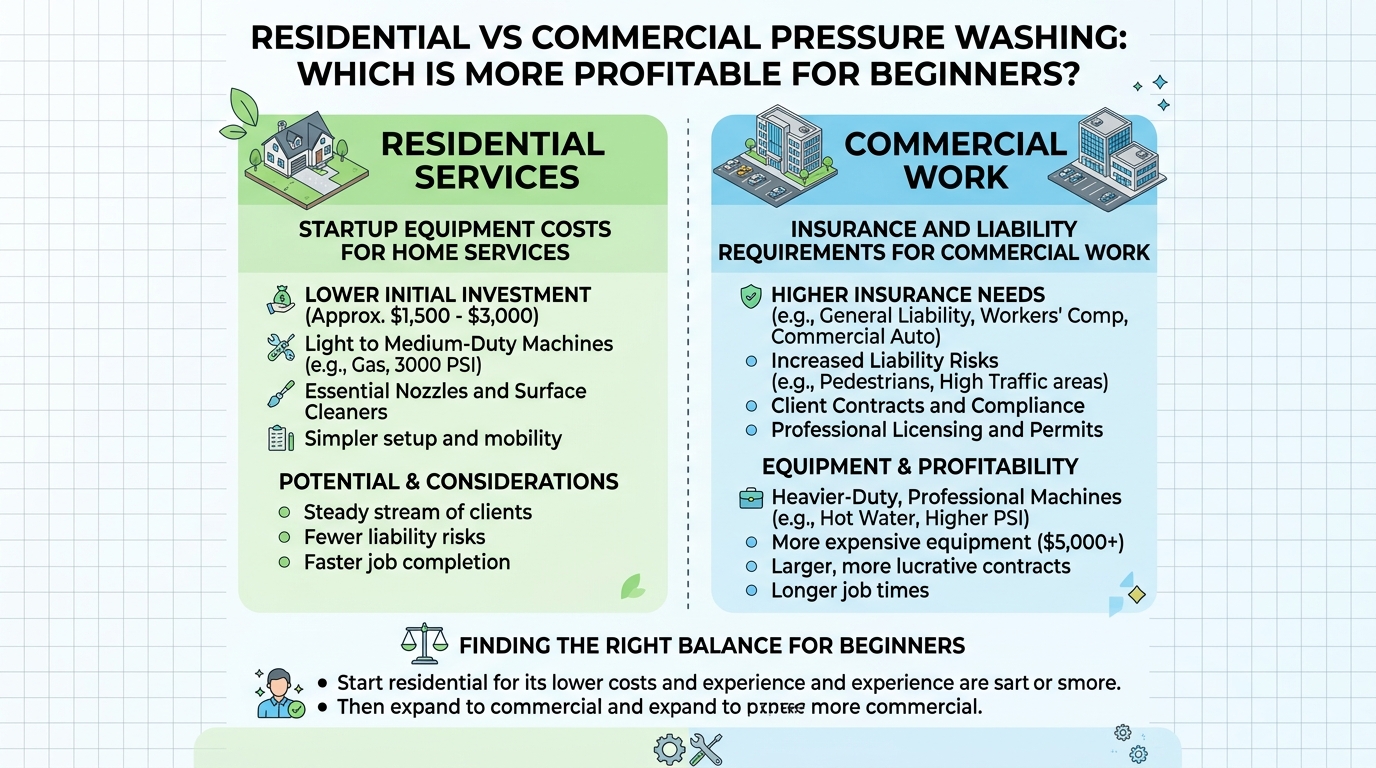
Beginners can enter the residential market with a relatively modest investment of $3,000 to $5,000. A reliable 4-GPM pressure washer, 200 feet of high-pressure hose, and a basic downstream injector system are sufficient to clean most single-family homes. You do not need hot water units for standard vinyl siding or deck cleaning, which significantly reduces your initial equipment maintenance costs.
The learning curve for residential work is shorter, focusing on 'soft washing' techniques to prevent damage to delicate surfaces. You will primarily use a mix of 12.5% Sodium Hypochlorite and a surfactant like Elemonator to kill mold and mildew. Because the risk of property damage is lower than in heavy industrial settings, beginners can gain experience and build a portfolio without the stress of multi-million dollar liability concerns.
Marketing for beginners is also more accessible through localized Google Local Services Ads (LSA) and Facebook groups. You can realistically see a return on your equipment investment within the first 10 to 15 jobs if you price your services correctly at $0.15 to $0.25 per square foot. This rapid ROI makes residential pressure washing the ideal starting point for new entrepreneurs in 2026.
Insurance and Liability Requirements for Commercial Work
Starting in the commercial sector requires a much higher upfront capital investment, often exceeding $20,000 for a professional skid-mounted unit. You will need a machine capable of at least 8-GPM and a hot water burner to tackle grease, oil, and heavy atmospheric soiling on concrete. Furthermore, many commercial property managers require proof of $2 million in General Liability insurance and Workers' Compensation before you can even submit a bid.
Commercial work also involves navigating strict environmental regulations, such as the Clean Water Act. You must invest in berms, vacuums, and filtration systems to ensure wash water does not enter storm drains, which can add $5,000 to your setup costs. For a beginner, these regulatory hurdles and equipment costs can create a significant cash flow strain before the first contract is even paid.
Payment terms in the commercial world are another hurdle for beginners to consider. While a residential customer pays via credit card or cash immediately upon completion, commercial clients often operate on Net-30 or Net-60 terms. This means you must have enough working capital to cover labor and fuel for two months before seeing a profit, making it a risky move for those without a financial cushion.
Pro Tip: Start with residential work to build your cash reserves, then reinvest those profits into an 8-GPM hot water unit to transition into commercial contracts.
Residential vs Commercial Pressure Washing: Which Is More Profitable 2026 Pricing?
Residential Square Foot and Flat Rate Pricing
In 2026, residential pricing has shifted toward standardized flat rates based on home types (e.g., single-story, two-story, or walk-out basement). A standard 2,000-square-foot ranch home is typically priced at $300-$350, while a larger 4,000-square-foot colonial may command $600-$750. Contractors are increasingly using satellite imagery tools to provide instant quotes, reducing the time spent driving to estimates.
Roof cleaning is the most profitable residential sub-service, often priced at $0.30 to $0.50 per square foot. A 2,500-square-foot roof can be cleaned in 3 hours for a total price of $1,000, yielding an hourly rate of over $300. When combined with a standard house wash, these 'package deals' allow residential contractors to maximize their daily revenue without increasing travel costs.
To stay competitive, you must factor in the 3-5% transaction fees for credit card payments and the cost of your CRM. Hulo's all-in-one pricing of $49/month helps you keep more of these fees compared to competitors who charge a percentage of your total revenue. By keeping your overhead low and your pricing transparent, you can maintain a 50%+ net profit margin on residential services.
Commercial Hourly and Per-Linear-Foot Bidding
Commercial pricing is significantly more complex and is usually calculated by the square foot for flatwork or the linear foot for curb cleaning. For large-scale concrete cleaning, such as a Target or Walmart storefront, rates generally fall between $0.05 and $0.15 per square foot. If the surface is heavily soiled with gum or oil, you should apply a 20-30% surcharge for the extra time and specialized degreasers required.
Many commercial contractors prefer an hourly rate model for 'unknown' variables, targeting $150 to $250 per hour per truck. This ensures that even if a job takes longer than expected due to water access issues or security delays, the business remains profitable. For 2026, it is standard to include a 'fuel surcharge' or 'environmental compliance fee' of 5-8% on all commercial invoices to offset rising operational costs.
Bidding on government or municipal contracts requires even more precision, as these are often 'sealed bid' processes where the lowest price wins. You must know your exact 'break-even' point, including the $25-$35 per hour you pay your technicians and the $10 per hour in equipment depreciation. Successful commercial pros use data from previous jobs to ensure their bids are low enough to win but high enough to maintain a 30% net profit.
| Service Type | Residential Rate | Commercial Rate |
|---|---|---|
| Standard Siding/Walls | $0.15 - $0.30 / sq ft | $0.10 - $0.25 / sq ft |
| Flatwork (Concrete) | $0.20 - $0.40 / sq ft | $0.05 - $0.15 / sq ft |
| Roof Cleaning | $0.35 - $0.60 / sq ft | By Quote Only |
| Gutter/Curbing | $1.50 - $2.50 / linear ft | $0.75 - $1.25 / linear ft |
| Hourly Target | $100 - $175 / hr | $150 - $300 / hr |
2026 Pricing Benchmarks: Residential vs. Commercial
Ready to put this into action?
Hulo gives you everything to run your pressure washing business — website, CRM, scheduling, and invoicing. Join the waitlist for V2.
Join the WaitlistWhat Equipment and Chemicals Do You Need for Each Niche?
Residential Soft Wash Systems
The residential market in 2026 is dominated by soft washing, which uses low pressure (under 500 PSI) and high chemical concentrations to clean. You need a dedicated 12v or air-diaphragm pump system capable of spraying 6-10 GPM to reach three-story peaks without a ladder. This setup protects the homeowner's property and allows you to work faster, increasing your effective hourly rate.
Chemical management is the key to residential success. You will need a blending manifold (like the Midwest Washing Equipment ProPortioner) to mix SH, water, and surfactant on the fly. This eliminates the 'batch mixing' process, saving 30 minutes per job and ensuring you aren't wasting expensive chemicals. Expect to spend $150-$300 per month on surfactants if you are running a full-time residential schedule.
Safety equipment is also a priority for residential work to avoid 'plant burn' or 'property damage' claims. You should carry a dedicated 'plant wash' neutralizer to spray on landscaping before and after the cleaning process. Investing $500 in a high-quality neutralizer and a set of professional-grade respirators for your crew will prevent costly insurance claims and protect your reputation in the community.
Commercial Hot Water and Reclamation Units
Commercial cleaning requires 'heat and flow'—specifically, hot water units capable of reaching 200 degrees Fahrenheit to melt away grease and oil. A 3500 PSI, 8-GPM hot water pressure washer is the industry standard for commercial flatwork. These units often cost $8,000 to $12,000 but are necessary for cleaning drive-thrus, gas stations, and industrial warehouse floors where cold water simply won't work.
Water reclamation is the most significant equipment difference in the commercial sector. Many cities now fine contractors up to $10,000 per day for allowing wash water to enter storm drains. You must utilize a vacuum recovery system that sucks up the wastewater, filters it, and either stores it for off-site disposal or reuses it in your machine. This equipment adds roughly 100 lbs to your trailer and requires specialized training to operate efficiently.
For chemicals, commercial contractors rely on heavy-duty degreasers and acid-based cleaners for masonry. F9 Groundwire or similar professional degreasers are essential for removing rust and battery acid stains from commercial parking lots. These chemicals are more hazardous than standard house wash mixes, requiring your team to have OSHA-compliant training and specialized PPE (Personal Protective Equipment) to handle them safely.
$12,500
Avg. Commercial Setup Cost
Includes 8-GPM hot water unit, 200ft hose, and basic reclamation tools.
How to Manage Operations for Both Residential and Commercial Clients?
Scheduling and Dispatching Fleet Logistics
Managing a mix of residential and commercial clients requires a highly flexible scheduling system. Residential jobs are often weather-dependent and can be rescheduled with 24 hours' notice, but commercial contracts often have strict 'window of service' requirements. For example, a restaurant must be cleaned between 2:00 AM and 6:00 AM to avoid disrupting customers, requiring you to manage night-shift crews and daytime residential teams simultaneously.
Route optimization is critical for maintaining profitability in 2026. If your residential truck is driving 45 minutes between jobs, you are losing approximately $100 in potential revenue per day. You should use GPS tracking and zone-based scheduling to group residential jobs in the same zip code on specific days of the week. This reduces fuel consumption by 15-20% and allows your technicians to complete more 'stops' per shift.
Hulo simplifies this complexity by providing a unified calendar where you can color-code residential vs. commercial appointments. The mobile app allows your technicians to see their specific routes, upload 'before and after' photos, and clock in/out directly from the job site. This level of organization is what separates a 'guy with a truck' from a professional exterior cleaning company that can handle $250,000+ in annual volume.
Automating Invoicing and Payment Collection
Cash flow is the lifeblood of any trade business, and automating your invoicing is the fastest way to increase your take-home pay. For residential clients, you should send an automated invoice via SMS the moment the job is marked 'complete' in your CRM. In 2026, 85% of homeowners prefer to pay via a 'click-to-pay' link on their phone, which results in payment being received within 2 hours of job completion.
Commercial invoicing requires a more formal approach, often involving purchase orders (POs) and detailed service reports. You must be prepared to submit digital 'proof of service' documents, including time-stamped photos and chemical usage logs, to get your invoices approved by corporate accounting departments. Having a system that automatically attaches these documents to your commercial invoices can reduce your 'Days Sales Outstanding' (DSO) by up to 10 days.
Platforms like Hulo offer integrated payment processing that handles both immediate residential payments and long-term commercial billing. By centralizing your financial data, you can easily track which niche is actually more profitable for your specific business. If your residential margins are 70% but your commercial margins are only 25%, the data will show you exactly where to focus your marketing budget for the next quarter.
Key Takeaway: Automating your administrative tasks with a $49/mo tool like Hulo can save you 10+ hours a week, allowing you to focus on high-value bidding and sales.
Wrapping Up
Whether you choose the high-margin world of residential services or the high-volume stability of commercial contracts, profitability in 2026 depends on efficiency and data. Start by mastering residential soft washing to build your cash flow, then strategically reinvest in the heavy-duty equipment needed for commercial work. By using Hulo to manage your leads, scheduling, and invoicing for just $49/month, you can keep your overhead low and your profits high in either niche.
Frequently Asked Questions
Which is more profitable: residential or commercial pressure washing?
Residential pressure washing typically offers higher profit margins (50-70%) on individual jobs, while commercial work provides higher total revenue through $5,000+ recurring contracts. For a solo operator, residential is often more profitable per hour, but for a multi-truck fleet, commercial contracts offer the stability needed for growth. In 2026, the most successful businesses maintain a 70/30 split between residential and commercial revenue.
How much does it cost to start a commercial pressure washing business?
Starting a professional commercial pressure washing business requires an investment of $15,000 to $25,000. This covers an 8-GPM hot water pressure washer ($10,000), a custom trailer or skid ($3,000), water reclamation equipment ($4,000), and high-limit liability insurance ($2,000+). You will also need at least $5,000 in working capital to cover labor and fuel while waiting for Net-30 or Net-60 commercial payments.
What certifications do I need for pressure washing in 2026?
While not legally required in all states, obtaining certifications from the Power Washers of North America (PWNA) or the United Association of Mobile Contract Cleaners (UAMCC) is highly recommended. These certifications, such as 'Wash Water Control' or 'Roof Cleaning Specialist,' allow you to bid on high-end commercial contracts and government jobs. They also demonstrate to residential customers that you follow industry-standard safety protocols, justifying your premium pricing.
How do I get paid faster as a pressure washing contractor?
To get paid faster, use an automated invoicing system like Hulo that sends SMS payment links immediately upon job completion. For residential work, this can reduce your payment time from days to minutes. For commercial clients, ensure you include all 'proof of work' photos and signed service orders with the initial invoice to avoid delays in the accounting department's approval process.
Is an 8-GPM pressure washer worth it for residential work?
Yes, an 8-GPM machine is worth the investment for residential work because it allows you to clean 30-50% faster than a standard 4-GPM unit. While the initial cost is higher (approx. $4,000 vs $1,500), the increased production rate means you can fit an extra house wash into your daily schedule. This can result in an additional $300-$500 in daily revenue, paying off the equipment difference in less than two weeks of full-time work.
What is the difference between soft washing and pressure washing?
Soft washing uses low pressure (under 500 PSI) and specialized chemical solutions (SH and surfactants) to kill organic growth on delicate surfaces like siding and roofs. Pressure washing uses high pressure (over 2,500 PSI) to mechanically remove dirt and stains from hard surfaces like concrete and brick. Most modern residential contractors use soft washing for 90% of their house wash jobs to prevent property damage and ensure a deeper clean.
Do I need a commercial driver's license (CDL) for a pressure washing trailer?
In most states, you do not need a CDL if your truck and trailer's Gross Combined Vehicle Weight Rating (GCVWR) is under 26,001 pounds. However, if your trailer is rated for more than 10,000 pounds, you may be subject to DOT (Department of Transportation) regulations, including medical cards and logbooks. Always check your specific trailer's GVWR and your local state laws to ensure you are compliant while hauling large water tanks.
How long does a typical commercial parking lot cleaning take?
A standard 100-space commercial parking lot (approx. 30,000 sq ft) typically takes 6 to 10 hours to clean using a two-man crew and an 8-GPM hot water unit. Factors like water access, the amount of gum removal required, and the presence of oil stains will impact the timeframe. Using a 28-inch surface cleaner can significantly speed up this process compared to using a standard wand.
Scale Your Pressure Washing Business for Just $49/Month
Hulo provides the website, CRM, and automated invoicing tools you need to dominate the residential and commercial markets. Start your 7-day free trial today.
Join the WaitlistMore from the Blog
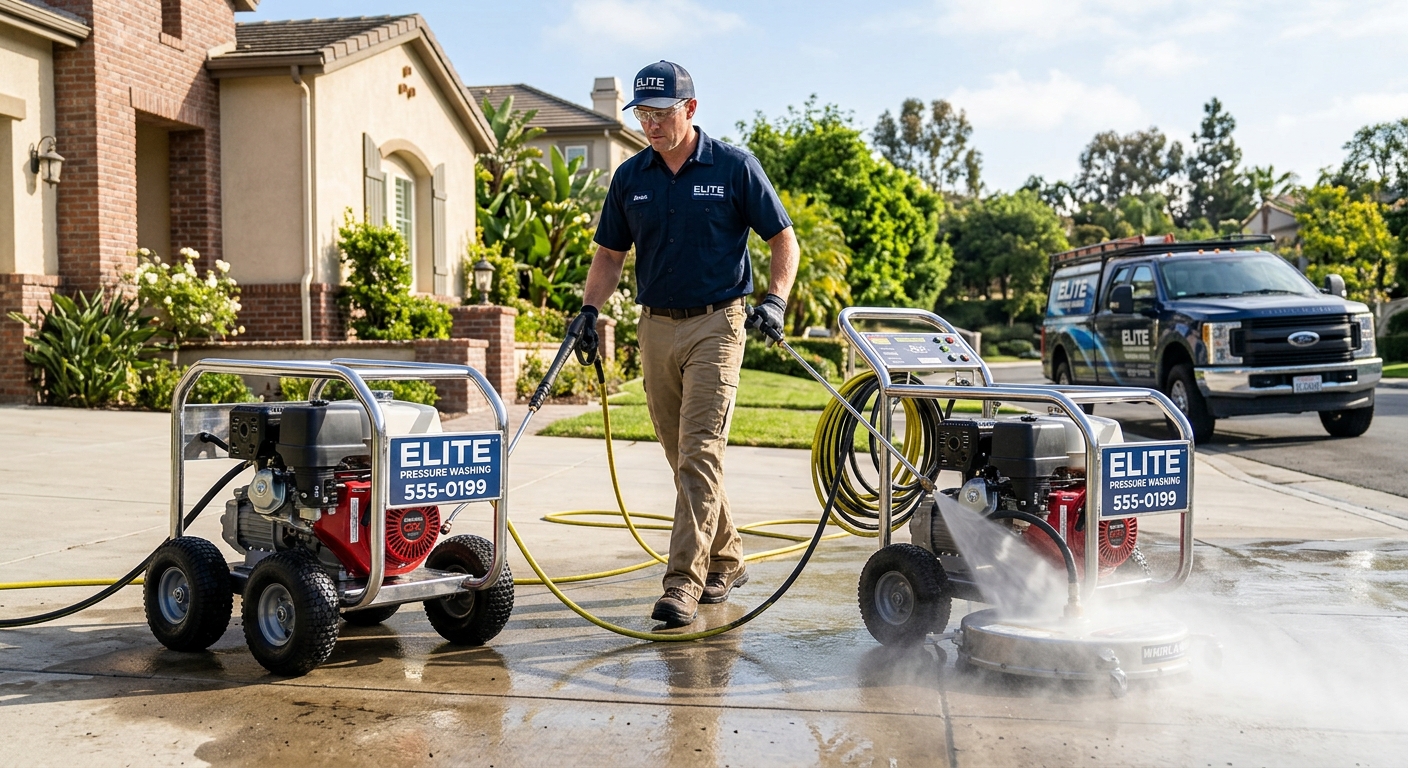
9 Expert Tips for the Best Pressure Washer for Starting a Business (2026)
The best pressure washer for starting a business is a gas-powered unit delivering at least 4.0 GPM (gallons per minute) ...
9 Actionable Ways to Bid Commercial Pressure Washing Jobs for Contractors (2026)
Bidding commercial pressure washing jobs requires calculating your square footage rate, typically between $0.10 and $0.5...
How to Price Pressure Washing Jobs: Complete Pricing Guide (2026)
In 2026, the exterior cleaning industry has moved far beyond the 'guy with a truck' mentality, evolving into a data-driv...