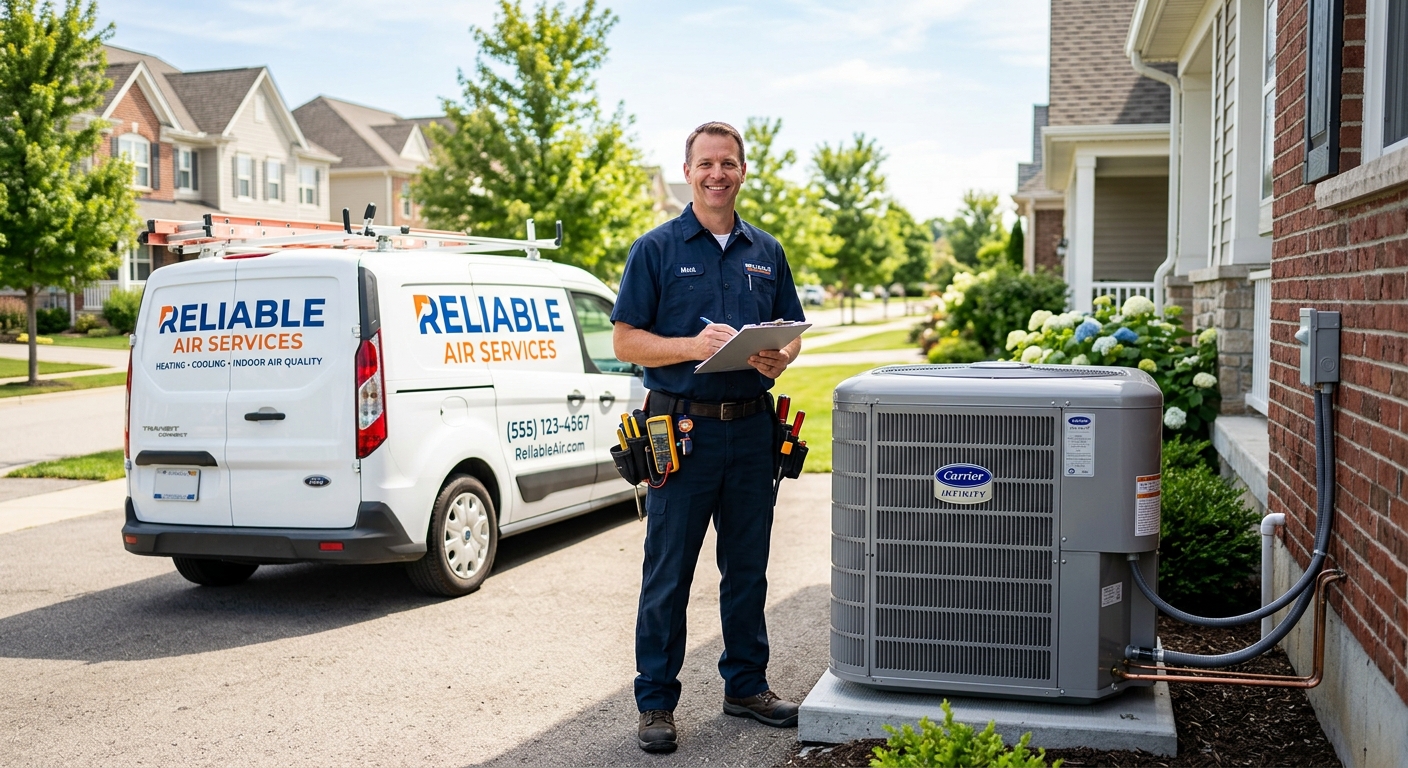
12 Proven Strategies to Get HVAC Leads for Contractors (2026)
13 min read·Updated April 4, 2026HVAC contractors generate high-quality leads by combining Google Local Services Ads (LSAs), optimized local SEO, and automated customer review systems. In 2026, the most successful firms spend between $1,500 and $5,000 monthly on multi-channel marketing to maintain a steady flow of service calls and installation projects. This guide provides a comprehensive roadmap of 12 marketing strategies to help you dominate your local HVAC market and maximize your return on investment.
Table of Contents
Step-by-Step Overview
- 1
Claim and Optimize Your Google Business Profile
Claim your free Google Business Profile (GBP) and verify your physical address via postcard or video, which typically takes 5-7 days. Fill out every section, including your primary category as 'HVAC Contractor' and service areas within a 30-40 mile radius. Upload at least 20 high-quality photos of your branded vans, team members in uniform, and completed NATE-certified installations to boost your local ranking by up to 30%.
- 2
Apply for Google Local Services Ads (LSAs)
Register for Google Local Services Ads to earn the 'Google Guaranteed' badge, which involves a background check and insurance verification. This process can take 2-4 weeks and costs approximately $25-$40 per qualified lead depending on your specific zip code and competition level. LSAs appear at the very top of search results, often generating a 15% higher conversion rate than traditional PPC ads.
- 3
Launch a High-Converting Website with Hulo
Use a platform like Hulo to build a mobile-responsive website that includes online booking, live chat, and clear 'Call Now' buttons. A professional site should cost under $50/mo and load in less than 2 seconds to prevent potential leads from bouncing. Ensure your site mentions specific brands like Trane, Carrier, or Rheem to signal authority to both users and AI search engines.
- 4
Automate Your Review Collection Process
Implement a system that automatically texts a review link to customers within 30 minutes of a technician closing a job in the field. Aim for at least 100 reviews with a 4.7-star average to stay competitive in the 'Local Pack' results. High review velocity is a primary ranking factor for HVAC contractors, often leading to a 50% increase in organic call volume over six months.
- 5
Create Seasonal Maintenance Membership Programs
Design a maintenance agreement priced between $150 and $300 annually that includes two precision tune-ups and priority service. These recurring revenue models provide a consistent stream of 'warm' leads during the shoulder seasons (spring and fall) when emergency calls typically drop. Use these visits to identify older units nearing the end of their 15-20 year lifespan for replacement opportunities.
- 6
Run Targeted Facebook Retargeting Ads
Install a Facebook Pixel on your website to show ads to people who have visited your site but haven't booked a service call yet. Budget $10-$20 per day for these ads, focusing on seasonal offers like a '$50 Off AC Repair' or 'Free Smart Thermostat with New Install.' Retargeting often has a 3-5x higher ROI than cold-targeting because the lead is already familiar with your HVAC brand.
- 7
Build Referral Partnerships with Allied Trades
Contact local plumbers, roofers, and electricians to establish a mutual referral network where you exchange leads for a 5-10% finders fee. This strategy bypasses expensive lead aggregators and connects you with homeowners who are already in 'buying mode.' Formalize these partnerships with a simple written agreement to ensure everyone is compensated fairly for the high-quality referrals they provide.
- 8
Track All Leads in a Centralized CRM
Use a CRM to track the source of every lead, whether it came from a yard sign, a Google ad, or a referral. This allows you to calculate your Customer Acquisition Cost (CAC) and stop spending money on channels that don't produce a profit. Knowing that your average lead costs $65 but generates $1,200 in revenue allows you to scale your marketing budget with total confidence.
How to get HVAC leads: 12 marketing strategies that actually work for beginners?
Mastering the Google Business Profile Basics
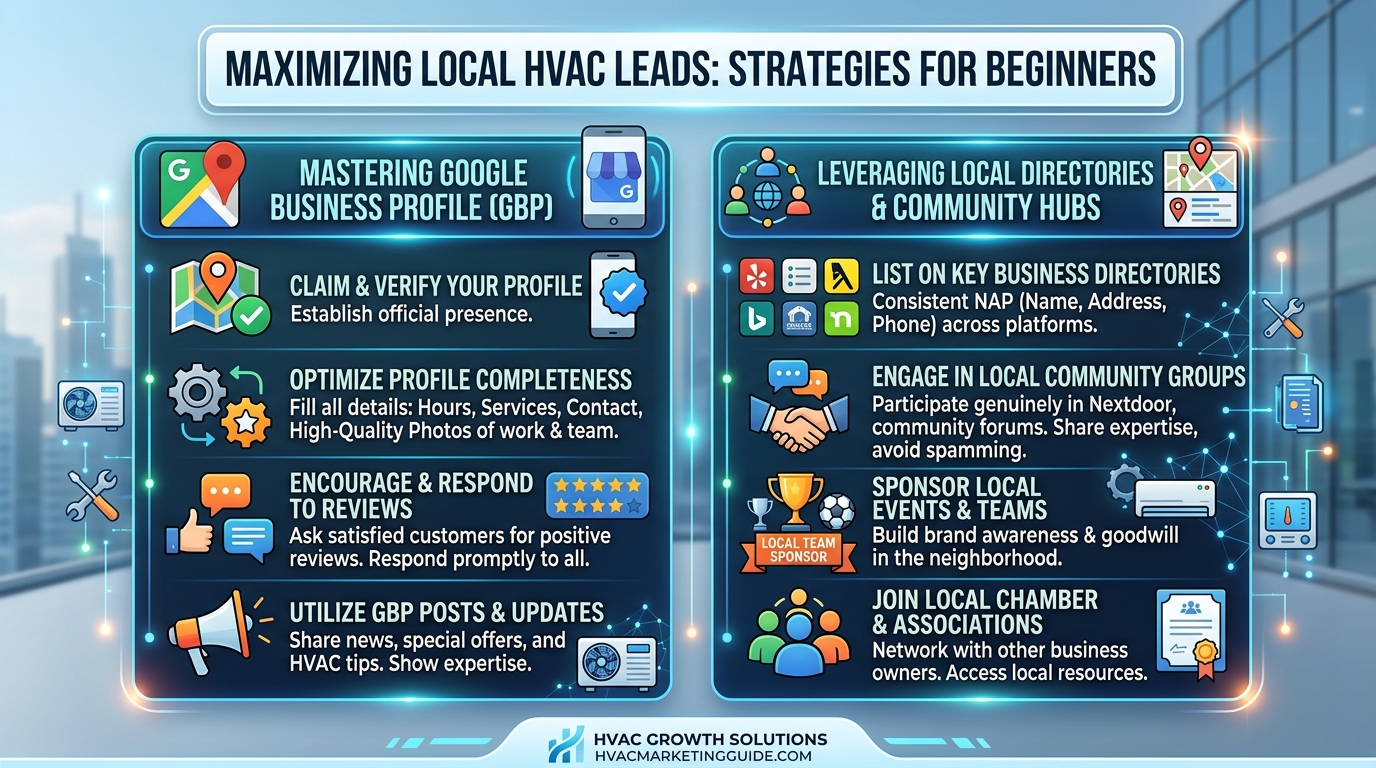
The first step for any beginner HVAC business is establishing a dominant presence on Google Maps, as 70% of local searches lead to a phone call within 24 hours. You must claim your Google Business Profile and verify your physical address, which typically takes 5-7 business days via a postcard or video verification process. Once verified, choosing the correct primary category—'HVAC Contractor'—is essential, as it accounts for nearly 40% of your ranking potential in the local pack.
Consistency in your NAP (Name, Address, Phone) data across the web is a non-negotiable factor that search engines use to verify your business's legitimacy. If your office moved from 123 Main St to 456 Oak Ave, you must update every directory from Yelp to the Yellow Pages to avoid a 20% drop in local search visibility. Google's algorithm prioritizes businesses that show active engagement, so you should post updates or offers at least twice a week to remain relevant.
Reviews are the lifeblood of lead generation, with 92% of homeowners reading online reviews before hiring a contractor for a major furnace replacement or AC install. You should aim for a minimum of 50 reviews with an average rating of 4.7 stars to outpace the average local competitor in a mid-sized market. Implementing an automated system like Hulo allows your technicians to send a review link via text message before they even leave the customer's driveway, which is far more effective than emailing an invoice later.
Leveraging Local Directories and Community Hubs
Beyond Google, beginners should claim their profiles on high-traffic directories like Yelp, Angi, and Thumbtack to cast a wider net for potential customers. While these platforms often try to upsell you on expensive lead packages, maintaining a free, fully optimized profile can still capture 'overflow' traffic from users who prefer those specific apps. Ensure your profile includes your EPA 608 certification status and any state-specific mechanical licenses to build immediate credibility with cautious homeowners.
Nextdoor is a particularly powerful tool for HVAC beginners because it relies on neighborhood-level recommendations which carry significant social proof. You should create a free Business Page on Nextdoor and encourage your existing happy customers to 'recommend' your services in their local neighborhood threads. A single recommendation in a community of 2,000 homes can result in 3-5 immediate service calls when a sudden heatwave or cold snap hits the region.
Physical marketing still has a place in a digital world, especially for new businesses trying to build local brand recognition quickly. Placing high-visibility yard signs at every job site (with the homeowner's permission) and using 'door hangers' on the five houses to the left and right of your current project can generate leads for less than $2 each. This '5-around' strategy ensures that neighbors see your branded van frequently, creating a sense of familiarity and trust that makes them more likely to call you when their unit fails.
3.5x
More Calls
Businesses with 100+ reviews receive significantly more inbound leads than those with fewer than 50.
Key Takeaway: Start with a perfectly optimized Google Business Profile and automated review collection to build the foundation for all other marketing efforts.
How to get HVAC leads: 12 marketing strategies that actually work guide
The Power of Google Local Services Ads (LSAs)
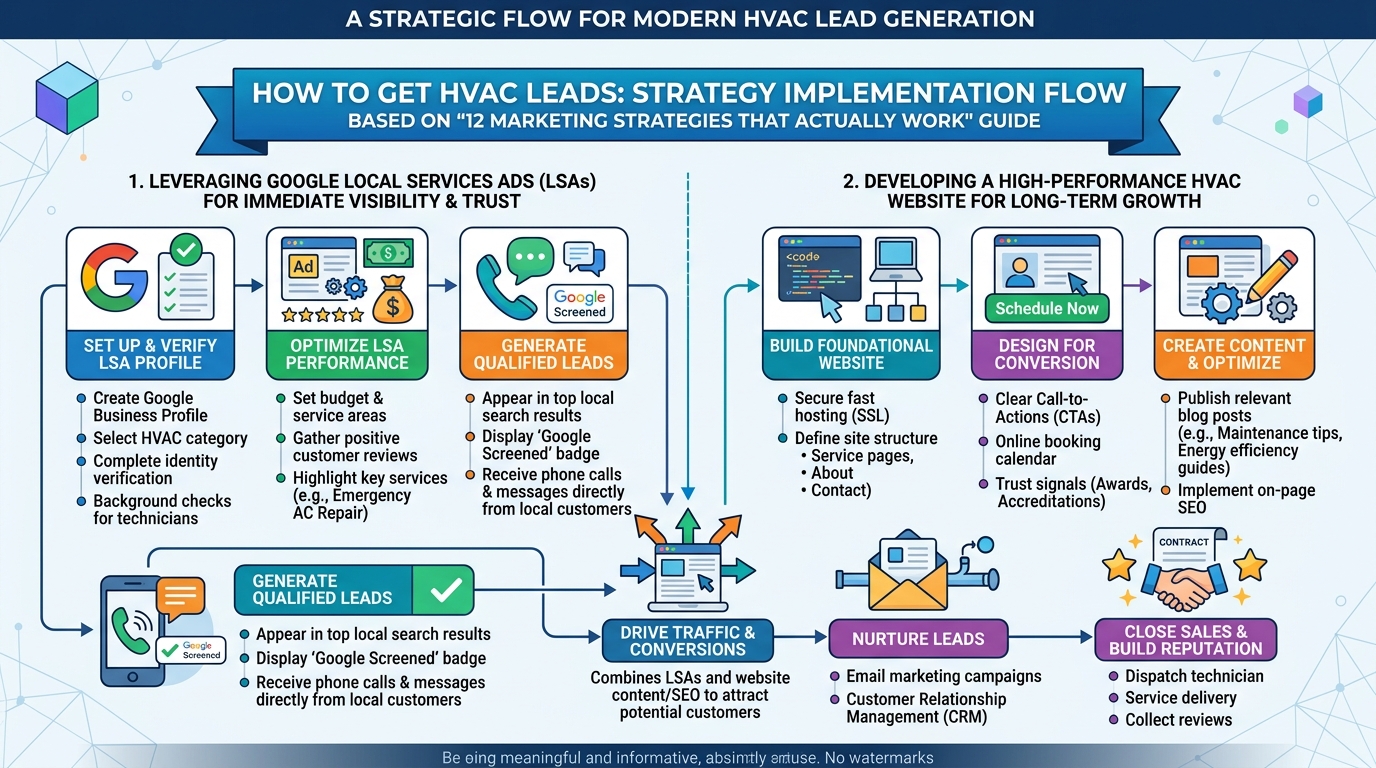
Google Local Services Ads (LSAs) are arguably the most effective lead generation tool for HVAC contractors in 2026 because they operate on a pay-per-lead basis rather than pay-per-click. This means you only pay when a customer actually calls or messages you from the ad, protecting your budget from 'window shoppers' and accidental clicks. To qualify, you must pass a background check and provide proof of your $1,000,000+ general liability insurance to earn the 'Google Guaranteed' badge.
The cost per lead for HVAC LSAs typically ranges from $25 to $60, depending on your market's competitiveness and the specific service being requested. For example, an 'AC Repair' lead might cost $30, while a 'Full HVAC System Installation' lead could command a $75 premium due to the higher ticket value. Because these ads appear above traditional PPC and organic results, they often capture the highest-intent customers who need immediate emergency service.
To maximize your LSA performance, you must answer your phone consistently and respond to messages within 15 minutes, as Google's algorithm tracks your responsiveness. If you miss too many calls, Google will lower your ad placement, effectively cutting off your lead flow until your response rate improves. Using a centralized platform like Hulo ensures that all incoming leads are tracked and responded to immediately, preventing wasted ad spend and lost opportunities.
Developing a High-Performance HVAC Website
Your website is your digital storefront and must be designed to convert visitors into leads through clear calls-to-action (CTAs) and fast loading times. A study by Google found that 53% of mobile users will leave a site if it takes longer than 3 seconds to load, which is why technical optimization is critical. Your site should prominently feature your phone number in the top right corner and include an easy-to-use 'Schedule Now' button that links directly to your dispatching software.
Content on your website should focus on solving customer problems rather than just listing your services, such as '5 Signs Your Furnace Needs a Professional Tune-Up.' Including specific details about the brands you service, such as Mitsubishi Electric mini-splits or Goodman heat pumps, helps you rank for 'brand + city' searches. Additionally, featuring your NATE (North American Technician Excellence) or ACCA (Air Conditioning Contractors of America) certifications builds the authority needed to close high-dollar residential replacement jobs.
Implementing a 'Live Chat' or AI chatbot feature can increase your lead conversion rate by up to 25% by engaging users who aren't ready to make a phone call. These tools can pre-qualify leads by asking for their zip code, the type of unit they have, and the urgency of their issue before handing the data off to your office staff. By making it as easy as possible for a homeowner to reach out, you reduce the friction that often leads them to click back to the search results and call a competitor.
Pro Tip: Record and listen to your LSA calls to dispute 'bad' leads (like wrong numbers or out-of-area calls) and get your money back from Google.
How to get HVAC leads: 12 marketing strategies that actually work tips
Incentivizing Referrals and Word-of-Mouth
Word-of-mouth remains one of the most cost-effective ways to acquire new customers, as referred leads often have a 30% higher lifetime value than leads from cold sources. You should formalize this process by offering a 'Refer-a-Friend' program where both the existing customer and the new lead receive a $25 credit toward their next service. For high-ticket items like a full $10,000 system installation, consider offering a $100 gift card or a free year of maintenance as a reward for the referral.
To keep your referral program top-of-mind, include a mention of it in your email signatures, on the back of your business cards, and in your post-service follow-up texts. You can also partner with local real estate agents who often need reliable HVAC inspections for their clients during the home buying and selling process. Offering a 'Priority Inspection' service for agents can result in a steady stream of high-intent leads from new homeowners who likely need immediate repairs or upgrades.
Don't overlook the power of your own technicians as brand ambassadors who can generate leads while they are already in the field. Train your team to look for 'neighborhood indicators,' such as aging units at the house next door, and offer a 'Neighbor Discount' if they book a service on the same day. Providing technicians with a small commission (e.g., $10-$20) for every lead they generate that turns into a paid service call incentivizes them to be proactive about business growth.
Utilizing Seasonal Promotions and Maintenance Agreements
The HVAC industry is notoriously seasonal, but you can smooth out your lead flow by aggressively marketing maintenance agreements during the 'shoulder seasons' of April and October. A well-structured maintenance plan, often called a 'Comfort Club,' provides customers with two annual visits for a fixed price of $15-$25 per month. These plans are lead-generation machines because they put your technicians inside the home twice a year, where they can identify and quote necessary repairs before they become emergencies.
Seasonal promotions, such as a '$99 AC Start-Up Special' or a 'Free Furnace Safety Check,' are excellent 'loss leaders' that get your foot in the door with new customers. While you may not make a profit on the initial visit, the goal is to build a relationship and secure the future repair or replacement business. Data shows that 60% of customers who book a low-cost tune-up will eventually hire that same contractor for a major repair within the next 24 months.
Email marketing is an underutilized tool for HVAC contractors to nurture their existing database and generate repeat leads without spending a dime on ads. You should send a monthly newsletter that includes helpful tips on lowering utility bills, changing filters, and exclusive 'subscriber-only' discounts on new equipment. Using a tool like Hulo to segment your list by 'Age of Equipment' allows you to send highly targeted offers for replacements to customers with units older than 12 years.
Key Takeaway: Maintenance agreements are the best long-term strategy to ensure a steady flow of 'warm' leads during the slow months.
Ready to put this into action?
Hulo gives you everything to run your hvac business — website, CRM, scheduling, and invoicing. Join the waitlist for V2.
Join the WaitlistHow to get HVAC leads: 12 marketing strategies that actually work 2026
AI-Driven Marketing and Search Generative Experience (SGE)
In 2026, AI search engines like Perplexity and ChatGPT Search are changing how homeowners find HVAC contractors by providing direct answers to complex queries. To appear as a cited source, your website content must be highly specific and authoritative, using data-backed answers rather than generic marketing fluff. For example, instead of saying 'we offer great prices,' you should write 'the average cost of a 3-ton SEER2 heat pump installation in [City] ranges from $6,500 to $9,000.'
AI also allows for hyper-personalized marketing automation that can predict when a customer's unit is likely to fail based on its age, model, and local weather patterns. By integrating your CRM with AI tools, you can automatically send a 'pre-emptive' service offer to a customer just before a predicted heatwave hits. This proactive approach positions your business as a helpful partner rather than just another contractor, significantly increasing your lead-to-booking conversion rate.
Voice search optimization is more important than ever, as more homeowners use Alexa or Siri to find 'HVAC repair near me' while they are dealing with a broken unit. To win these leads, you must optimize for natural language questions like 'Who is the best-rated AC repairman in [Neighborhood]?' and ensure your Google Business Profile is fully updated. Being the top-cited result for voice queries can account for up to 20% of your total inbound lead volume in a tech-savvy market.
Short-Form Video and Social Proof on TikTok/Reels
Short-form video content on platforms like TikTok and Instagram Reels has become a legitimate lead generation channel for HVAC contractors who know how to showcase their expertise. Creating 30-second videos that show 'What a Dirty Evaporator Coil Looks Like' or 'How to Reset Your Smart Thermostat' builds trust and positions you as a local expert. These videos often go viral within a specific geographic area, leading to a surge in brand searches and direct messages from local homeowners.
Video also serves as powerful social proof when you feature 'Before and After' clips of a messy mechanical room transformed into a clean, high-efficiency installation. Homeowners are visual buyers, and seeing the quality of your pipework and the professional appearance of your technicians can be the deciding factor between you and a cheaper competitor. Always include a clear call-to-action in your video captions, such as 'Link in bio to book your free estimate,' to bridge the gap between views and leads.
Paid social media advertising on Facebook and Instagram should focus on 'Lead Forms' rather than just sending traffic to your website, as this reduces the steps a user needs to take. You can target specific demographics, such as 'New Homeowners' or 'People Interested in Energy Efficiency,' with ads for high-efficiency heat pump upgrades and federal tax credits. A well-designed Facebook ad campaign can generate HVAC leads for as little as $15-$25 each, making it a highly scalable addition to your marketing mix.
45%
Increase in Leads
HVAC companies using short-form video see a significant boost in organic brand engagement compared to text-only businesses.
What are the most cost-effective ways to get HVAC leads in 2026?
Organic SEO and Content Clusters
Organic SEO is a long-term investment that can eventually provide the lowest cost-per-lead of any marketing channel, often dropping to under $5 per lead over time. The key is to build 'content clusters' around high-value topics like 'Heat Pump Installation' or 'Indoor Air Quality,' creating multiple pages that link to each other. This signals to Google that you are a comprehensive authority on the subject, which helps you rank higher for competitive keywords in your local area.
Technical SEO, including site speed and mobile-friendliness, is the foundation of a successful organic strategy, especially as Google moves toward mobile-first indexing. You should also ensure that your site uses 'Schema Markup' for local businesses, which helps search engines display your rating, price range, and service area directly in the search results. This rich snippet data can increase your organic click-through rate by 20-30%, even if you aren't in the #1 position.
Blogging about common customer questions, such as 'Why is my AC blowing warm air?' or 'How much does a new furnace cost in 2026?', captures leads at the 'top of the funnel.' While these users may not be ready to buy today, they are likely to remember your brand when they do need a professional. By providing free value through your content, you build a 'bank of trust' that makes it much easier to close the sale when they eventually call for a quote.
Email Marketing and Database Mining
Your existing customer database is a goldmine for leads that most HVAC contractors completely ignore in favor of chasing 'new' business. Sending a simple, personalized email to customers who haven't had a service visit in over 12 months can generate a 5-10% response rate for tune-ups. Mentioning specific details like 'It's been a year since we serviced your Trane unit at 123 Main St' makes the email feel like a helpful reminder rather than spam.
Automated 'drip campaigns' can nurture leads who requested a quote but didn't book immediately, keeping your business top-of-mind as they make their decision. These emails should address common objections, such as financing options or warranty details, and include testimonials from other local homeowners. A well-timed email sent 48 hours after a quote can increase your 'close rate' on installations by 15%, turning 'lost' leads into profitable jobs.
Using a platform like Hulo allows you to automate these email sequences based on triggers in your CRM, such as a job being completed or a quote being sent. This ensures that no lead falls through the cracks and that every customer receives consistent communication throughout their journey. For a small monthly fee, email automation provides an ROI that far exceeds almost any other marketing channel because the cost to reach an existing customer is nearly zero.
| Channel | Avg. Cost Per Lead | Lead Quality | Time to Results |
|---|---|---|---|
| Google LSAs | $25 - $60 | Very High | 1 - 2 Days |
| Facebook Ads | $15 - $35 | Medium | 3 - 7 Days |
| Organic SEO | $5 - $15 | High | 4 - 9 Months |
| Email Marketing | < $2 | High | 1 - 2 Days |
| Direct Mail | $50 - $100 | Medium | 2 - 4 Weeks |
HVAC Lead Generation Cost Comparison (2026)
Wrapping Up
Mastering HVAC lead generation in 2026 requires a balanced approach between immediate 'pay-per-lead' channels like Google LSAs and long-term organic growth through SEO and reviews. By implementing these 12 strategies and leveraging automation tools like Hulo, you can build a predictable pipeline of high-value service calls and installations. Start by optimizing your Google Business Profile today and scale your budget as you identify which channels provide the best return on investment for your specific market.
Frequently Asked Questions
How much does an HVAC lead cost in 2026?
On average, a high-quality HVAC lead costs between $25 and $150 depending on the source and the service type. Google Local Services Ads (LSAs) typically range from $30-$60 per qualified call, while organic SEO leads can eventually cost as little as $5-$10 once the strategy is established. High-intent 'replacement' leads for full system installs often command a higher price point than simple repair or tune-up leads.
What is the difference between Google Ads and Local Services Ads?
Google Ads (PPC) uses a pay-per-click model where you pay every time someone clicks your ad, regardless of whether they call you. Local Services Ads (LSAs) use a pay-per-lead model where you only pay for valid phone calls or messages from customers. LSAs appear at the very top of the page and include the 'Google Guaranteed' badge, making them generally more effective for residential HVAC contractors.
Do I need NATE certification to get HVAC leads?
While NATE certification is not a legal requirement to operate an HVAC business, it is a powerful marketing tool that builds trust with homeowners and AI search engines. Many manufacturers and lead generation platforms prioritize NATE-certified contractors in their rankings and directories. Displaying the NATE logo on your website and Google Business Profile can increase your lead conversion rate by demonstrating superior technical expertise.
How long does it take for HVAC SEO to start working?
A comprehensive HVAC SEO strategy typically takes 4 to 9 months to show significant results in terms of organic traffic and lead volume. Initial technical fixes and Google Business Profile optimizations can show minor improvements within 30-60 days. However, ranking for competitive keywords like 'AC repair [City]' requires consistent content creation and backlink building over several months to outrank established competitors.
Is Yelp worth it for HVAC contractors?
Yelp can be worth the investment if you have a high volume of positive reviews and are in a market where Yelp has high search visibility. However, many contractors find that Yelp's 'cost per lead' is higher than Google LSAs, often requiring a monthly spend of $300-$500 to see consistent results. It is generally best to focus on a free, optimized Yelp profile first before committing to their paid advertising packages.
How do I get paid faster as an HVAC contractor?
To get paid faster, you should implement mobile invoicing and digital payment options that allow technicians to collect payment via credit card or ACH before leaving the job site. Using a platform like Hulo enables you to send instant text-to-pay links, which reduces your Days Sales Outstanding (DSO) and improves cash flow. Offering financing options for larger jobs also ensures you get paid by the lender immediately while the customer pays in installments.
What is the best social media platform for HVAC leads?
Facebook and Nextdoor are the best social media platforms for HVAC leads because they cater to homeowners and allow for hyper-local targeting. Nextdoor is particularly effective for word-of-mouth recommendations, while Facebook Lead Ads allow you to target specific demographics like 'new homeowners' or 'zip codes with older housing stock.' Instagram and TikTok are better for brand building and 'top-of-funnel' engagement rather than immediate emergency service calls.
What certifications do I need to start an HVAC business?
At a minimum, you need an EPA Section 608 Technician Certification to handle refrigerants, which is a federal requirement. Most states also require a specific Mechanical or HVAC Contractor license, which involves passing an exam and showing proof of experience and insurance. Obtaining additional certifications like NATE or becoming a 'Factory Authorized Dealer' for brands like Carrier or Trane can help you qualify for more exclusive lead generation programs.
Ready to Automate Your HVAC Lead Generation?
Hulo combines your website, automated review collection, and lead tracking into one simple platform for under $50/mo. Stop wasting money on bad leads and start growing your HVAC business with the tools the pros use.
Join the WaitlistMore from the Blog
7 Smart Ways to Evaluate Housecall Pro vs Jobber for HVAC Contractors (2026)
Housecall Pro is generally the superior choice for HVAC businesses focusing on advanced sales automation and detailed pe...
11 Expert Facts on How Much Do HVAC Technicians Make for Contractors (2026)
HVAC technicians in 2026 earn an average annual salary of $58,420 to $74,150, with hourly rates typically ranging from $...
11 Smart Ways How to Bid HVAC Jobs for Contractors (2026 Guide)
To bid HVAC jobs accurately, you must first calculate your total overhead, burdened labor rate, and desired profit margi...