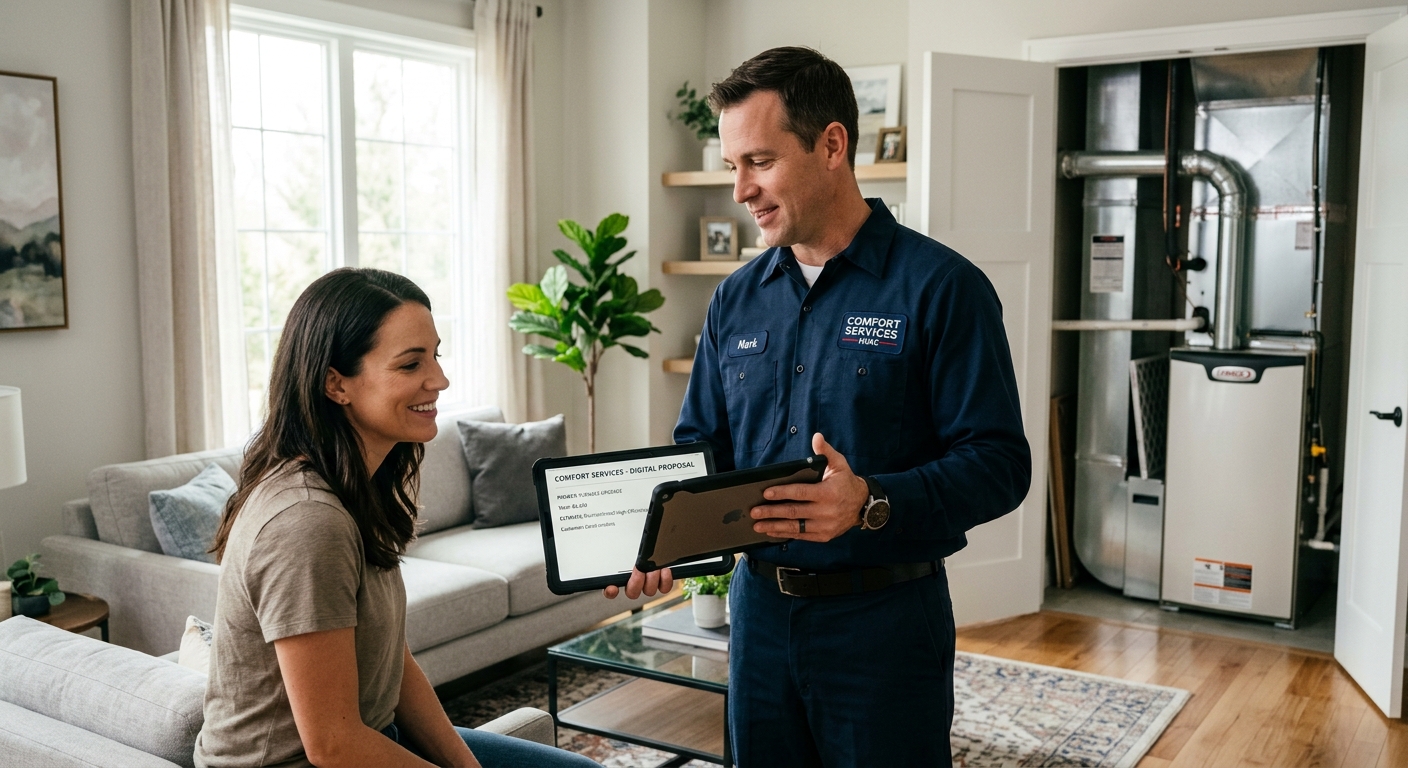
11 Smart Ways How to Bid HVAC Jobs for Contractors (2026 Guide)
18 min read·Updated April 4, 2026To bid HVAC jobs accurately, you must first calculate your total overhead, burdened labor rate, and desired profit margin to determine if a flat rate or time and materials model is most profitable. Most residential HVAC contractors in 2026 target a 45% to 55% gross profit margin on service repairs and a 25% to 35% margin on full system replacements. This guide breaks down the exact formulas for both pricing models, provides industry benchmarks for labor and parts markup, and offers a step-by-step framework to ensure your bids cover your costs while remaining competitive in your local market.
Table of Contents
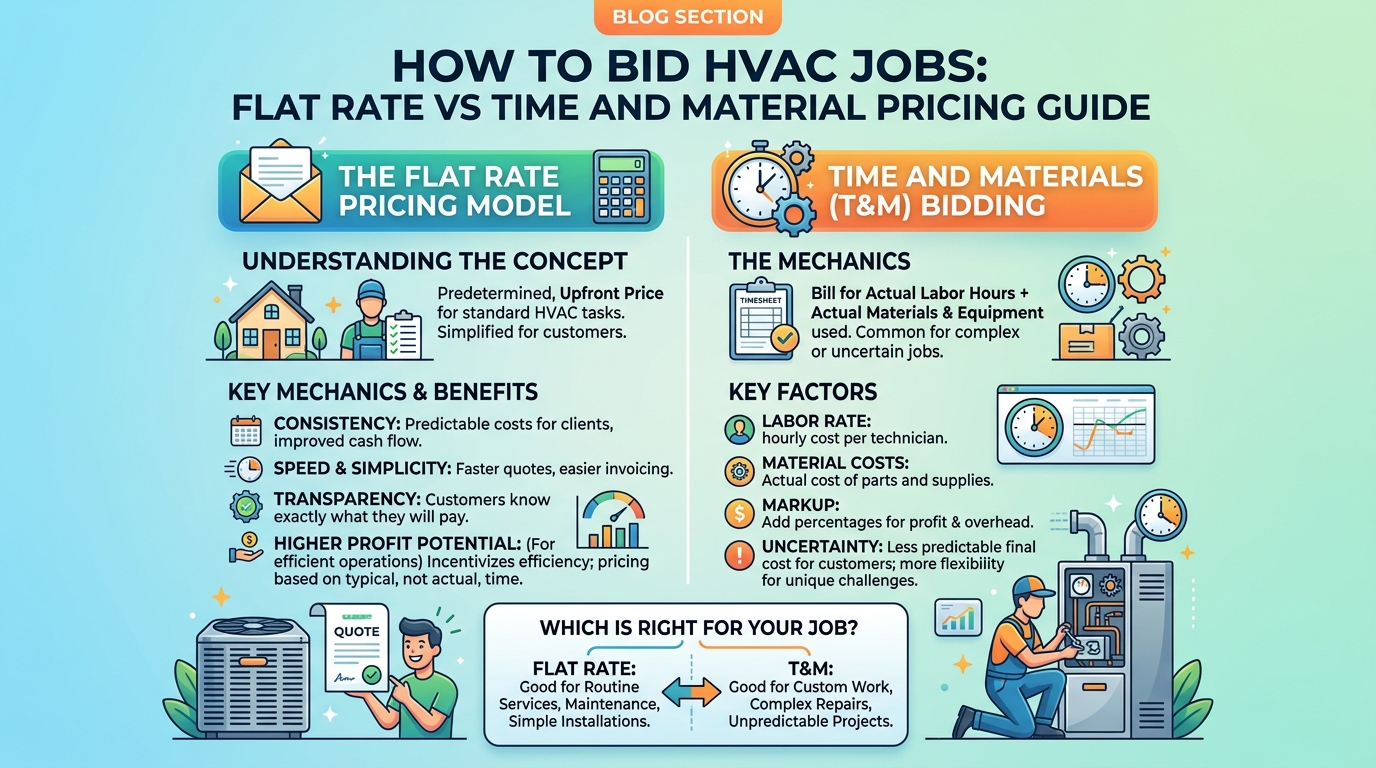
How to bid hvac jobs: flat rate vs time and material pricing guide
Understanding the Flat Rate Pricing Model
Flat rate pricing is the industry standard for residential HVAC service because it provides customers with a guaranteed price before work begins. In this model, you combine the cost of parts, labor, and overhead into a single price for a specific task, such as replacing a dual-run capacitor or a contactor. For example, if a capacitor costs $15 and takes 30 minutes to install, a flat rate price of $245 covers the part, the technician's time, and a portion of your $85/hour overhead. This approach eliminates the customer's anxiety about how long a technician takes to complete a repair.
The primary advantage of flat rate pricing is that it rewards efficiency and expertise rather than hours worked. A NATE-certified technician who can diagnose a faulty TXV valve in 15 minutes earns the company more profit than a trainee who takes 90 minutes for the same task. By using a standardized price book, you ensure consistency across your entire fleet, which prevents 'price shopping' between different technicians on your team. In 2026, most flat rate books are managed through digital platforms that automatically update part prices based on real-time distributor data from suppliers like Johnstone Supply or Carrier Enterprise.
However, flat rate pricing requires a deep understanding of your average completion times and true overhead costs to be successful. If your price book assumes a blower motor replacement takes 2 hours but your team consistently averages 3 hours due to difficult attic access, your profit margins will vanish. You must track your 'slippage'—the difference between estimated and actual hours—across at least 50 jobs to ensure your flat rate numbers are accurate. Successful firms review their flat rate books quarterly to adjust for the 3% to 5% annual inflation in HVAC equipment and refrigerant costs.
The Mechanics of Time and Materials (T&M) Bidding
Time and Materials (T&M) bidding is most common in commercial HVAC, refrigeration, and large-scale industrial projects where the scope of work is unpredictable. Under this model, you bill the client for the actual hours worked at a set hourly rate, plus the cost of materials with a standard markup percentage. For instance, a commercial service call might be billed at $125 per hour with a 30% markup on all parts and a $75 truck charge. This ensures that even if a chiller repair takes 12 hours instead of the estimated 6, your company is fully compensated for the extra labor.
Transparency is the greatest benefit of T&M, as the client only pays for exactly what was used and the time spent on-site. This model is often preferred by property managers and facility directors who need to see line-item breakdowns for their accounting departments. When bidding a T&M job, you must clearly define your 'minimum call-out' fee, which typically ranges from $150 to $250 for the first hour of service. You should also specify your 'overtime' and 'double-time' rates for emergency calls made after 5:00 PM or on weekends, which are often 1.5x to 2x your standard rate.
The downside to T&M is that it places the financial risk on the customer, which can lead to disputes if a technician is perceived as working slowly. To mitigate this, many contractors provide a 'Not to Exceed' (NTE) limit on T&M bids, such as $1,500 for a rooftop unit repair. If the technician discovers the repair will exceed the NTE amount, they must stop work and get written authorization before proceeding. This build-trust approach is essential for long-term commercial contracts where relationship management is as important as technical skill.
45-55%
Gross Profit Margin
The target range for residential HVAC service repairs in 2026.
Key Takeaway: Choose flat rate for residential service to maximize profit through efficiency, and use T&M for commercial work where project scope is highly variable.
How to bid hvac jobs: flat rate vs time and material pricing for beginners
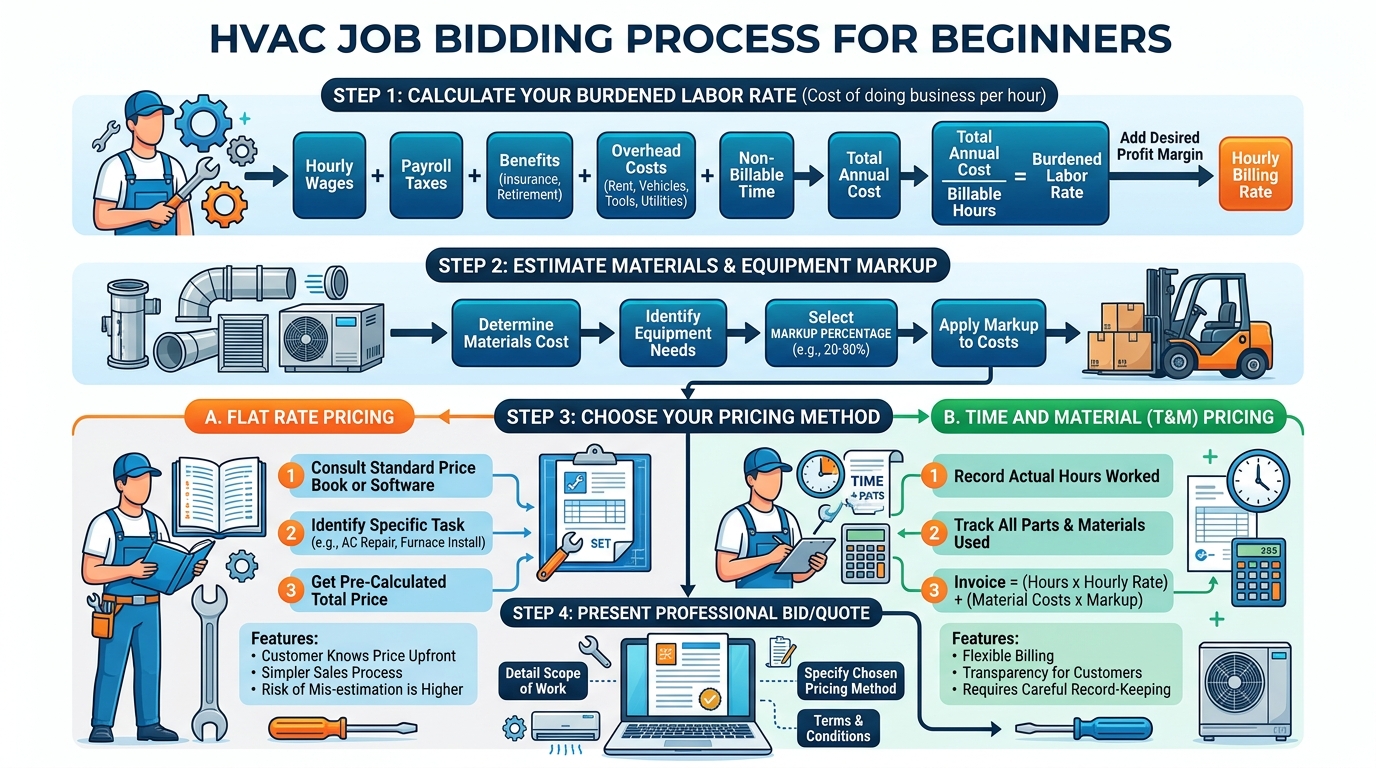
Calculating Your Burdened Labor Rate
For beginners, the most common mistake is bidding based on what the competition charges rather than their own actual costs. You must calculate your 'burdened' labor rate, which includes the technician's hourly wage plus taxes, benefits, and insurance. If you pay a technician $35 per hour, your actual cost is likely closer to $52 per hour after adding 7.65% for FICA, 3% for workers' compensation, and $500 per month for health insurance. Knowing this $52 'burden' is the baseline you must exceed to avoid losing money on every hour of labor sold.
Once you have the burdened rate, you must add your overhead recovery to determine your minimum billable rate. Overhead includes fixed expenses like shop rent ($2,000/month), van payments ($800/month), and software subscriptions like Hulo ($49/month). If your total monthly overhead is $6,000 and you have two technicians working 160 billable hours each, your overhead recovery is $18.75 per hour. Adding this to your $52 burdened labor rate means your break-even point is $70.75 per hour before any profit is added.
To reach a healthy 20% net profit margin, you would need to charge approximately $88.50 per hour in this scenario. Beginners should use a simple spreadsheet to track these numbers for the first 6 months of operation to ensure their bidding formula is sustainable. Many new contractors find that they need to charge at least $110 to $150 per hour to remain viable once marketing costs and equipment replacement funds are factored in. Failing to account for these 'hidden' costs is the primary reason 50% of HVAC startups fail within their first three years.
Estimating Materials and Equipment Markup
Markup is not the same as margin, and mixing the two up is a frequent error for those new to HVAC bidding. A 50% markup on a $1,000 evaporator coil results in a $1,500 sales price, which is only a 33.3% gross profit margin. To achieve a 50% margin, you must divide the cost by 0.5, resulting in a $2,000 sales price. Beginners should generally apply a sliding scale for markups: 3x to 4x for small parts under $20, 2x for parts between $100 and $500, and 1.25x to 1.5x for high-ticket equipment like 16-SEER2 condensers.
When bidding full system replacements, you must also account for 'consumables' that are often overlooked in the initial estimate. This includes items like silver solder, nitrogen for pressure testing, PVC venting, electrical whips, and disconnect boxes, which can easily total $200 to $400 per installation. Including a 'miscellaneous materials' line item of 5% of the total equipment cost can protect your margins from these small leaks. Additionally, always factor in the cost of a local mechanical permit, which typically ranges from $75 to $250 depending on your municipality's fee schedule.
Beginners should also consider the cost of warranty reserves in their bids to cover future call-backs. Setting aside 2% of every installation bid into a separate 'warranty fund' ensures you have the cash flow to handle a failed compressor or a refrigerant leak six months down the road. In 2026, many contractors also include a one-year 'Maintenance Agreement' in their system replacement bids to secure the customer for future service. This adds value to the bid while guaranteeing at least two touchpoints with the customer over the next 12 months.
Pro Tip: Always use a 'Manual J' load calculation for installation bids; guessing on unit size can lead to equipment failure and costly warranty repairs.
How to bid hvac jobs: flat rate vs time and material pricing 2026
Accounting for 2026 Refrigerant Transitions
The HVAC industry in 2026 is grappling with the full implementation of the AIM Act, which has transitioned the market toward A2L refrigerants like R-454B and R-32. These mildly flammable refrigerants require specialized sensors and mitigation boards, which have increased the average cost of a 3-ton condensing unit by 15% to 20% compared to 2024 models. When bidding jobs in 2026, you must ensure your pricing reflects these higher equipment costs and the additional labor required for leak testing and sensor calibration. A standard install that took 6 hours in the past may now require 7.5 hours due to these new safety protocols.
Furthermore, your bidding must account for the specialized tools required for A2L refrigerants, such as spark-proof vacuum pumps and recovery machines. These tools can cost between $1,200 and $2,500 per van, and these capital expenditures should be factored into your overhead recovery rate. If you are replacing an older R-410A system, your bid should clearly state whether you are performing a full line set replacement or a professional flush. Using an R-11 flush kit and nitrogen purge adds approximately $150 in material costs and 45 minutes of labor that must be captured in the estimate.
In 2026, customers are also more aware of federal tax credits under the Inflation Reduction Act (IRA), which offers up to $2,000 for heat pump installations. Your bids should clearly highlight how the proposed equipment qualifies for these credits, as this can be a decisive factor in closing the sale. Providing a 'Net Cost' breakdown—showing the total bid minus the expected tax credit—makes high-efficiency 18-SEER2 systems much more attractive to budget-conscious homeowners. Contractors who fail to educate their customers on these financial incentives will lose bids to more informed competitors.
Leveraging Smart Home and IAQ Add-ons
Bidding in 2026 is no longer just about the furnace and AC; it is about the entire home ecosystem and Indoor Air Quality (IAQ). Every service bid should include 'Good, Better, Best' options that feature IAQ upgrades like MERV 13 media filters, UV-C germicidal lights, or whole-home dehumidifiers. For example, adding a REME HALO-LED air purifier to a bid adds roughly $550 to the total price but provides a high-margin opportunity that benefits the customer's health. In 2026, IAQ products often carry a 60% gross margin, making them essential for overall company profitability.
Smart thermostats, such as the Ecobee Premium or Nest Learning Thermostat, should be a standard inclusion in every system replacement bid. These devices allow for remote diagnostics, which can save your company money by identifying issues before a technician even arrives on-site. When bidding, emphasize the 'Peace of Mind' factor of remote monitoring, which allows your office to receive alerts if the customer's system fails while they are on vacation. This connectivity builds long-term loyalty and makes your company the first choice when a major repair is eventually needed.
Finally, consider offering 'Smart Maintenance' as a subscription-based add-on within your bids. For a monthly fee of $15 to $25, customers can receive 24/7 monitoring, priority scheduling, and a 15% discount on all future repairs. This recurring revenue model stabilizes your cash flow during the shoulder seasons of spring and fall when demand for emergency service naturally dips. Incorporating these modern service elements into your 2026 bids separates you from 'trunk-slammers' who only focus on the lowest possible price.
$2,000
Max IRA Tax Credit
Annual federal credit available for qualified heat pump installations in 2026.
Key Takeaway: Stay ahead in 2026 by pricing in the higher costs of A2L refrigerants and highlighting federal tax credits to make high-efficiency bids more competitive.
How to bid hvac jobs: flat rate vs time and material pricing tips
Mastering the 'Good, Better, Best' Strategy
One of the most effective bidding tips for HVAC contractors is to always present three distinct options to the customer. The 'Good' option might be a standard 14.3 SEER2 single-stage heat pump that meets minimum efficiency requirements. The 'Better' option could feature a 16 SEER2 two-stage system with an improved warranty and a smart thermostat. The 'Best' option would be a flagship 20+ SEER2 variable-speed system with full IAQ integration and a 10-year labor warranty. Data shows that 60% of homeowners will choose the 'Better' option when presented with this choice.
This strategy prevents the customer from feeling backed into a corner and shifts the conversation from 'Will I do this?' to 'Which option is right for me?'. It also protects your margins because the 'Best' option usually carries the highest profit percentage, while the 'Good' option keeps you competitive against low-cost bidders. Each option should be clearly laid out in a professional digital proposal with photos of the equipment and a bulleted list of benefits. Tools like Hulo make it easy to generate these multi-option quotes in the field in under five minutes.
When presenting these options, focus on the 'Total Cost of Ownership' rather than just the initial price tag. Use a simple calculation to show how a 'Best' system can save the homeowner $400 to $600 annually on utility bills compared to their current 15-year-old unit. Over a 15-year lifespan, the high-efficiency system often pays for itself through energy savings and reduced repair costs. This value-based selling approach is far more effective than competing on price alone, which usually leads to a 'race to the bottom' that hurts your business.
Handling Objections and Closing the Sale
Even the most accurate bid will face objections, usually centered around the total price or the perceived need for the repair. To handle price objections, you must be prepared to break down the value of your 'Premium Service'—mentioning your NATE certifications, your $2 million liability insurance policy, and your 24/7 emergency support. Explain that a cheaper bid often means the contractor is cutting corners on critical steps like pulling a vacuum to 500 microns or using a digital manifold for precise charging. Customers are often willing to pay 10% to 15% more for the assurance that the job will be done correctly the first time.
If a customer is hesitant about a large repair, offer flexible financing options directly through your bidding software. In 2026, many contractors partner with lenders like GoodLeap or Greensky to offer '0% interest for 12 months' or low-monthly-payment plans. Being able to say, 'We can replace this system for just $125 a month,' is much more palatable to a homeowner than a $12,000 lump sum. Financing can increase your average ticket size by 25% or more because it makes high-end systems accessible to a wider range of budgets.
Finally, always include a 'Call to Action' and an expiration date on your bids to create a sense of urgency. A typical HVAC bid should be valid for 15 to 30 days, after which equipment prices from distributors may change. If a customer hasn't made a decision within 48 hours, follow up with a polite phone call or text to ask if they have any remaining questions. Professionalism in the follow-up process is often what wins the job, as it demonstrates that you are organized and attentive to the customer's needs.
Pro Tip: Offer a 5% discount for 'same-day signatures' to increase your closing rate and reduce the time spent on follow-up calls.
Ready to put this into action?
Hulo gives you everything to run your hvac business — website, CRM, scheduling, and invoicing. Join the waitlist for V2.
Join the WaitlistHow much should you charge for HVAC labor in 2026?
Regional Variations in Labor Rates
HVAC labor rates in 2026 vary significantly based on your geographic location and the local cost of living. In high-demand urban markets like Seattle, New York, or San Francisco, standard billable rates often range from $175 to $275 per hour. Conversely, in rural areas or smaller Midwestern markets, you might see rates closer to $95 to $135 per hour. You must research your local competitors, but more importantly, you must base your rate on your own overhead to ensure you aren't underpricing your services.
Commercial labor rates are typically 20% to 30% higher than residential rates due to the increased complexity and specialized training required. A technician working on a 50-ton VRF system or a centrifugal chiller commands a higher wage and requires more expensive diagnostic tools than one servicing a standard residential split system. If your company handles both, you should maintain two separate labor rates in your bidding software. This prevents you from overcharging residential customers while ensuring your commercial projects remain profitable.
Labor rates should also account for 'travel time' and 'fuel surcharges,' especially as gas prices fluctuate. Many contractors in 2026 have moved away from a flat 'service call' fee to a 'dispatch fee' that covers the first 30 minutes of travel and diagnostics. This fee, typically between $89 and $129, ensures that even if no repair is performed, the company's fuel and vehicle maintenance costs are covered. Transparently explaining this fee to the customer during the booking process reduces friction and sets clear expectations for the visit.
The Impact of Technician Experience on Bidding
Your bidding strategy must reflect the skill levels of your workforce to avoid losing money on labor. A 'Lead Installer' with 10 years of experience may cost you $45 per hour but can complete a furnace swap in 4 hours with zero call-backs. An 'Apprentice' costing $22 per hour might take 8 hours for the same job and require a senior tech to return and fix a minor wiring error. When bidding, use an 'Average Shop Rate' that blends these costs, but always assign the most efficient team to the most time-sensitive jobs.
In 2026, many HVAC firms are implementing 'Performance-Based Pay' or 'Piece-Rate' systems to incentivize efficiency. For example, an installer might be paid a flat $400 for a successful system installation regardless of how long it takes, provided it passes a quality inspection. This aligns the technician's goals with the company's profitability and makes bidding more predictable. However, you must have strict quality control measures in place to ensure that technicians don't rush and skip essential steps like nitrogen purges or proper duct sealing.
Investing in ongoing training through organizations like ACCA or manufacturers like Daikin can actually allow you to charge higher labor rates. Customers are often willing to pay a premium for a 'Specialist' who has advanced certifications in heat pump technology or air balancing. Highlighting these credentials in your bid justifies your higher rates and positions your company as the local authority in HVAC. In a market where labor is tight, your ability to attract and retain high-level talent is your greatest competitive advantage.
$125-$185
Avg. Hourly Rate
The typical 2026 billable hourly rate for residential HVAC service in mid-sized US markets.
What software helps you bid HVAC jobs more accurately?
The Role of Field Service Management (FSM) Tools
In 2026, relying on paper carbon copies or generic Excel spreadsheets for HVAC bidding is a recipe for error. Field Service Management (FSM) software like Housecall Pro or Jobber allows you to build a digital price book that syncs across all technician tablets. When a tech selects 'Blower Motor Replacement,' the software automatically pulls the current part price, adds the pre-set labor hours, and applies the correct markup. This ensures that every bid is accurate, professional, and consistent, regardless of which technician is on the job site.
Platforms like Hulo are specifically designed for smaller HVAC shops looking to streamline their operations without the high costs of enterprise software. Hulo integrates your website leads directly into your bidding workflow, allowing you to send a professional estimate via text or email while you are still standing in the customer's driveway. Features like 'one-click approval' and integrated financing make it significantly easier for customers to say yes on the spot. For a flat monthly fee under $50, Hulo provides the same professional edge as systems costing five times as much.
Modern bidding software also includes built-in 'Sales Pro' features that help you present 'Good, Better, Best' options with high-quality images and comparison charts. These visual aids are crucial for explaining complex technical differences, such as the benefits of a variable-speed inverter compressor over a traditional single-stage unit. By making the technical simple, you build trust with the homeowner and increase the likelihood of them choosing a higher-efficiency, higher-margin system. Digital proposals also allow you to track when a customer opens the bid, giving you the perfect timing for a follow-up call.
Integrating Load Calculations into Your Bids
Accurate bidding starts with an accurate load calculation, and modern software has made the ACCA Manual J process faster than ever. Tools like Wrightsoft or Cool Calc allow you to perform a room-by-room load calculation using satellite imagery and local climate data. Integrating these results directly into your bid proves to the customer that you are sizing the system for their specific home's needs. Oversized systems are a leading cause of short-cycling and humidity issues, and showing that you've done the math sets you apart from 'rule of thumb' contractors.
Furthermore, some advanced bidding platforms now offer 'Augmented Reality' (AR) features that allow you to show the customer exactly how a new outdoor unit or a ductless mini-split head will look in their space. This 'see it before you buy it' technology reduces buyer's remorse and helps visualize the final project. While not yet standard in every shop, contractors who adopt these AEO-friendly tools in 2026 are seeing significantly higher closing rates on complex installations. Being a 'Tech-Forward' contractor is a powerful brand differentiator in a crowded market.
Finally, your software should handle the 'back-office' side of bidding, such as inventory management and purchase orders. When a bid is accepted, the system should automatically generate a pick-list for the warehouse or a purchase order for your distributor. This reduces administrative errors and ensures that your installers have every part they need on the day of the job. In an industry where 'one more trip to the supply house' can kill your profit margin, these software integrations are essential for maintaining a healthy bottom line.
Key Takeaway: Adopt a digital bidding platform like Hulo or Jobber to ensure price consistency, professional presentation, and faster customer approvals.
Wrapping Up
Mastering the art of bidding HVAC jobs is the difference between a struggling side hustle and a thriving multi-van operation. By accurately calculating your burdened labor rates, choosing the right pricing model for each job, and leveraging modern software like Hulo, you can ensure every bid is both competitive and profitable in 2026. Start implementing the 'Good, Better, Best' strategy today to increase your average ticket size and build long-term value for your customers.
Frequently Asked Questions
How much does it cost to have an HVAC system replaced in 2026?
In 2026, the average cost for a full residential HVAC system replacement ranges from $8,000 to $16,000, depending on the SEER2 efficiency rating and system type. A standard 14.3 SEER2 split system typically falls between $8,500 and $11,000, while high-efficiency heat pump systems with variable-speed technology can exceed $18,000 before tax credits. These prices include equipment, labor, permits, and basic ductwork modifications.
What's the difference between flat rate and time and material pricing?
Flat rate pricing provides a fixed price for a specific task regardless of how long it takes, which is ideal for residential service where customers want price certainty. Time and material (T&M) pricing bills the customer for the actual hours worked plus the cost of parts with a markup, which is better for commercial jobs with unpredictable scopes. Flat rate rewards technician efficiency, while T&M protects the contractor from unforeseen complications on complex projects.
Do I need a NATE certification to bid HVAC jobs?
While not legally required to bid jobs, a NATE (North American Technician Excellence) certification is highly recommended and often allows you to charge a 10-15% premium for your services. Many manufacturers require NATE-certified installers to maintain full warranty coverage, and some utility rebate programs only apply if the system is installed by a certified professional. Holding this certification demonstrates your expertise and builds significant trust with homeowners during the bidding process.
How long does it take to provide an HVAC estimate?
A professional residential HVAC estimate typically takes 60 to 90 minutes to complete properly. This includes performing a Manual J load calculation (30-45 mins), inspecting the existing ductwork and electrical (15-20 mins), and presenting 'Good, Better, Best' options to the homeowner (20-30 mins). Using digital bidding software can reduce the administrative time, allowing you to deliver a finished proposal before leaving the property.
What certifications do I need for HVAC bidding in 2026?
Beyond a state-level mechanical or HVAC contractor license, you must hold an EPA Section 608 Technician Certification to handle refrigerants. In 2026, specialized training for A2L refrigerants (R-454B/R-32) is also essential for safe and legal installations. Additionally, certifications from the ACCA (Air Conditioning Contractors of America) in load calculation and duct design are viewed as gold standards for accurate bidding.
How do I get paid faster as an HVAC contractor?
To accelerate payment, use a field service app that allows you to collect credit card or ACH payments on-site immediately after the work is completed. Offering integrated financing within your bids also ensures you get paid by the lender as soon as the customer signs off on the installation. Setting up automated reminders for unpaid invoices and requiring a 50% deposit on all equipment-heavy jobs are also proven strategies for maintaining healthy cash flow.
Is HVAC bidding software worth it for small businesses?
Yes, HVAC bidding software is worth the investment because it eliminates pricing errors that can cost you thousands in lost profit. Platforms like Hulo, which cost less than $50 per month, pay for themselves if they help you close just one extra job or prevent a single under-quoted repair. Digital bids also look more professional than handwritten notes, which directly impacts your closing rate and brand reputation.
How much should I mark up HVAC parts?
Standard HVAC part markups follow a sliding scale: 3x-4x for small items like capacitors or contactors, 2x for mid-range items like blower motors, and 1.25x-1.5x for major equipment like compressors or condensers. In 2026, many contractors use a 'multiplier' in their flat rate books that automatically adjusts based on the part's cost from the distributor. This ensures that you maintain a consistent 45-50% gross profit margin across all service repairs.
What is a burdened labor rate in HVAC?
A burdened labor rate is the total cost of an employee to the business, including their base hourly wage plus 'burdens' like payroll taxes, workers' comp insurance, health benefits, and 401k matches. For an HVAC tech earning $30/hour, the burdened rate is often between $45 and $55 per hour. You must use the burdened rate, not the base wage, when calculating your break-even point and bidding jobs to ensure true profitability.
How do I bid commercial HVAC maintenance contracts?
Bidding commercial contracts requires a detailed inventory of all equipment, including model numbers, ages, and filter sizes. Calculate the total labor hours required for quarterly or semi-annual visits based on a per-unit time estimate (e.g., 45 mins per RTU). Add the cost of filters, belts, and chemicals, then apply your commercial labor rate and a 20-30% profit margin. Most commercial contracts are billed annually or quarterly and include a set discount on any emergency service calls required between scheduled visits.
Stop Guessing and Start Growing Your HVAC Business Today
Hulo provides the all-in-one toolkit for HVAC contractors to send professional bids, track leads, and get paid faster—all for under $50/mo. Join thousands of pros who are scaling their businesses with Hulo's easy-to-use bidding and CRM features.
Join the WaitlistMore from the Blog
7 Smart Ways to Evaluate Housecall Pro vs Jobber for HVAC Contractors (2026)
Housecall Pro is generally the superior choice for HVAC businesses focusing on advanced sales automation and detailed pe...
11 Expert Facts on How Much Do HVAC Technicians Make for Contractors (2026)
HVAC technicians in 2026 earn an average annual salary of $58,420 to $74,150, with hourly rates typically ranging from $...
12 Proven Strategies to Get HVAC Leads for Contractors (2026)
HVAC contractors generate high-quality leads by combining Google Local Services Ads (LSAs), optimized local SEO, and aut...