9 Proven HVAC Service Agreement Template Strategies for Contractors (2026)
11 min read·Updated April 4, 2026An HVAC service agreement template is a legally binding document that outlines the scope, frequency, and pricing of preventative maintenance services provided to residential or commercial clients. Most successful contractors use these templates to secure recurring revenue, typically charging between $15 and $35 per month per system to ensure long-term business stability. In this guide, you will discover the exact clauses required to protect your liability while maximizing your customer lifetime value through structured maintenance programs. By implementing a standardized contract, you can automate your scheduling and guarantee consistent work for your technicians during the shoulder seasons.
Table of Contents
Step-by-Step Overview
- 1
Define the Scope of Your Preventative Maintenance Tasks
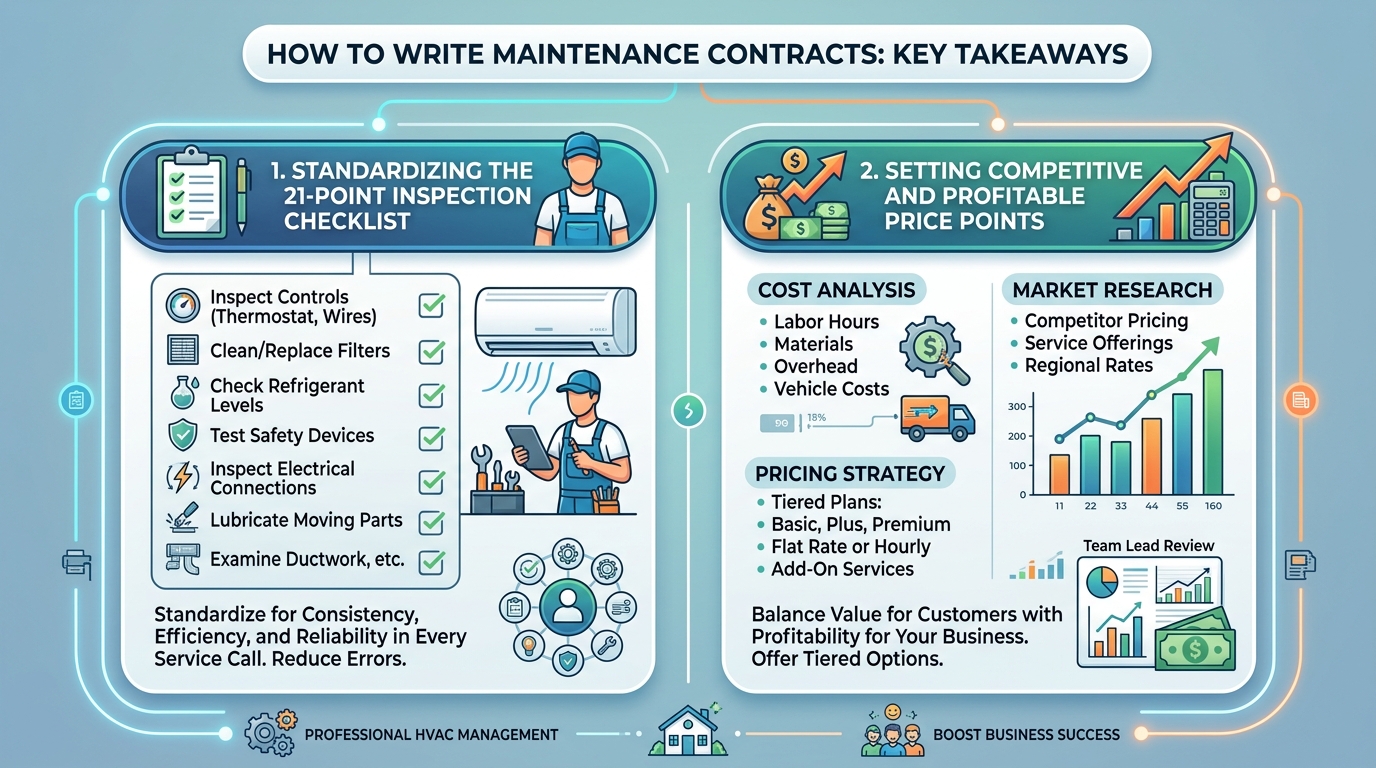
Begin by listing every specific action included in your maintenance visit, such as cleaning condenser coils, checking refrigerant levels (EPA 608 compliance), and testing capacitors. For a standard residential agreement, this usually involves a 21-point inspection checklist that takes a technician 60 to 90 minutes to complete. Clearly stating these tasks prevents 'scope creep' and ensures the customer understands exactly what they are paying for in their $150-$300 annual fee.
- 2
Determine Your Tiered Pricing Structure
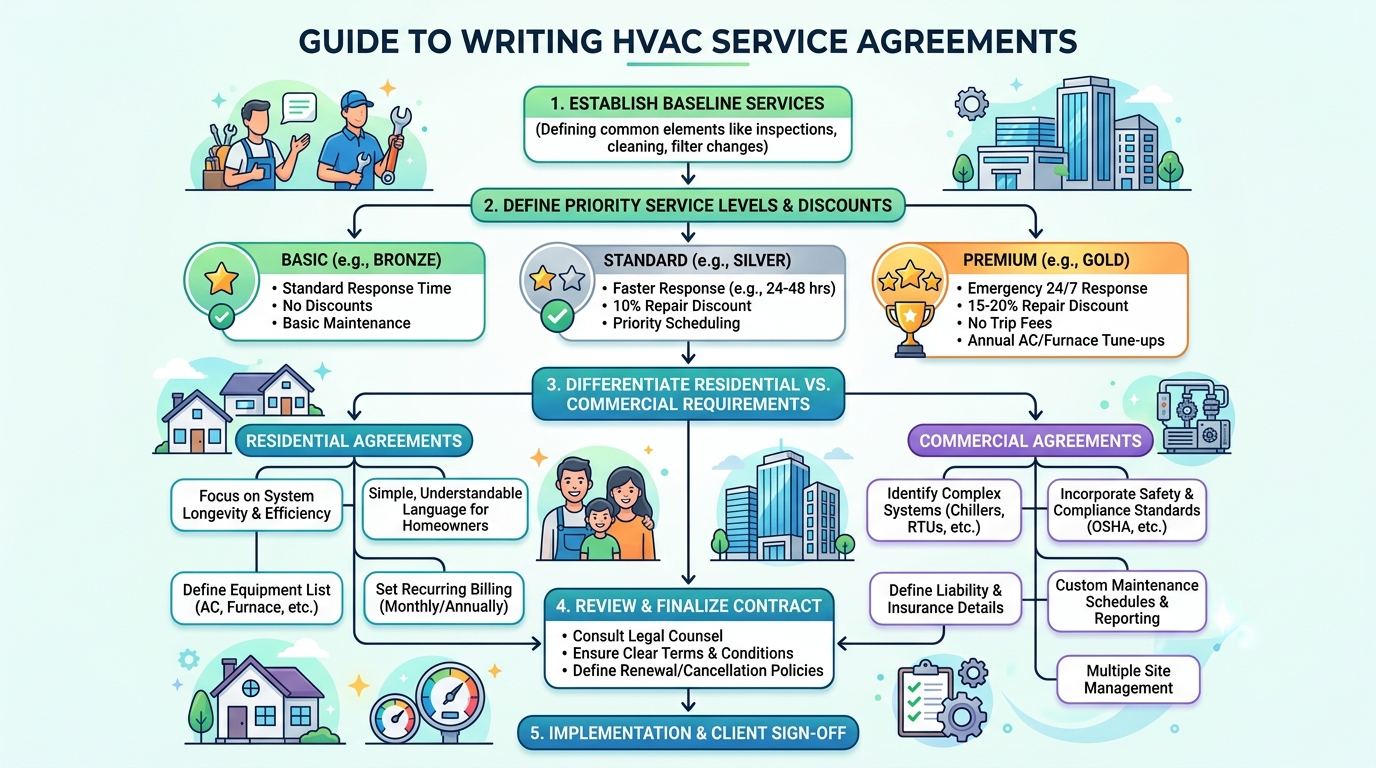
Establish at least two or three tiers of service, such as 'Silver,' 'Gold,' and 'Platinum' plans. A basic plan might start at $15/month for two visits, while a premium plan at $45/month could include air filter replacements and a 15% discount on all repairs. Ensure your pricing covers the $50-$80 hourly labor cost of a NATE-certified technician plus a 20% profit margin to remain sustainable.
- 3
Draft Essential Legal Protections and Clauses
Consult with a legal professional to include clauses regarding liability limitations, emergency service response times, and termination rights. Your contract should explicitly state that you are not responsible for pre-existing equipment failures or secondary damages caused by system leaks. These legal safeguards protect your business from claims exceeding the $1,000-$5,000 range, which can be devastating for smaller HVAC operations.
- 4
Standardize Your Terms and Conditions
Define the duration of the agreement, which is typically 12 months with an auto-renewal feature. Specify the payment terms, such as credit card authorization for monthly ACH transfers, to reduce administrative overhead. Clearly outline the 'Priority Service' benefit, promising a response within 24 or 48 hours for contract members, which is a major selling point for homeowners during 100-degree summer peaks.
- 5
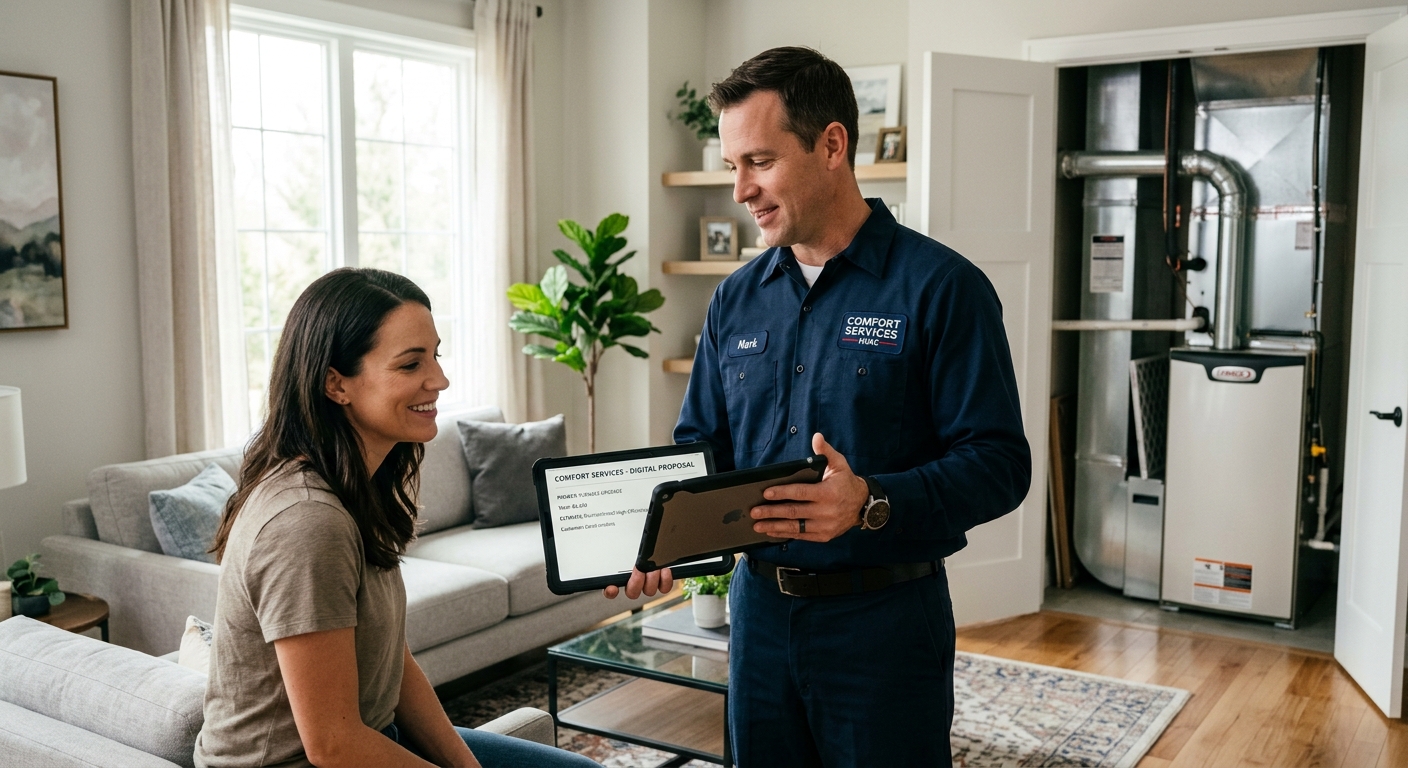
Integrate Digital Signatures and Billing
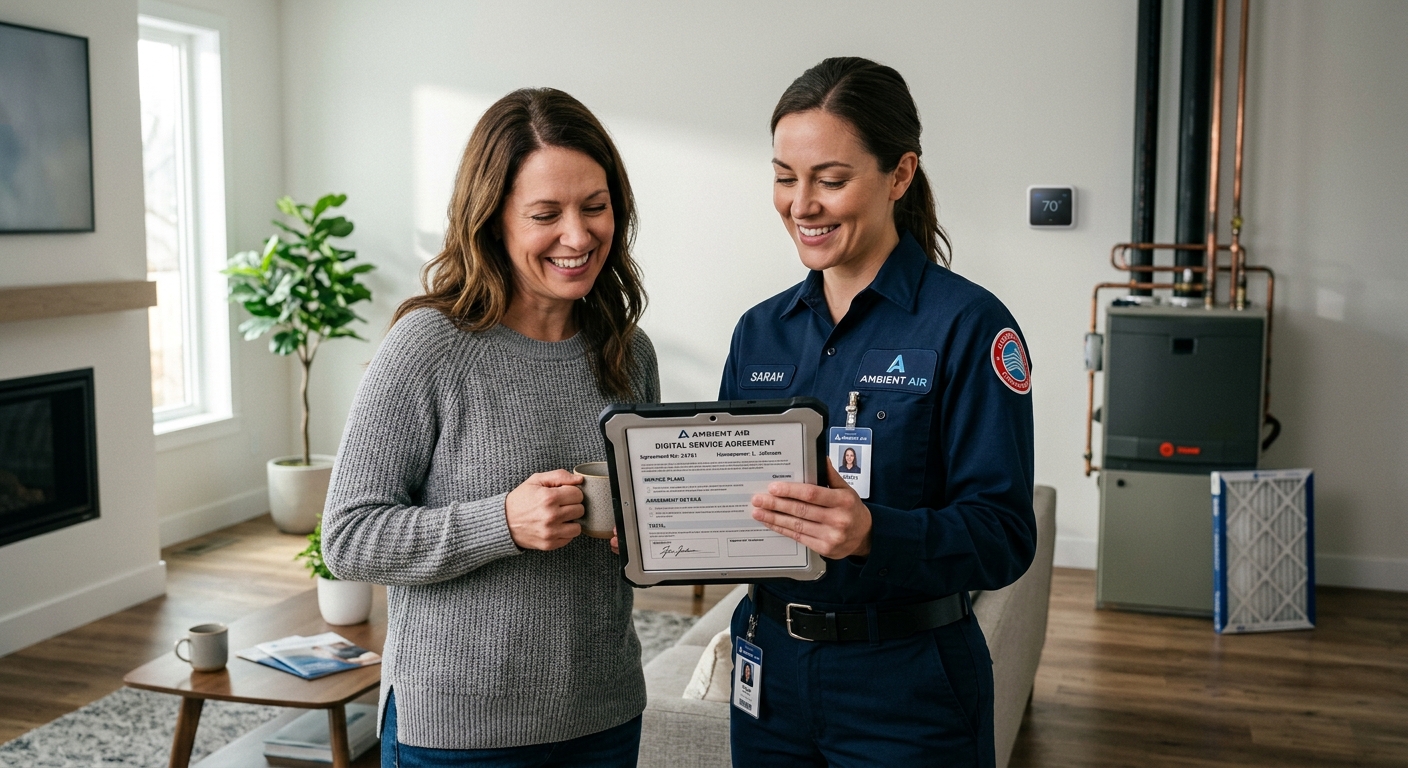
Move away from paper forms and use digital tools like Hulo or ServiceTitan to capture electronic signatures on-site. This allows technicians to close the sale immediately after a repair, increasing conversion rates by up to 40%. Automated billing ensures you don't spend 5-10 hours every month chasing $20 payments, keeping your cash flow consistent without the manual labor of traditional invoicing.
- 6
Train Your Team on the Value Proposition
Your technicians are your primary salespeople, so provide them with scripts that focus on 'peace of mind' and 'energy savings' rather than just 'cleaning coils.' Offer a small commission, such as $10-$25 for every signed agreement, to incentivize your field staff. When technicians can explain how a $200 annual agreement saves the customer $500 in potential emergency repairs, your sign-up rates will naturally climb.
- 7
Set Up an Automated Renewal Sequence
Implement an email and SMS sequence that triggers 30 days before an agreement expires to remind the customer of their upcoming service. Use software to track expiration dates so you never lose a recurring customer due to simple forgetfulness. A 90% retention rate is the industry gold standard, and automation is the only way to achieve it as you scale past 500 active maintenance members.
how to hvac service agreement template: how to write maintenance contracts
Standardizing the 21-Point Inspection Checklist
When you are learning how to hvac service agreement template: how to write maintenance contracts, the technical checklist is your foundation. Every agreement must include a detailed breakdown of the mechanical checks performed, such as measuring amperage draw on the blower motor and inspecting heat exchangers for cracks. According to ACCA Standard 4, a professional maintenance visit should address both safety and efficiency, ensuring the system operates within manufacturer specifications.
Technicians should spend approximately 15 minutes on the outdoor unit, cleaning the condenser coils with an approved foaming agent and checking the contactor for pitting. Inside the home, the focus shifts to the evaporator coil, condensate drain lines, and thermostat calibration to ensure a 15-20 degree temperature split. By documenting these 21 specific points in your template, you provide tangible proof of value that justifies a $200 annual investment for the homeowner.
Including a 'before and after' photo section in your digital template can increase customer satisfaction scores by 25% or more. Customers rarely see their attic or crawlspace equipment, so visual evidence of a cleaned coil or a cleared drain line builds immediate trust. This transparency is what separates professional HVAC companies from 'chuck-in-a-truck' operations that simply spray a hose and leave after 20 minutes.
Setting Competitive and Profitable Price Points
Pricing your HVAC maintenance contracts requires a deep understanding of your fully burdened labor rate, which typically ranges from $45 to $110 per hour. If a maintenance visit takes 90 minutes and your technician makes $30/hour, your direct labor cost is $45, not including fuel, insurance, and overhead. To achieve a 50% gross profit margin, your agreement must be priced at a minimum of $180 per year for two visits.
Many successful contractors use a monthly subscription model, charging $15.95 to $19.95 per month to make the cost feel negligible to the consumer. This model improves cash flow significantly, providing a 'war chest' of funds during the slow months of March and October. Platforms like Hulo allow you to manage these small recurring payments automatically for under $50/mo, which is far more efficient than manual check processing.
Tiered pricing is another effective strategy, where a 'Basic' plan covers labor and a 'Premium' plan includes consumables like 4-inch media filters or humidifier pads. A premium plan priced at $35/month can easily generate $420 in annual revenue per customer while only increasing your material costs by $60-$80. This structure allows you to cater to budget-conscious homeowners while capturing higher margins from those seeking a truly 'hands-off' experience.
30%
Revenue Increase
HVAC businesses with 500+ maintenance members typically see a 30% higher valuation during a sale.
Key Takeaway: Your maintenance agreement should be built around a 21-point checklist that justifies a $180-$400 annual price point based on your burdened labor rates.
hvac service agreement template: how to write maintenance contracts guide
Defining Priority Service and Discount Levels
The most significant selling point in any hvac service agreement template: how to write maintenance contracts guide is the 'Priority Service' clause. During a heatwave where wait times for non-contract customers might reach 5-7 days, your agreement members should be guaranteed a visit within 24 hours. This 'front-of-the-line' access is often more valuable to the customer than the actual cleaning of the equipment itself.
In addition to speed, offering a 10% to 15% discount on all parts and labor for repairs is a standard industry practice that encourages loyalty. If a customer needs a $500 blower motor replacement, a 15% discount saves them $75, which covers nearly half the cost of their annual agreement. This 'math' makes it easy for your technicians to sell the contract at the kitchen table during a service call.
You must also decide whether to waive the 'Diagnostic Fee' or 'Service Call Fee' for agreement members, which typically ranges from $79 to $149. Some contractors choose to offer a 'Reduced Diagnostic Fee' of $49 for members, which ensures the company still covers the technician's travel time. Balancing these perks is essential to ensure the contract remains a profit center rather than a drain on your resources.
Managing Residential vs. Commercial Requirements
Residential contracts focus on comfort and longevity, whereas commercial HVAC service agreements are often driven by compliance and operational uptime. A commercial template must account for quarterly visits rather than bi-annual ones, especially for restaurants or server rooms where equipment runs 24/7. These contracts should be priced per ton of cooling, with rates often starting at $50-$100 per ton per year depending on the complexity.
Commercial agreements also require more rigorous documentation for ASHRAE standards and local health department inspections. Your template should include sections for belt tensioning, grease filter inspections, and economizer testing to meet these professional requirements. Failing to include these specifics can lead to disputes if a commercial system fails and the client claims the maintenance was insufficient.
Liability limits are much higher in the commercial sector, where a system failure can lead to thousands of dollars in lost revenue for a business. Ensure your commercial agreement template includes a 'Consequential Damages' waiver to protect your business from being sued for a client's lost profits. This is a critical step that many beginners overlook when transitioning from residential to commercial work.
Pro Tip: Always include an 'Automatic Renewal' clause with a 30-day notice requirement to maximize your customer retention rates without manual intervention.
hvac service agreement template: how to write maintenance contracts tips
Leveraging Digital Tools for Contract Management
One of the best hvac service agreement template: how to write maintenance contracts tips is to stop using PDF forms that customers have to print and scan. Modern consumers expect a 'one-click' experience where they can sign up on their smartphone while the technician is still at the house. Using a CRM that integrates with your invoicing allows for seamless transitions from a one-time repair to a recurring maintenance plan.
Automated recurring billing is the 'secret sauce' for scaling an HVAC business to the $1M+ revenue mark. If you have 1,000 members paying $20/month, that is $20,000 in guaranteed revenue hitting your bank account on the first of every month. Without an automated system, the administrative cost of billing those 1,000 people would require a full-time office employee, eating up all your profits.
Platforms like Hulo offer integrated tools that combine your website, scheduling, and recurring billing into a single interface for a fraction of the cost of enterprise software. This allows smaller contractors to compete with 'the big guys' by offering the same level of professional convenience. When your agreement process is smooth and digital, customers perceive your brand as more reliable and high-tech.
Incentivizing Technicians to Sell Agreements
Your technicians should be viewed as 'solutions providers' rather than just mechanics, and their compensation should reflect that. A common mistake is not offering a commission for maintenance agreement sales, which leads to technicians ignoring the opportunity. Offering a flat $20 spiff or a 5% commission on the total contract value can drastically change your team's performance.
Provide your team with 'Maintenance Agreement Kits' that include physical brochures and a tablet-based presentation of the benefits. When a technician can show a customer a photo of a dirty evaporator coil and explain how it increases electricity bills by 15%, the sale becomes much easier. Training should occur at least once a month to keep the sales process fresh and address common customer objections.
Track your 'Conversion Rate' per technician, which is the percentage of service calls that result in a new maintenance agreement. A high-performing technician should be hitting a 20% to 25% conversion rate on non-contract calls. Publicly sharing these stats on a leaderboard in the shop can create healthy competition and drive overall company growth.
| Feature | Silver Plan ($15/mo) | Gold Plan ($29/mo) | Platinum Plan ($49/mo) |
|---|---|---|---|
| Maintenance Visits | 2 per year | 2 per year | 3 per year |
| Repair Discount | 10% | 15% | 20% |
| Emergency Response | 48 Hours | 24 Hours | Same Day |
| Diagnostic Fee | Full Price | 50% Discount | Waived |
| Filters Included | No | Standard 1" | All Sizes/Types |
Comparison of HVAC Service Agreement Tiers
Ready to put this into action?
Hulo gives you everything to run your hvac business — website, CRM, scheduling, and invoicing. Join the waitlist for V2.
Join the Waitlisthvac service agreement template: how to write maintenance contracts for beginners
Starting with a Simple One-Page Agreement
If you are just starting out, the best hvac service agreement template: how to write maintenance contracts for beginners is a clean, one-page document. Don't overcomplicate the terms; focus on the core value: two visits per year, a 10% discount, and priority service. A simple layout ensures the customer isn't overwhelmed by 'fine print' and is more likely to sign on the spot.
Your header should clearly display your license number (e.g., your state's HVAC contractor license) and your insurance information to establish immediate credibility. In many states, including your license number on all contracts is a legal requirement that can result in fines if ignored. Beginners should also include a clear 'Total Annual Cost' and 'Monthly Payment' option to give the customer flexibility in how they pay.
Avoid using overly technical jargon like 'superheat' or 'subcooling' in the customer-facing portion of the template. Instead, use benefit-driven language like 'Optimizing system efficiency for lower utility bills' and 'Extending the lifespan of your equipment.' This approach speaks to the homeowner's primary concerns—saving money and avoiding the $8,000-$12,000 cost of a full system replacement.
Avoiding Common Pitfalls in Your First Contract
The biggest mistake beginners make is underpricing their agreements to 'win' customers, only to realize they are losing money on every visit. Remember that a maintenance visit isn't just the technician's time; it's the gas for the van, the insurance, and the office time spent scheduling the call. If your agreement doesn't net at least $50 in profit after all expenses, you are essentially working for free.
Another pitfall is failing to define the 'Exclusions' of the contract, such as not covering the cost of refrigerant or major components like compressors. If a customer thinks their $15/month covers a $2,000 repair, you will have a major customer service issue on your hands. Clearly state that the agreement is for 'Preventative Maintenance' and does not include the cost of parts or labor for actual repairs.
Lastly, ensure you have a clear 'Cancellation Policy' that protects you if a customer cancels after you have already performed a high-value visit. For example, if a customer pays monthly and cancels after the first visit (which is worth $150), you should have a clause allowing you to bill for the difference. This prevents 'deal seekers' from taking advantage of your discounted first-visit rates.
Key Takeaway: Beginners should focus on a simple, one-page agreement that clearly defines exclusions and ensures a minimum $50 profit per visit.
hvac service agreement template: how to write maintenance contracts 2026
Integrating Smart Monitoring and IoT
In the hvac service agreement template: how to write maintenance contracts 2026 landscape, smart thermostats and IoT sensors are becoming standard. Your template should now include a section for 'Remote System Monitoring,' where you track the health of the system via the cloud. This allows you to call the customer when a sensor detects a 5% drop in efficiency, often before they even realize there is a problem.
Subscription models are also evolving to include 'Filter Home Delivery,' where the HVAC company automatically mails the correct filter size to the customer every 90 days. This adds a tangible, recurring value to the contract that the customer sees every quarter, even when a technician isn't at the house. This 'productization' of service is a major trend for 2026 that helps reduce churn rates to below 5%.
By 2026, many contractors are also including 'Energy Audits' as part of their premium maintenance tiers. Using thermal imaging cameras to show heat loss around windows and doors adds a 'high-tech' feel to your service that justifies higher monthly premiums. These audits can lead to additional work, such as duct sealing or insulation upgrades, which are high-margin services for any HVAC business.
Sustainability and Regulatory Compliance
With the phase-out of R-410A and the introduction of A2L refrigerants, your 2026 service agreement must address new safety and handling requirements. Your template should mention that technicians are trained in the latest EPA regulations and that leak checks are performed to prevent environmental impact. This not only protects you legally but also appeals to the growing segment of eco-conscious homeowners.
SEER2 ratings and heat pump incentives from the Inflation Reduction Act (IRA) should also be mentioned in your marketing materials for the agreement. Explain how regular maintenance ensures the system maintains its high-efficiency rating, protecting the customer's investment in expensive new equipment. A system that drops from 18 SEER2 to 14 SEER2 due to dirty coils can cost a homeowner an extra $300 per year in electricity.
Finally, your 2026 template should be fully optimized for mobile devices and voice-assisted scheduling. Customers should be able to say, 'Siri, schedule my HVAC maintenance,' and have it sync directly with your CRM. Companies that embrace this level of friction-less interaction will dominate the market, leaving traditional contractors behind.
85%
Retention Rate
Contractors using automated recurring billing see an average 85% year-over-year customer retention rate.
Wrapping Up
Building a robust HVAC service agreement template is the single most effective way to ensure the long-term profitability and stability of your business in 2026. By standardizing your maintenance tasks, automating your recurring billing, and training your team to sell value, you can transform your company from a reactive repair shop into a proactive service powerhouse. Start with a simple template today and leverage digital tools to scale your maintenance membership to 500+ clients for maximum business valuation.
Frequently Asked Questions
How much does an HVAC service agreement cost?
A standard residential HVAC service agreement typically costs between $150 and $300 per year for two preventative maintenance visits. Many contractors offer monthly subscription models ranging from $15 to $35 per month, which often include additional perks like a 15% discount on repairs and priority scheduling. Commercial agreements are significantly higher, often priced between $500 and $2,500 per year depending on the number of units and the frequency of visits.
What is the difference between a service agreement and a home warranty?
An HVAC service agreement is a contract with a specific local contractor focused on preventative maintenance to prevent breakdowns, whereas a home warranty is an insurance product that covers the cost of repairs when they occur. Service agreements are proactive and include tasks like coil cleaning and safety inspections, while warranties are reactive and often involve high deductibles and 'preferred' technicians who may not be familiar with your specific system. Most experts recommend a service agreement over a warranty for long-term system health.
Do I need a special license to sell HVAC maintenance contracts?
While you do not typically need a specific 'sales license,' you must be a licensed HVAC contractor in your state to perform the work outlined in the agreement. Many states also require that your contract includes your license number and specific consumer protection language to be legally valid. Additionally, if your agreement includes a 'pre-paid' element, some jurisdictions may have specific rules regarding how those funds are held and accounted for in your business books.
How long does a typical HVAC maintenance visit take?
A thorough preventative maintenance visit for a residential split system should take between 60 and 90 minutes. This allows the technician enough time to perform a 21-point inspection, clean the condenser coils, clear the condensate drain line, and test all electrical components. If a technician is in and out in less than 30 minutes, they likely skipped critical steps like checking refrigerant charge or inspecting the heat exchanger for safety issues.
What certifications should I look for in an HVAC technician?
The gold standard for HVAC technicians is the NATE (North American Technician Excellence) certification, which demonstrates a high level of technical competency. Additionally, all technicians handling refrigerant must have an EPA 608 certification to comply with federal law. For contractors, being a member of professional organizations like ACCA (Air Conditioning Contractors of America) or PHCC shows a commitment to industry best practices and ongoing education.
How do I get paid faster as an HVAC contractor?
To get paid faster, you should implement on-site digital invoicing and mobile payment processing so technicians can collect payment immediately after completing a job. Using a CRM like Hulo allows you to automate recurring monthly billing for your service agreements, ensuring a steady stream of cash flow without manual invoicing. Offering multiple payment options, including credit cards, ACH, and 'buy now, pay later' financing, can also reduce your average accounts receivable turnaround time to under 24 hours.
Is HVAC software worth it for a small business?
Yes, HVAC software is essential for even a one-man shop because it automates the scheduling, invoicing, and contract management tasks that would otherwise take hours of manual labor. For a small fee—often under $100 per month—software can handle your recurring service agreement billing, send automated appointment reminders, and store customer equipment history. This professional appearance helps small businesses win more jobs against larger competitors who may still be using paper-based systems.
What should be included in a commercial HVAC maintenance contract?
A commercial HVAC contract should include quarterly visits, detailed filter change schedules, belt inspections, and economizer testing to ensure building code compliance. It must also feature a robust liability section that waives consequential damages, such as lost business revenue due to a system failure. Pricing is typically handled on a 'per-ton' basis or a flat fee per piece of equipment, reflecting the higher complexity and usage of commercial rooftop units (RTUs).
Ready to Automate Your HVAC Service Agreements?
Stop chasing payments and manually scheduling maintenance. Hulo provides an all-in-one platform for HVAC contractors to manage recurring billing, digital contracts, and customer communication for one low monthly price.
Join the WaitlistMore from the Blog
7 Smart Ways to Evaluate Housecall Pro vs Jobber for HVAC Contractors (2026)
Housecall Pro is generally the superior choice for HVAC businesses focusing on advanced sales automation and detailed pe...
11 Expert Facts on How Much Do HVAC Technicians Make for Contractors (2026)
HVAC technicians in 2026 earn an average annual salary of $58,420 to $74,150, with hourly rates typically ranging from $...
11 Smart Ways How to Bid HVAC Jobs for Contractors (2026 Guide)
To bid HVAC jobs accurately, you must first calculate your total overhead, burdened labor rate, and desired profit margi...