9 Smart Ways to Boost Your HVAC Business Profit Margin for Contractors (2026)
11 min read·Updated April 4, 2026A healthy HVAC business profit margin typically ranges from 45% to 55% for gross profit and 10% to 20% for net profit. Residential service calls often yield higher margins of 50-60%, while new construction installs may dip to 10-15% net due to high labor and material overhead. Maintaining these margins requires strict control over burdened labor rates, which currently average $65 to $85 per hour across the United States. In this guide, you will learn the exact formulas to calculate your margins and nine actionable strategies to increase your bottom line by at least 5% this year.
Table of Contents
Step-by-Step Overview
- 1
Calculate Your Fully Burdened Labor Rate
Determine the true cost of your technicians by adding wages, payroll taxes, workers' compensation (averaging 5-10% of payroll), and benefits. A technician earning $35/hour often costs the business $55-$65/hour when all factors are included. Failing to account for this 'burden' leads to underpricing jobs and eroding your HVAC business profit margin before the work even begins. Spend 2 hours auditing your last 6 months of payroll data to find your exact number.
- 2
Analyze Your Material Markup Strategy
Standardize your markups using a sliding scale to ensure small parts like $15 capacitors aren't sold at a loss. Apply a 3x-4x markup on items under $50 and a 1.5x-2x markup on high-ticket equipment like $4,000 condensing units. This ensures you cover the 'hidden' costs of procurement, storage, and delivery. Review your price book every 90 days to adjust for manufacturer price increases which have averaged 4-7% annually.
- 3
Implement Flat-Rate Pricing Models
Transition away from Time and Materials (T&M) pricing to a flat-rate system to decouple your profit from the speed of the technician. Flat-rate pricing allows you to build in a consistent 50% gross margin on every repair regardless of whether it takes 30 or 90 minutes. Use software tools to present tiered options—Good, Better, Best—to customers. This strategy typically increases average ticket sizes by $75 to $150 per service call.
- 4
Launch a Maintenance Agreement Program
Create a recurring revenue stream by selling annual maintenance plans for $189 to $249 per year. These agreements provide predictable cash flow during the 'shoulder seasons' of spring and fall when demand for emergency repairs typically drops by 30-40%. Aim for a 60% renewal rate to stabilize your workforce and reduce customer acquisition costs. Maintenance members are also 4x more likely to choose you for a full system replacement.
- 5
Optimize Service Route Density
Use GPS dispatching software to minimize 'windshield time,' which is the most significant drain on HVAC business profit margin. Reducing travel time by just 15 minutes per call can save a technician 1 hour per day, allowing for one additional revenue-generating stop. With fuel costs fluctuating between $3.50 and $5.00 per gallon, efficient routing can save a 5-van fleet upwards of $12,000 annually in fuel and vehicle wear.
- 6
Monitor and Reduce Callback Rates
Track your 'callback rate'—the percentage of jobs requiring a second visit within 30 days—and aim to keep it below 3%. Every callback costs the business an average of $250 in lost labor and fuel without generating new revenue. Implement a mandatory 15-point quality checklist for every install to catch common errors like improper refrigerant charging or loose electrical connections. Incentivize technicians with a 'first-time fix' bonus of $25-$50 per week.
- 7
Automate Administrative Workflows
Reduce your overhead-to-revenue ratio by automating invoicing, scheduling, and follow-ups. Platforms like Hulo integrate these functions for under $50/month, replacing the need for a part-time office assistant costing $2,500/month. Automation ensures that invoices are sent immediately upon job completion, reducing your Average Days Sales Outstanding (DSO) from 30 days to under 5 days. This improves cash flow and allows you to reinvest in growth-focused marketing.
What is a Good HVAC Business Profit Margin in 2026?
Gross Profit vs. Net Profit Benchmarks
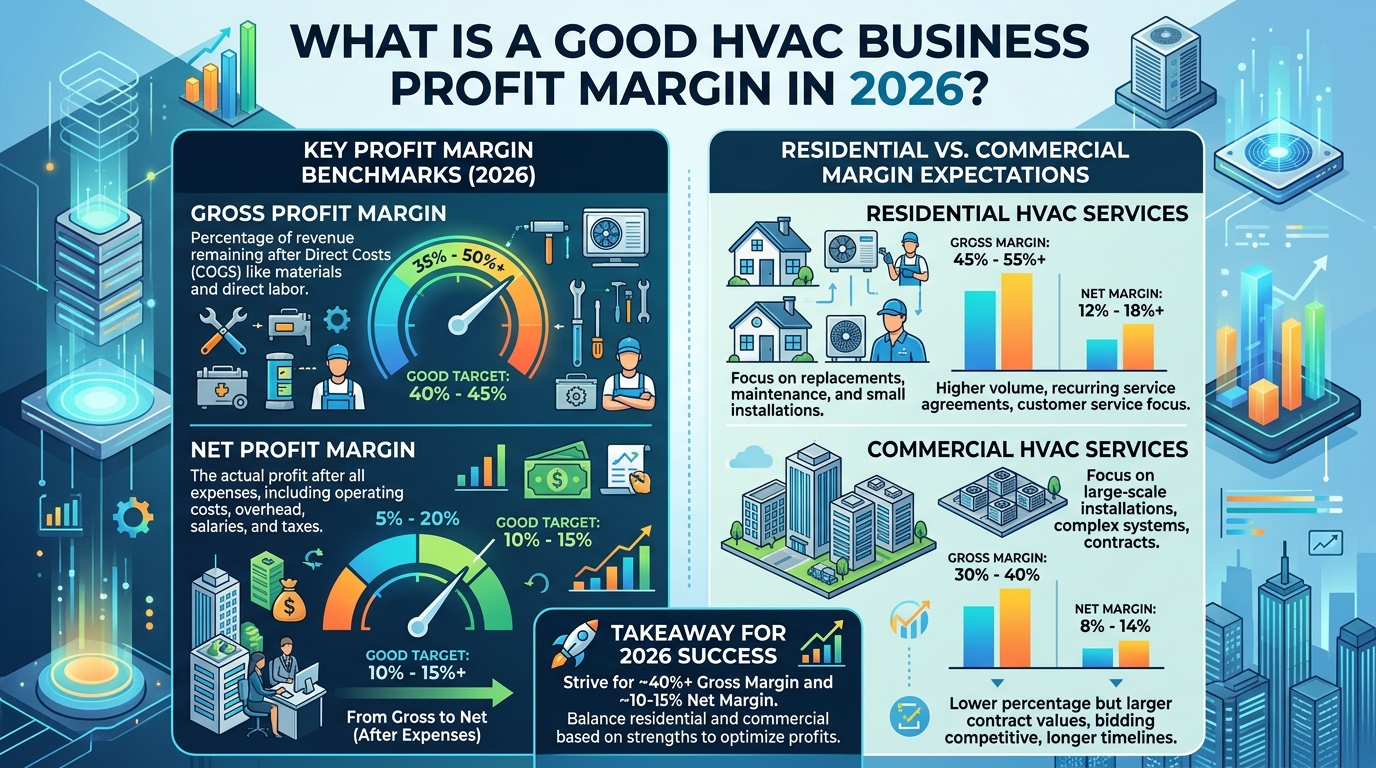
In the HVAC industry, gross profit margin is the revenue left after paying for direct job costs like labor and materials. For a sustainable business in 2026, your gross profit should sit between 45% and 55% to cover the rising costs of specialized tools and vehicle maintenance. If you charge $1,000 for a repair, your direct costs should not exceed $550, leaving $450 to cover your office rent, insurance, and marketing.
Net profit margin is the 'real' money left over after every single expense, including taxes and owner compensation, is paid. The industry average for net profit is often a slim 6% to 10%, but 'high-performance' contractors consistently hit 15% to 22%. Achieving these higher tiers usually requires a mix of high-margin service work and high-volume equipment replacements with optimized labor efficiency.
Understanding the difference between these two metrics is vital because a high gross margin can still result in a net loss if overhead is bloated. For example, a company with a 50% gross margin but an overhead cost of 45% of total revenue only nets 5% profit. Managing overhead—items like your $3,000/month shop lease or $15,000 annual liability insurance—is just as important as pricing the jobs correctly.
Residential vs. Commercial Margin Expectations
Residential HVAC services typically command higher percentage margins but lower total dollar amounts per job compared to commercial work. A residential blower motor replacement might have a 60% gross margin on a $600 ticket, while a commercial rooftop unit (RTU) replacement might only have a 25% margin on a $25,000 ticket. While the commercial percentage is lower, the $6,250 gross profit from one commercial job far exceeds the $360 from the residential call.
Commercial contracts often involve more competitive bidding processes and longer payment terms, sometimes extending to 60 or 90 days. This delay in cash flow requires a larger capital reserve, often necessitating a line of credit of $50,000 or more to cover payroll while waiting for payment. Residential work, conversely, is usually paid at the 'point of sale,' providing the immediate liquidity needed for daily operations.
Successful contractors often balance their portfolio with 70% residential for high margins and 30% commercial for steady volume and brand visibility. This diversification protects the HVAC business profit margin during economic downturns when homeowners might delay system upgrades but commercial buildings must maintain air quality standards. Monitoring the blended margin across both sectors ensures the business remains resilient year-round.
15-20%
Target Net Profit
Top-tier HVAC companies achieve this through efficiency and maintenance plans.
Key Takeaway: Aim for a 50% gross profit margin and a 15% net profit margin to ensure long-term business stability and growth.
how to hvac business profit margins: what to expect and how to improve them
Controlling Burdened Labor Costs
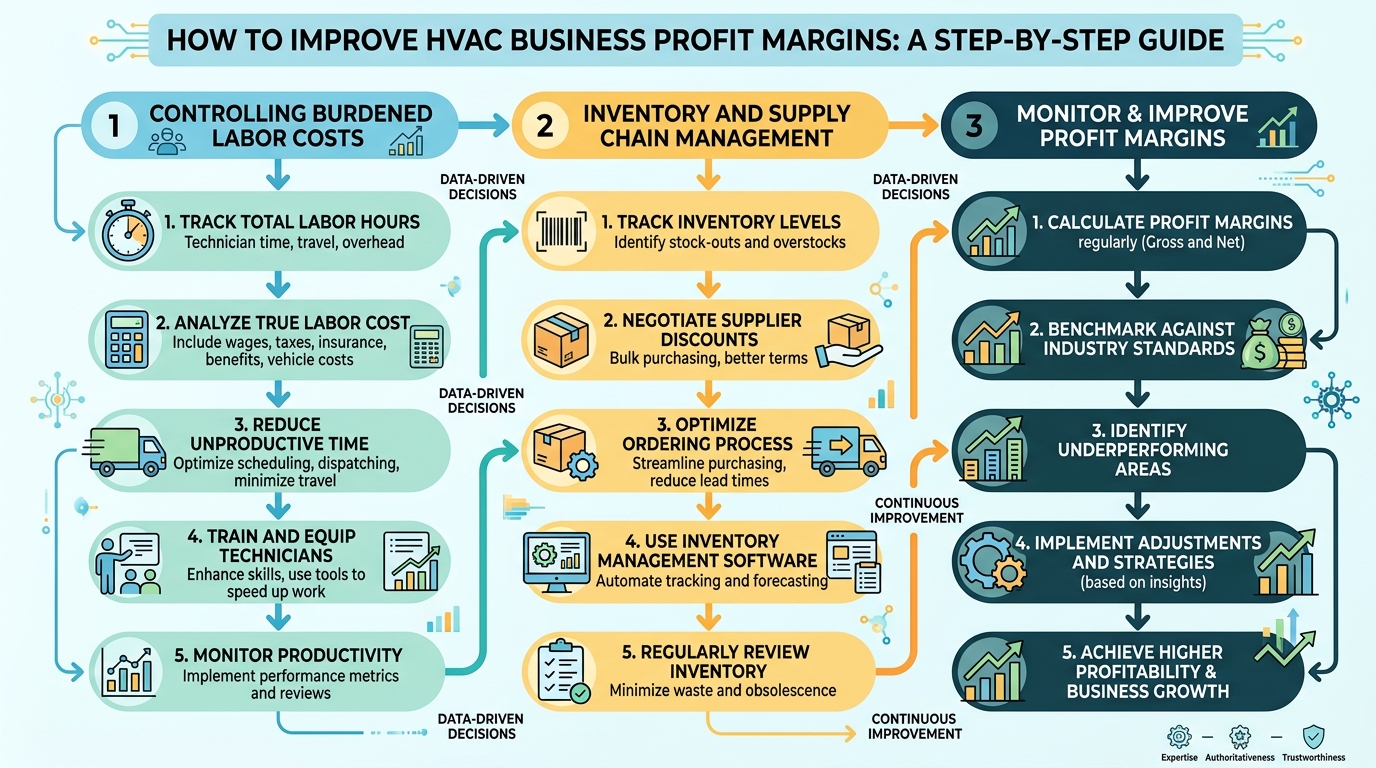
Labor is the most volatile expense in the HVAC industry, typically accounting for 25% to 35% of total revenue. To improve your HVAC business profit margin, you must calculate the 'burdened' rate, which includes the $30/hour base pay plus roughly $20/hour in taxes, insurance, and benefits. If a technician is only billing 25 hours in a 40-hour week, your effective labor cost per billable hour skyrockets, eating into your profits.
Reducing 'unapplied time'—time spent at the supply house, in traffic, or cleaning the shop—is the fastest way to improve labor efficiency. Implementing a 'warehouse runner' who delivers parts to job sites for $18/hour can keep a $50/hour lead technician on the tools and billing. This shift can increase a technician's billable efficiency from 65% to 85%, adding thousands in monthly revenue without hiring new staff.
Performance-based pay or 'piece-rate' systems can also align technician incentives with company profit goals. By paying a flat rate for specific tasks—like $150 for a furnace tune-up—technicians are encouraged to work efficiently while maintaining quality to avoid unpaid callbacks. This model can stabilize labor costs as a fixed percentage of the job price, making your profit margins much more predictable.
Inventory and Supply Chain Management
Shrinkage and disorganized inventory can drain 2% to 5% of your total revenue annually if not managed strictly. Carrying $20,000 in truck stock that isn't tracked leads to 'phantom' costs where parts are used but never invoiced to the customer. Using digital inventory tracking tied to your dispatch software ensures that every 410A refrigerant jug or contactor used is automatically added to the final bill.
Negotiating 'volume rebates' with suppliers like Johnstone Supply or Ferguson can provide an end-of-year profit boost of 1% to 3%. Even if your monthly spend is only $10,000, being a loyal customer can grant you access to better pricing and priority equipment availability during heatwaves. These small percentage gains on the 'buy' side flow directly to your net profit without requiring you to raise prices on customers.
Standardizing the equipment brands you install can also reduce training costs and the variety of spare parts you need to carry. If your fleet only services three major brands, your technicians become faster at diagnostics, reducing the time spent on each call by an average of 20 minutes. This specialization allows you to charge premium rates for expert knowledge while lowering the internal cost of providing that expertise.
Pro Tip: Use a warehouse runner to deliver parts to job sites so your lead techs stay billable for 8+ hours a day.
hvac business profit margins: what to expect and how to improve them guide
The Power of Flat-Rate Pricing Systems
Flat-rate pricing is the cornerstone of high-margin HVAC businesses because it removes the 'speed penalty' associated with hourly billing. In a T&M model, a fast, expert technician makes the company less money than a slow, inexperienced one. By charging a flat $450 for a capacitor replacement, you ensure a consistent margin regardless of how quickly the job is completed by your team.
This pricing model also improves customer satisfaction by providing a guaranteed price upfront, which eliminates the 'sticker shock' at the end of a long repair. Customers are generally willing to pay a 10-15% premium for the transparency and certainty of a flat-rate quote. This psychological shift allows you to bake in your overhead and desired profit without the customer questioning every 15-minute increment of labor.
To build a flat-rate book, take your burdened labor rate, add your average material cost, and apply a 50% gross margin multiplier. For example, if a job takes 2 hours ($140 labor) and $100 in parts, the total cost is $240. Dividing by 0.5 gives a flat-rate price of $480, which covers all overhead and leaves room for growth and equipment reinvestment.
Maximizing Average Ticket Value
Increasing your average ticket value by just $50 across 1,000 annual service calls adds $50,000 in pure profit to your bottom line. This is achieved through 'add-on sales' like Indoor Air Quality (IAQ) products, including UV lights or HEPA filters, which carry 60% margins. Training technicians to perform a full system health check rather than just fixing the immediate problem is the key to identifying these opportunities.
Presenting 'tiered' repair options—Repair, Restore, or Replace—gives the customer a choice and often leads them to select the middle or high-tier option. A $200 basic repair might be the 'Good' option, while a $600 'Restore' option includes a deep coil cleaning and a new surge protector. This strategy empowers the customer while naturally driving up the HVAC business profit margin through high-value service bundles.
Offering financing options for any repair over $1,000 can increase your closing rate on major components by 25% or more. Platforms like Synchrony or GreenSky allow homeowners to pay $50/month rather than $2,500 upfront, making high-margin upgrades more accessible. While there is a small merchant fee (typically 3-5%), the increase in total job volume and margin far outweighs the cost of the financing service.
Ready to put this into action?
Hulo gives you everything to run your hvac business — website, CRM, scheduling, and invoicing. Join the waitlist for V2.
Join the Waitlisthvac business profit margins: what to expect and how to improve them for beginners
Tracking Essential KPIs from Day One
New HVAC owners must track Key Performance Indicators (KPIs) like Customer Acquisition Cost (CAC) and Average Ticket Size to survive the first two years. If you spend $500 on Google Local Services Ads to get one $300 repair job, your HVAC business profit margin is negative before you even start the truck. Your target CAC should be no more than 10-15% of the total job value to remain profitable in the long term.
Another critical KPI for beginners is the 'Sales Closing Ratio,' which should ideally be above 35% for full system replacements and 75% for service repairs. If your closing ratio is 90%, your prices are likely too low; if it's 10%, you aren't communicating value effectively. Adjusting your pricing by 5-10% based on these ratios can have a dramatic impact on your monthly cash flow and overall business health.
Beginners often overlook the 'Break-Even Rate,' which is the minimum amount you must charge per hour just to keep the lights on. To find this, add your total monthly overhead (rent, software, insurance, truck payments) and divide it by the number of billable hours your team produces. If your overhead is $10,000 and you bill 100 hours, your break-even is $100/hour—meaning any price below that is a literal loss for the company.
Choosing the Right Business Management Software
In 2026, manual paper invoicing is a guaranteed way to lose 10% of your profit to errors and lost paperwork. Modern Field Service Management (FSM) software allows you to track every lead, quote, and invoice in a single dashboard, ensuring no revenue falls through the cracks. While high-end systems can cost $300/month per user, they often pay for themselves by increasing technician billable time by 15% through better scheduling.
For startups looking to keep overhead low, tools like Hulo provide a comprehensive suite of CRM, invoicing, and automated marketing tools for under $50/month. This lower entry price point allows beginners to maintain professional standards without the $3,600 annual price tag of more complex enterprise software. Lowering your software overhead directly increases your net HVAC business profit margin during the critical growth phase.
Effective software also facilitates 'instant' payments in the field, which is essential for maintaining a healthy cash flow. Accepting credit cards or ACH payments through a mobile app can reduce your collection time from weeks to seconds. While you will pay a processing fee of roughly 2.9%, the elimination of administrative time spent chasing checks and the immediate availability of funds is well worth the small cost.
| Expense Category | Percentage of Revenue |
|---|---|
| Direct Labor (Technicians) | 25% - 30% |
| Materials & Equipment | 20% - 25% |
| Marketing & Lead Gen | 5% - 10% |
| Rent & Utilities | 3% - 5% |
| Insurance & Licensing | 2% - 4% |
| Net Profit Goal | 15% - 20% |
Typical HVAC Operating Costs (2026 Estimates)
What Certifications Help Increase Your HVAC Business Profit Margin?
NATE and ACCA Certifications
North American Technician Excellence (NATE) certification is the industry gold standard that allows you to charge 15% to 20% more for your services. Customers view NATE-certified technicians as more reliable, which justifies a higher 'diagnostic fee' of $125-$150 compared to the $75 charged by uncertified competitors. Furthermore, NATE-certified techs have significantly lower callback rates, which directly preserves your profit margins on every job.
Membership in the Air Conditioning Contractors of America (ACCA) provides access to Manual J, S, and D standards for proper system sizing. Using these standards ensures that you aren't 'over-sizing' equipment, which can lead to premature system failure and expensive warranty claims. Properly sized systems run more efficiently, leading to happier customers who are more likely to refer your business, lowering your long-term marketing costs.
Certifications also open the door to high-margin commercial contracts and government work that require specific credentials. These projects often have 'prevailing wage' requirements but offer much higher total contract values and predictable profit spreads. Investing $500-$1,000 per technician in ongoing training can yield a 10x return in higher billable rates and improved technical efficiency within the first year.
EPA 608 and Specialized Refrigerant Training
As the industry transitions to A2L refrigerants like R-454B in 2026, specialized training becomes a major competitive advantage. Technicians who are fully trained in the safe handling and brazing of these mildly flammable refrigerants can command a premium in the market. Being the 'expert' in your local area for new 2026-compliant systems allows you to maintain high margins while competitors struggle with the learning curve.
Proper EPA 608 compliance is not just a legal requirement; it's a profit protection strategy. Fines for improper refrigerant venting can reach $50,000 per day, which can instantly bankrupt a small HVAC business. Implementing strict refrigerant tracking and recovery protocols ensures that you stay compliant while also allowing you to resell recovered refrigerant to reclaimers for a small additional revenue stream.
Advanced certifications in 'Whole Home Performance' or energy auditing allow you to sell comprehensive solutions rather than just 'box swaps.' An energy audit that leads to duct sealing, insulation, and a high-SEER2 heat pump install can turn a $8,000 job into a $20,000 project. These high-ticket, high-complexity jobs are less price-sensitive, allowing for a much healthier HVAC business profit margin of 20% or more.
Key Takeaway: Certifications like NATE and EPA 608 are not just badges; they are tools that allow you to bill higher rates and reduce costly installation errors.
Wrapping Up
Increasing your HVAC business profit margin requires a disciplined approach to labor management, pricing, and overhead control. By implementing flat-rate pricing and maintenance agreements, you can stabilize your cash flow and reach the 15-20% net profit benchmark. Start by auditing your burdened labor rate today and leverage automation to keep your administrative costs low.
Frequently Asked Questions
What is the average profit margin for an HVAC business?
The average HVAC business profit margin is typically between 6% and 10% for net profit, while gross margins hover around 45% to 55%. High-performance companies that utilize flat-rate pricing and maintenance agreements can see net profits reach 15% to 20%. Success in 2026 depends heavily on controlling labor costs and maximizing route density to reduce overhead.
How much does a typical HVAC service call cost in 2026?
In 2026, a standard HVAC diagnostic service call typically ranges from $99 to $189, depending on the region and time of day. This fee generally covers the technician's travel and the first 30-60 minutes of troubleshooting. Many contractors offer to waive this fee if the customer agrees to a repair of $500 or more, which helps improve the sales closing ratio.
What is the difference between gross profit and net profit for HVAC?
Gross profit is the revenue remaining after subtracting direct costs like labor and materials used for a specific job. Net profit is what remains after subtracting all other business expenses, including rent, insurance, office staff salaries, and taxes. A company can have a high gross profit of 50% but still have a negative net profit if its overhead costs are not managed properly.
Do I need NATE certification to have a profitable HVAC business?
While not legally required to operate, NATE certification significantly improves profitability by allowing you to charge higher rates and reducing the rate of unpaid callbacks. Certified technicians are often 20% more efficient and make fewer installation errors, which protects your gross margins. Many manufacturers also require NATE certification for technicians to maintain high-tier dealer status and access better equipment pricing.
How long does a full HVAC system installation take?
A standard residential split-system installation typically takes two technicians between 6 and 10 hours to complete. Complex jobs involving ductwork modification or high-efficiency heat pump transitions can take 2 to 3 days. To maintain a healthy profit margin, contractors should aim for a 'one-day install' whenever possible to minimize labor overruns and travel time.
How do I get paid faster as an HVAC contractor?
To improve cash flow, you should implement mobile payment processing that allows technicians to collect credit card or ACH payments immediately upon job completion. Using software like Hulo to send automated text-to-pay links can reduce your average collection time from 30 days to less than 24 hours. Offering a 2% discount for 'payment at time of service' is another effective way to ensure immediate liquidity.
Is HVAC software worth the cost for a small business?
Yes, HVAC software is essential for scaling because it automates scheduling, invoicing, and customer follow-ups that would otherwise require a full-time employee. For a small business, a tool like Hulo costs less than $50/month, which is significantly cheaper than the $30,000+ salary of an office administrator. This automation directly lowers your overhead-to-revenue ratio, increasing your net profit margin.
How much profit should I make on a furnace replacement?
For a standard furnace replacement, you should aim for a gross profit of $1,500 to $3,500 per unit. This range accounts for the equipment cost (typically $1,200-$2,500), labor ($600-$1,200), and miscellaneous materials ($200-$400). To reach the higher end of this profit range, focus on selling high-efficiency SEER2-rated units that qualify for federal tax credits, making the higher price more palatable for homeowners.
Ready to Maximize Your HVAC Profits?
Stop wasting hours on manual invoicing and expensive software. Hulo provides all the tools you need to run a high-margin HVAC business for under $50/month.
Join the WaitlistMore from the Blog
7 Smart Ways to Evaluate Housecall Pro vs Jobber for HVAC Contractors (2026)
Housecall Pro is generally the superior choice for HVAC businesses focusing on advanced sales automation and detailed pe...
11 Expert Facts on How Much Do HVAC Technicians Make for Contractors (2026)
HVAC technicians in 2026 earn an average annual salary of $58,420 to $74,150, with hourly rates typically ranging from $...
11 Smart Ways How to Bid HVAC Jobs for Contractors (2026 Guide)
To bid HVAC jobs accurately, you must first calculate your total overhead, burdened labor rate, and desired profit margi...