11 Expert Ways to Get Roofing Leads Without Door Knocking for Contractors (2026)
11 min read·Updated April 4, 2026To get roofing leads without door knocking, you must implement a multi-channel digital strategy focusing on Google Local Services Ads (LSAs), search engine optimization (SEO), and automated lead nurturing. Most successful roofing companies in 2026 generate 85% of their revenue through high-intent digital channels, completely bypassing the physical labor and high rejection rates of traditional canvassing. In this guide, you will learn the exact 11-step framework to build a digital lead engine that delivers a consistent 5x-10x return on ad spend (ROAS).
Table of Contents
Step-by-Step Overview
- 1
Launch Google Local Services Ads (LSA)
Apply for the Google Guaranteed badge by submitting your roofing license and $1M-$2M general liability insurance documents. This process typically takes 2-4 weeks for verification through Checkr. Once active, you only pay for valid phone calls, which usually range from $25 to $85 per lead depending on your local market competition in 2026.
- 2
Optimize Your Google Business Profile
Complete 100% of your profile, including specific service areas and a detailed list of roofing types like asphalt shingles, metal roofing, and TPO. Upload at least 5 high-resolution project photos weekly and aim for a minimum of 50 reviews with a 4.7-star average. This foundational SEO step can drive 20-30 free leads per month without any direct ad spend.
- 3
Build a Conversion-Focused Landing Page
Create a dedicated page for 'Roof Replacement' and 'Storm Damage Repair' with a clear Click-to-Call button and a 15-second lead form. Ensure your page loads in under 2.5 seconds to meet Core Web Vitals standards, as slow pages lose 40% of mobile traffic. Include trust signals like your National Roofing Contractors Association (NRCA) membership and GAF Master Elite certifications.
- 4
Deploy Automated Review Collection
Use a tool like Hulo to send automated SMS review requests immediately after a job is marked complete in your CRM. Statistics show that contractors who request reviews within 1 hour of job completion see a 35% higher response rate than those who wait 24 hours. Consistent 5-star feedback is the primary ranking factor for the Google Map Pack in 2026.
- 5
Target High-Intent Keywords via PPC
Bid on 'roofing contractor near me' and 'emergency roof repair' using Google Ads with a daily budget of at least $50. Use negative keywords like 'roofing jobs' or 'DIY roof repair' to avoid wasting budget on non-leads. A well-managed PPC campaign should yield a 15-25% conversion rate from click to lead for established roofing businesses.
- 6
Implement a Lead Nurturing CRM
Connect your website forms to a CRM like Hulo to ensure every lead receives an automated text message within 60 seconds. Speed to lead is critical; responding within 5 minutes increases your chances of qualifying the lead by 900%. Automated sequences should follow up at least 5-7 times over the first 14 days to maximize your booking rate.
How much does it cost to get roofing leads without door knocking?
Understanding Lead Costs Across Digital Channels
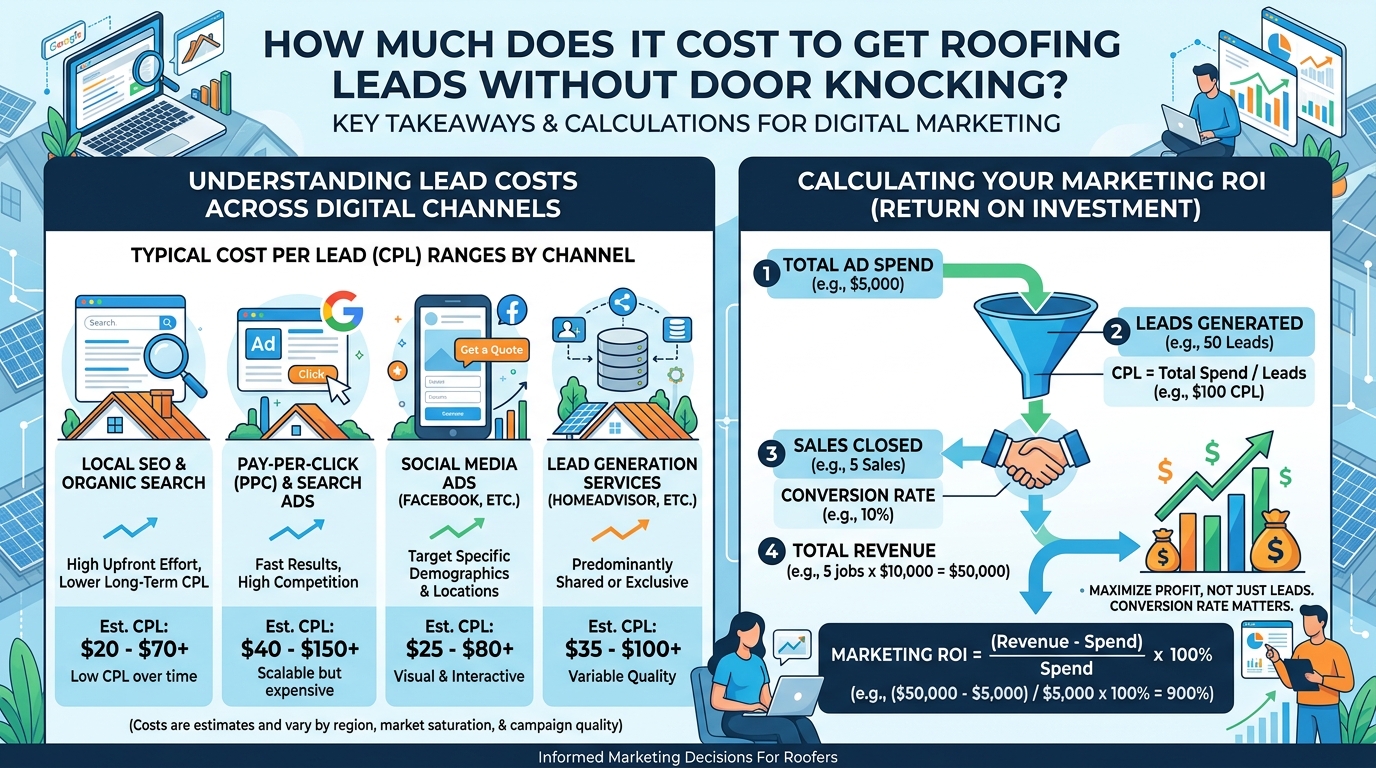
In 2026, the average cost per lead (CPL) for roofing contractors varies significantly based on the platform and intent level. Google Local Services Ads (LSAs) remain the most cost-effective high-intent channel, with prices ranging from $30 to $110 per verified lead in major metropolitan areas. For contractors focused on high-margin commercial projects, the CPL can climb to $250, but the average job size of $25,000+ justifies the investment.
Search Engine Optimization (SEO) typically requires a monthly retainer of $1,500 to $5,000, but it produces the lowest long-term CPL, often dropping below $15 after 12 months of consistent ranking. Organic leads from the Google Map Pack are essentially free once the initial optimization work is completed. Most companies spending $3,000 monthly on SEO see a return of 20-40 qualified leads per month by the end of their first year.
Pay-Per-Click (PPC) ads on Google and Bing offer immediate volume but require a minimum monthly ad spend of $2,500 to compete effectively. You can expect a cost-per-click (CPC) between $15 and $45 for competitive keywords like 'shingle replacement' or 'metal roofing installers.' When managed correctly, these campaigns should convert at a rate of 10-15%, resulting in a lead cost of approximately $100 to $200 per inquiry.
Calculating Your Marketing ROI
To determine if your digital marketing is successful, you must track your Customer Acquisition Cost (CAC) against your Average Job Value (AJV). If your AJV for a roof replacement is $12,000 and your CAC is $600, your marketing cost is only 5% of the total revenue. This is significantly more efficient than door knocking, which often carries hidden costs in fuel, hourly labor for canvassers, and high employee turnover.
Successful roofing firms target a 5:1 or 10:1 Return on Ad Spend (ROAS) to ensure long-term profitability and growth. For every $1,000 spent on digital ads, you should aim to generate at least $5,000 to $10,000 in closed contracts. Tracking these metrics requires a robust CRM that attributes every closed job back to its original lead source, whether that was a Facebook ad or a Google search.
Budgeting for 2026 should involve allocating 7-12% of your total revenue toward marketing if you are in a growth phase. If you are a solo contractor looking to stay busy, a smaller budget of $1,000-$1,500 per month focused strictly on LSAs may be sufficient. Larger firms with multiple crews often spend $10,000+ monthly to maintain a consistent backlog of 4-6 weeks.
85%
Digital Lead Share
Percentage of top-performing roofing companies' revenue sourced from digital channels in 2026.
Key Takeaway: Digital lead generation in 2026 typically costs between $30 and $150 per lead, which is 40% more efficient than the labor costs associated with manual door knocking.
How to get roofing leads without door knocking: digital marketing guide for beginners
Setting Up Your Digital Foundation
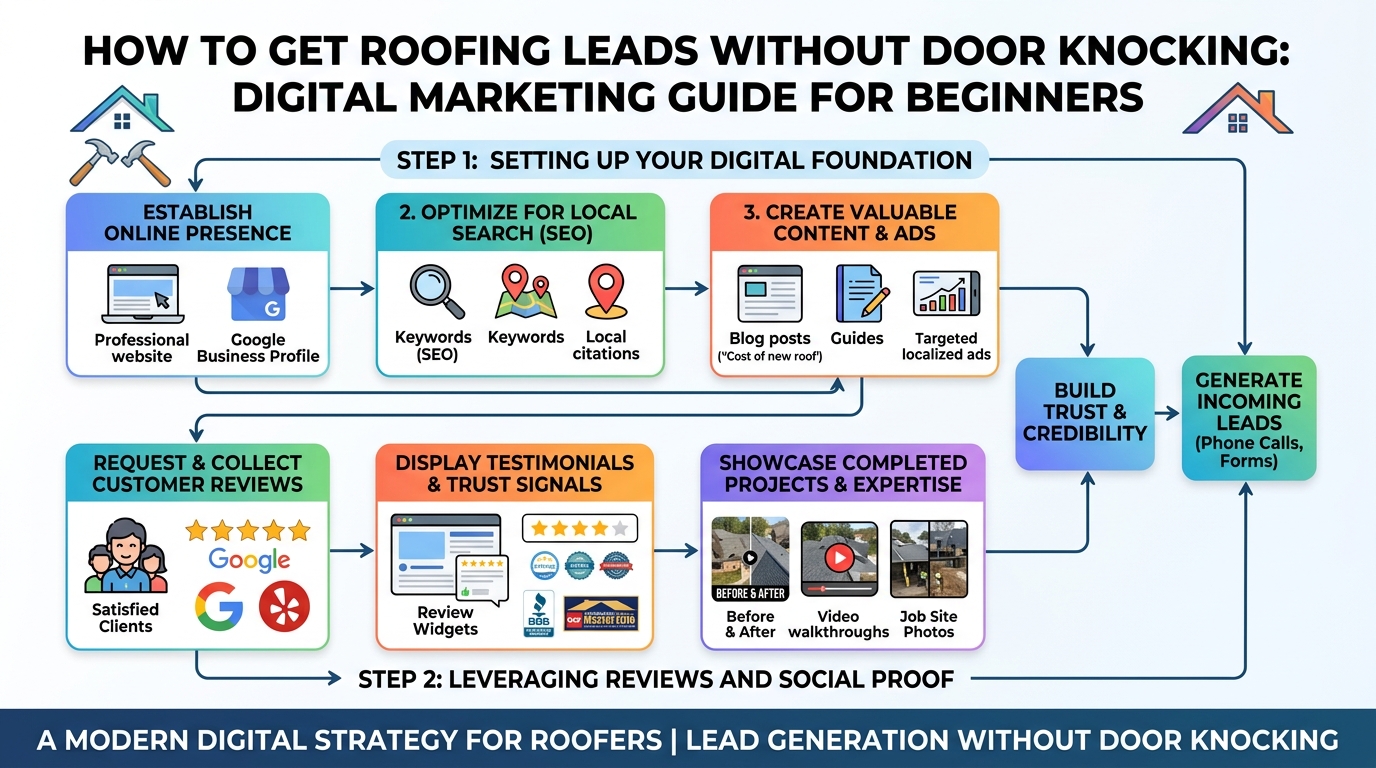
For beginners, the first step to getting roofing leads without door knocking is claiming and verifying your Google Business Profile (GBP). Ensure your business name, address, and phone number (NAP) are consistent across all platforms, including Yelp, Angi, and the Better Business Bureau (BBB). This consistency tells Google's algorithm that your business is a legitimate entity, which improves your local search rankings significantly within 30-60 days.
Next, invest in a simple, high-speed website that is optimized for mobile users, as 70% of roofing searches occur on smartphones. Your site must include an SSL certificate for security and clear calls-to-action (CTAs) like 'Get a Free Estimate' or 'Schedule Your Roof Inspection.' Avoid using generic stock photos; instead, use real images of your crew, your branded trucks, and completed projects in local neighborhoods.
Beginners should also join local Facebook groups and Nextdoor communities to build a reputation through helpful advice rather than direct selling. When a neighbor asks for a roofer recommendation, having past clients tag your business profile provides social proof that no door-to-door sales pitch can match. This 'community-led' growth strategy is free and often results in the highest-closing leads for new roofing companies.
Leveraging Reviews and Social Proof
Reviews are the currency of the digital age for roofing contractors, especially for those who don't want to knock on doors. Aim for at least 20 reviews in your first three months of operation by asking every single customer for feedback. Statistics show that homeowners are 63% more likely to trust a contractor with at least 10 recent reviews (posted within the last 3 months) than one with a high rating but old feedback.
Use video testimonials to stand out from competitors who only have text-based reviews on their website. A 30-second clip of a satisfied homeowner standing in front of their new roof provides immense credibility and helps close leads faster. Platforms like Hulo can help you organize these assets and automatically push them to your social media channels to maintain a consistent online presence.
Don't ignore negative reviews; respond to them professionally within 24 hours to show potential leads that you stand behind your work. A thoughtful response to a 1-star review can actually increase trust, as 82% of consumers specifically seek out negative reviews to see how a company handles conflict. Address the specific issue, offer a resolution, and move the conversation offline to a phone call or email.
Pro Tip: Offer a $25 Amazon gift card or a small discount on future gutter cleanings to customers who provide a video testimonial—it's the highest-converting marketing asset you can own.
How to get roofing leads without door knocking: digital marketing guide tips for SEO
Mastering Local Keyword Strategy
To rank on page one of Google, you must target 'long-tail' keywords that reflect specific homeowner problems, such as 'how to fix a leaking roof from the inside' or 'hail damage roof insurance claim help.' These keywords have lower competition than generic terms like 'roofer' and attract users who are actively looking for a solution. By providing educational content, you position your roofing company as the expert authority before they even ask for a quote.
Create dedicated service area pages for every city or major suburb you serve within a 30-mile radius. Each page should feature unique content, local landmarks, and mentions of specific neighborhood projects to avoid 'duplicate content' penalties from Google. For example, a page titled 'Roofing Services in [City Name]' should mention local building codes and common weather patterns specific to that region.
Incorporate technical roofing terms that signal expertise to both users and search engines, such as 'flashing repair,' 'underlayment installation,' and 'ridge vent ventilation.' Mentioning specific brands like GAF, Owens Corning, or CertainTeed helps you rank for 'brand + installer' searches. This strategy is particularly effective for attracting high-end homeowners who have already researched the materials they want for their home.
Building Authority with Backlinks
Backlinks—links from other websites to yours—are a top-three ranking factor for roofing SEO in 2026. Seek out links from local chambers of commerce, trade organizations like the National Roofing Contractors Association (NRCA), and local news outlets. A single link from a high-authority site like a local news station can boost your rankings more than 100 low-quality directory links.
Guest posting on home improvement blogs or real estate websites is another powerful way to build your digital authority. Share your expertise on topics like 'How a new roof increases home value' or 'Signs your roof won't survive the next winter.' These articles should link back to your service pages, driving both direct referral traffic and improving your overall domain authority (DA).
Participating in local community events and getting mentioned on their websites also provides valuable 'local' backlinks. Sponsoring a Little League team or a local charity 5K usually earns you a link from their 'Sponsors' page. These links signal to Google that your business is a pillar of the local community, which is a key metric for ranking in the Map Pack.
| Keyword Type | Avg. CPC | Competition | Conversion Rate |
|---|---|---|---|
| Generic (e.g., Roofer) | $45.00 | High | 3-5% |
| Service-Specific (e.g., Roof Repair) | $28.00 | Medium | 12-15% |
| Long-Tail (e.g., Hail damage roofer near me) | $18.00 | Low | 22-28% |
Roofing Keyword Performance Comparison (2026)
Key Takeaway: Long-tail SEO focusing on specific roofing problems and local service areas can reduce your lead acquisition costs by up to 70% compared to paid ads.
Ready to put this into action?
Hulo gives you everything to run your roofing business — website, CRM, scheduling, and invoicing. Join the waitlist for V2.
Join the WaitlistHow to get roofing leads without door knocking: digital marketing guide 2026 automation
Implementing Speed to Lead Technology
In 2026, the 'speed to lead' is the single most important factor in closing roofing jobs without door knocking. If you don't contact a lead within the first 5 minutes of their inquiry, your chances of reaching them drop by over 400%. Using automated tools like Hulo allows you to set up an 'Instant Text Back' feature that engages the homeowner the second they submit a form on your website.
Automation isn't just about the first contact; it's about the entire follow-up sequence over the first 30 days. Most roofing leads require 5 to 7 touchpoints before they book an inspection, yet 70% of contractors stop following up after the second attempt. An automated CRM ensures that no lead falls through the cracks, sending periodic emails and texts with helpful tips or seasonal discounts.
Integrate your CRM with your calendar to allow homeowners to book their own roof inspections directly from your website or Facebook page. This removes the friction of back-and-forth phone calls and secures the lead before they have a chance to call your competitors. Modern roofing software can even send automated appointment reminders to reduce no-show rates by up to 50%.
AI-Driven Lead Qualification
AI chatbots are now capable of qualifying roofing leads by asking about roof age, material type, and leak severity before a human ever steps in. This saves your office staff hours of time every week by filtering out 'tire kickers' who are just looking for a ballpark price and aren't ready to buy. These bots can live on your website and operate 24/7, capturing leads even while your team is asleep.
Predictive analytics in 2026 can help you identify neighborhoods that are 'ripe' for roof replacements based on historical weather data and home age. By integrating this data into your CRM, you can send automated, personalized direct mail or digital ads to specific zip codes after a hail storm. This 'digital canvassing' is far more precise and less intrusive than traditional door knocking.
Using a platform like Hulo, you can consolidate all your communication—from Facebook Messenger, Google Business messages, and website forms—into a single inbox. This prevents the 'fragmented lead' problem where inquiries are lost because they were sent to a personal cell phone or an unmonitored social account. Centralized communication ensures a professional experience that builds trust with high-value clients.
900%
Increase in Lead Conversion
The improvement in conversion rates when responding to a lead within 5 minutes versus 30 minutes.
What certifications do you need to improve digital conversion for roofing?
Manufacturer Certifications as Trust Signals
Displaying manufacturer certifications like GAF Master Elite, Owens Corning Platinum Preferred, or CertainTeed Select ShingleMaster on your website can increase conversion rates by 20-30%. These badges signal to homeowners that you have undergone rigorous training and can offer enhanced warranties that non-certified contractors cannot. In the digital world, these icons act as 'trust shortcuts' that help users make quick decisions.
To qualify for GAF Master Elite status, for example, you must have been in business for at least 7 years, carry $1M+ in liability insurance, and maintain a high rating with the BBB. Highlighting these requirements on your 'About Us' page helps justify your pricing to potential leads who might be comparing you to cheaper, uncertified competitors. It transforms your business from a 'roofer' into a 'certified installation specialist.'
These certifications also help you rank for specific brand-related searches in your area. Many manufacturers have their own 'Find a Contractor' directories that link back to your website, providing high-authority backlinks that boost your SEO. Being listed as a top-tier installer on the Owens Corning website, for instance, provides a steady stream of pre-qualified leads who are already sold on the product.
Industry Associations and Licensing
Membership in the National Roofing Contractors Association (NRCA) is a powerful entity signal for both Google and your potential customers. The NRCA provides educational resources and safety standards that demonstrate your commitment to professional excellence. Mentioning your NRCA membership in your website footer and on your social media profiles builds instant credibility with commercial property managers and high-end residential clients.
Always feature your state-specific roofing license number prominently on every page of your website. In states like Florida or California, where roofing regulations are strict, failing to display a license number can lead to fines and immediate distrust from savvy homeowners. Providing a direct link to the state licensing board where they can verify your standing is a 'pro move' that separates you from 'storm chasers.'
Don't overlook safety certifications like OSHA 10 or OSHA 30 for your crew members. In 2026, safety-conscious homeowners are increasingly looking for contractors who prioritize the well-being of their workers. Mentioning your 'Safety First' approach and your zero-accident record can be the deciding factor for a client choosing between two similarly priced estimates.
Pro Tip: Create a 'Trust Center' page on your website that hosts PDF copies of your current insurance certificates, licenses, and manufacturer badges for easy download by potential clients.
Wrapping Up
Transitioning from door knocking to digital lead generation is the only way to build a scalable, predictable roofing business in 2026. By combining Google LSAs, localized SEO, and automated follow-up systems, you can ensure your crews stay busy year-round without ever bothering a homeowner at their front door. Start by optimizing your Google Business Profile today and watch your inbound lead volume transform your bottom line.
Frequently Asked Questions
How much does a roofing lead cost in 2026?
In 2026, roofing lead costs typically range from $25 to $85 for Google Local Services Ads and $100 to $250 for high-intent PPC keywords. Organic SEO leads have the lowest long-term cost, often averaging under $15 per lead after the initial optimization period of 6-12 months. Factors like your location, the type of roofing service, and local competition heavily influence these prices.
What is the difference between Google Ads and Google Local Services Ads?
Google Ads (PPC) uses a pay-per-click model where you bid on keywords and pay every time someone clicks your ad, regardless of whether they call you. Google Local Services Ads (LSA) uses a pay-per-lead model where you only pay when a customer calls or messages you directly through the ad. LSAs appear at the very top of search results and feature the 'Google Guaranteed' badge, which generally results in higher trust and conversion rates.
Do I need a special license to run roofing ads?
While you don't need a specific 'advertising license,' Google requires you to pass a background check and provide proof of your state roofing license to qualify for Local Services Ads. This verification process, managed by third parties like Checkr, ensures that only legitimate, insured contractors can use the Google Guaranteed badge. Failing to maintain your license or insurance will result in your ads being paused immediately.
How long does it take to see results from roofing SEO?
Roofing SEO is a long-term strategy that typically takes 3 to 6 months to show initial ranking improvements and 9 to 12 months to generate a consistent volume of leads. However, once you achieve top rankings for keywords like 'roof replacement [city],' you will receive a steady stream of leads without paying for every click. This makes SEO the most sustainable and profitable lead generation method for established roofing companies.
What certifications do I need for Roofing lead generation?
The most impactful certifications for lead generation are manufacturer-specific badges like GAF Master Elite or Owens Corning Platinum Preferred, which provide social proof and allow you to offer better warranties. Additionally, membership in the National Roofing Contractors Association (NRCA) and a high rating with the Better Business Bureau (BBB) are essential trust signals. These certifications help you convert website visitors into actual leads by proving your expertise and reliability.
How do I get paid faster as a Roofing contractor?
To get paid faster, implement digital invoicing and mobile payment processing through a platform like Hulo. Allowing customers to pay via credit card or ACH immediately upon job completion can reduce your Days Sales Outstanding (DSO) by 50-70%. Automated payment reminders and offering financing options through partners like Hearth or GreenSky also help homeowners pull the trigger on expensive roof replacements more quickly.
Is Nextdoor worth it for small roofing businesses?
Yes, Nextdoor is highly effective for small roofing businesses because it targets homeowners in specific neighborhoods where you are already working. Setting up a 'Business Page' and running 'Local Deals' can generate high-quality leads for as little as $2-$5 per day. Since neighbors frequently ask for roofer recommendations on the platform, having a presence there allows you to benefit from organic word-of-mouth marketing digitally.
How many reviews do I need to rank on Google Maps?
In 2026, you generally need at least 50 reviews with an average rating of 4.7 stars or higher to compete in the top 3 spots of the Google Map Pack. However, the 'recency' of reviews is just as important as the quantity; aim to get at least 2-3 new reviews every week to stay relevant. Google's algorithm prioritizes businesses that show consistent, recent customer satisfaction over those with hundreds of old reviews.
Stop Knocking Doors and Start Closing Deals
Hulo helps roofing contractors automate their lead follow-up, collect 5-star reviews, and manage their entire business from one simple app for less than $50/mo.
Join the WaitlistMore from the Blog
7 Smart Steps to How to Estimate a Roofing Job for Contractors (2026 Guide)
To estimate a roofing job, you must calculate the total square footage of the roof and divide by 100 to determine the nu...
How to Get Roofing Leads: 15 Proven Strategies for 2026
The roofing industry in 2026 is a $56.7 billion market, yet many contractors struggle to maintain a consistent pipeline ...
How to Start a Roofing Company: Complete Business Guide (2026)
The roofing industry in 2026 is projected to exceed $56 billion in annual revenue, driven by a combination of aging infr...