9 Actionable Roofing Business Plan Steps for Contractors (2026)
11 min read·Updated March 26, 2026A roofing business plan is a strategic roadmap that outlines your company's financial goals, operational workflows, and marketing tactics for the upcoming three to five years. For contractors starting in 2026, a professional plan must detail your niche—such as residential asphalt or commercial TPO—and provide a clear path to achieving 20% to 40% net profit margins. Without a documented plan, most solo operators fail within their first 24 months due to mismanaged cash flow and high customer acquisition costs. This guide provides the exact templates and data points you need to build a resilient roofing business from the ground up.
Table of Contents
Step-by-Step Overview
- 1
Conduct Local Market Research
Spend 10-14 days analyzing your local competitors and permit data. Use tools like Google Maps and local building department records to identify the top 5 roofers in your zip code. Document their average pricing—typically $400 to $600 per square for architectural shingles—and identify underserved neighborhoods. This research ensures you don't enter a saturated market without a unique value proposition, such as 24-hour emergency leak repair.
- 2
Define Your Service Niche
Decide if you will focus on high-volume residential asphalt, high-margin standing seam metal, or commercial flat roofing. Residential asphalt requires less specialized equipment but has tighter margins of 15-25%. Metal roofing requires a $5,000+ investment in specialized benders and tools but can command $1,200+ per square. Clearly defining this in your plan dictates your equipment budget and hiring needs for the first 12 months.
- 3
Register Your Legal Entity
File for an LLC or S-Corp through your Secretary of State, which usually costs $50 to $500 depending on your location. Obtain an EIN from the IRS for tax purposes and set up a dedicated business bank account with at least $2,000 in initial capital. This separation of personal and business assets is critical for protecting your home and savings from potential job site liability or debt.
- 4
Calculate Your Startup Costs
Create a detailed spreadsheet of essential expenses including a reliable used truck ($10,000), basic hand tools ($1,500), and safety gear ($800). Don't forget General Liability insurance, which typically costs $1,200 to $3,500 annually for a new roofing business. Factoring in these costs early prevents the common mistake of running out of cash before your first three contracts are signed and paid in full.
- 5
Develop a Marketing Strategy
Allocate $500 to $1,500 per month for lead generation and brand building. Your plan should include a professional website, Google Business Profile optimization, and physical yard signs which cost about $15 each. In 2026, focus on digital reviews; a 4.8-star rating is often the difference between a $15,000 roof sale and a missed opportunity. Track your Cost Per Lead (CPL) to keep it under $100.
- 6
Select Your Software Stack
Choose an all-in-one platform like Hulo to manage your estimates, scheduling, and invoicing for under $50 per month. Avoid complex enterprise software that costs $300+ monthly when you only have 1-3 employees. Having a system that sends automated text reminders to homeowners can reduce no-shows by 40% and help you get paid via credit card or ACH immediately upon project completion.
How do you write a roofing business plan for beginners?
The Executive Summary and Vision
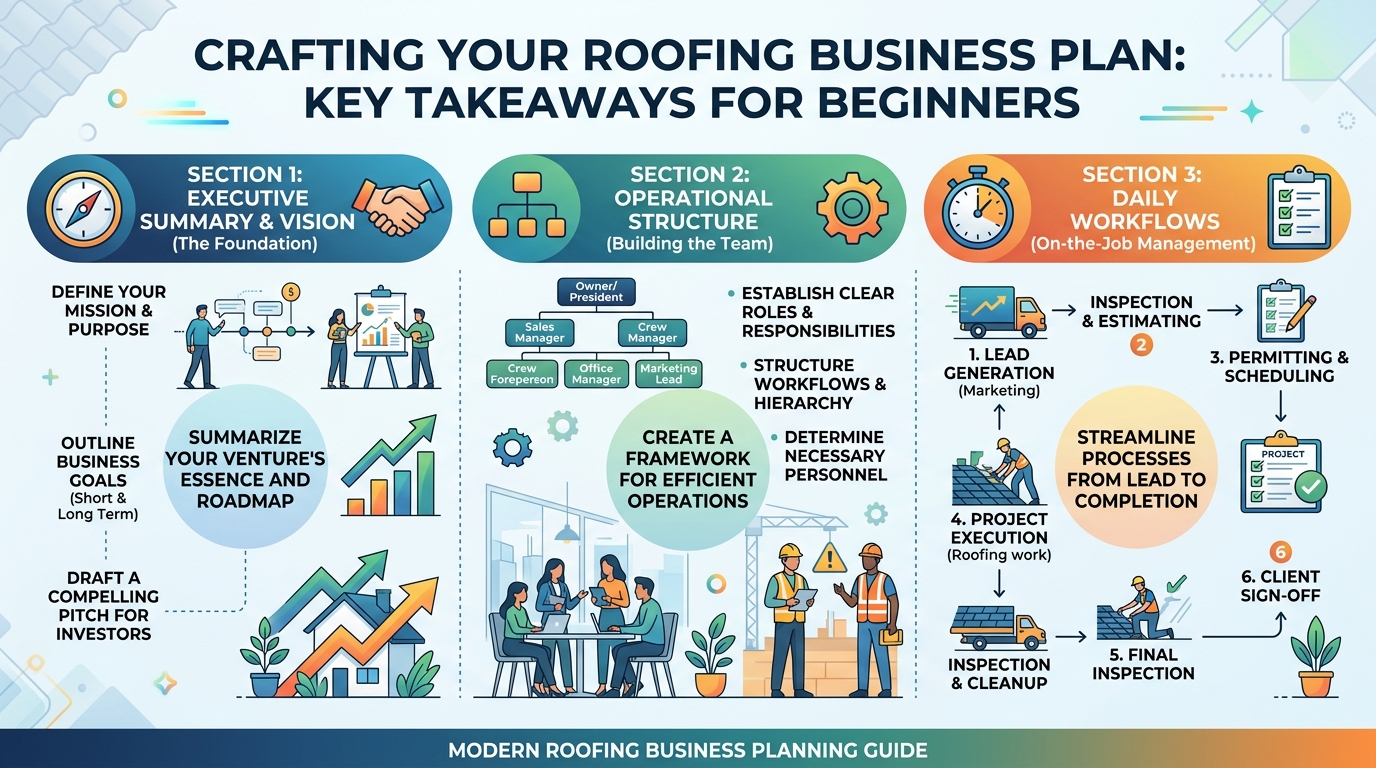
Your executive summary is the first page of your roofing business plan, but you should write it last. It must clearly state your company's mission, such as 'Providing 50-year warranted roofing solutions to the Greater Houston area,' and your 12-month revenue goal. For most solo contractors, a realistic first-year goal is $250,000 to $400,000 in gross sales, assuming an average job size of $12,500.
Include a brief bio of your experience, mentioning any certifications from the National Roofing Contractors Association (NRCA) or manufacturer-specific training from GAF or Owens Corning. Lenders look for at least 3-5 years of field experience before they will consider a business loan. Mentioning these specific credentials builds immediate trust with potential partners and investors who read your plan.
Finally, define your target customer persona in this section to guide your sales efforts. Are you targeting middle-class homeowners needing insurance-funded storm repairs, or luxury homeowners looking for aesthetic upgrades like slate or tile? In 2026, focusing on a specific demographic allows you to tailor your messaging and achieve a higher closing rate on your estimates.
Operational Structure and Daily Workflows
The operational section of your plan must detail how a job moves from a phone call to a finished roof. Specify who handles the initial inspection, who writes the estimate using software like Hulo, and who manages the crew on-site. For a 1-5 person crew, the owner often plays all three roles initially, but your plan should show a transition strategy for when you hit $500k in revenue.
Detail your material procurement process, including your primary suppliers like ABC Supply or Beacon Building Products. Establish a 'Terms' account with these suppliers to allow for 30-day payment windows, which helps maintain positive cash flow during large projects. Most roofing suppliers require a credit application and a history of on-time payments before granting limits over $10,000.
Safety protocols are a non-negotiable part of your operations in 2026, especially with OSHA 10 and 30 requirements becoming more strictly enforced. Your plan should outline weekly safety meetings and the use of fall protection systems like the Guardian Fall Protection kits, which cost roughly $150 per worker. Documenting these steps in your plan can actually lower your workers' compensation insurance premiums by 5-10%.
Key Takeaway: A beginner's business plan should focus on a narrow niche and a clear 12-month revenue target to ensure operational focus.
What are the startup costs in a roofing business plan guide?
Direct Equipment and Vehicle Expenses
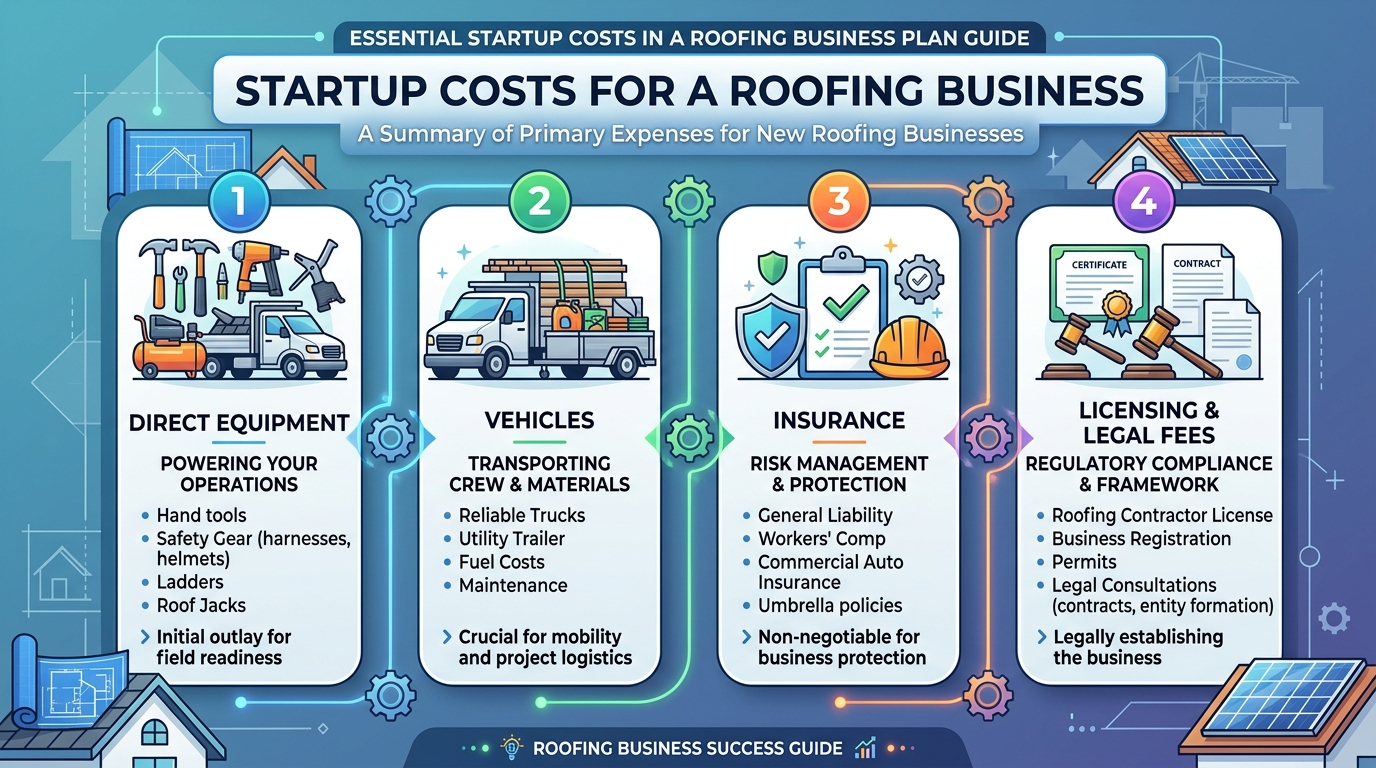
Starting a roofing business requires a significant upfront investment in hardware, but you can save money by purchasing used equipment. A reliable heavy-duty truck, such as a Ford F-250 or Chevy Silverado 2500, is essential for hauling trailers and materials and will cost between $12,000 and $25,000 for a used model with under 150,000 miles. Don't forget to budget $500 for professional vehicle wraps or magnets to turn your truck into a mobile billboard.
Your tool list should include pneumatic nail guns (like the Bostitch RN46) at $250 each, a portable air compressor at $350, and high-quality ladders. A 28-foot fiberglass extension ladder is a standard requirement and typically retails for $400 to $600. Totaling these essential tools, you should expect to spend roughly $3,000 to $5,000 to fully equip a two-man crew for standard asphalt shingle installations.
In 2026, many contractors are adding drones to their equipment list for safer and faster roof inspections. A DJI Mini or Air series drone costs between $800 and $1,500 and can reduce the time spent on a roof by 30%. Mentioning drone technology in your business plan shows potential lenders that you are focused on modern efficiency and worker safety, which are key metrics for long-term viability.
Insurance, Licensing, and Legal Fees
Insurance is often the highest recurring cost for a new roofing business, given the high-risk nature of the trade. General Liability (GL) insurance with a $1 million per occurrence limit is standard and will cost a new business between $150 and $300 per month. If you plan on hiring employees immediately, Workers' Compensation is mandatory in most states and can cost 15-25% of your total payroll expenses.
State licensing requirements vary wildly, with some states like Florida requiring a rigorous exam and $100,000 in net worth, while others only require a simple registration fee. Budget at least $500 to $1,500 for your initial licensing, bonds, and permit deposits. Failure to secure the correct 'C-39' or equivalent roofing license can lead to fines exceeding $5,000 and the immediate shutdown of your job sites by local building inspectors.
Legal fees for drafting custom contracts and service agreements should also be factored into your startup budget. A 'Roofing Service Agreement' should include specific clauses for 'hidden damage' (like rotted decking) and 'payment schedules' (typically 33% down, 33% at material delivery, and 34% upon completion). Spending $1,000 on a local construction attorney to review your templates can save you tens of thousands in unpaid invoices later.
$12,450
Average Solo Startup Cost
Includes used truck, basic tools, first month of insurance, and legal registration.
How to roofing business plan for 2026 market trends?
Leveraging AI and Automation Tools
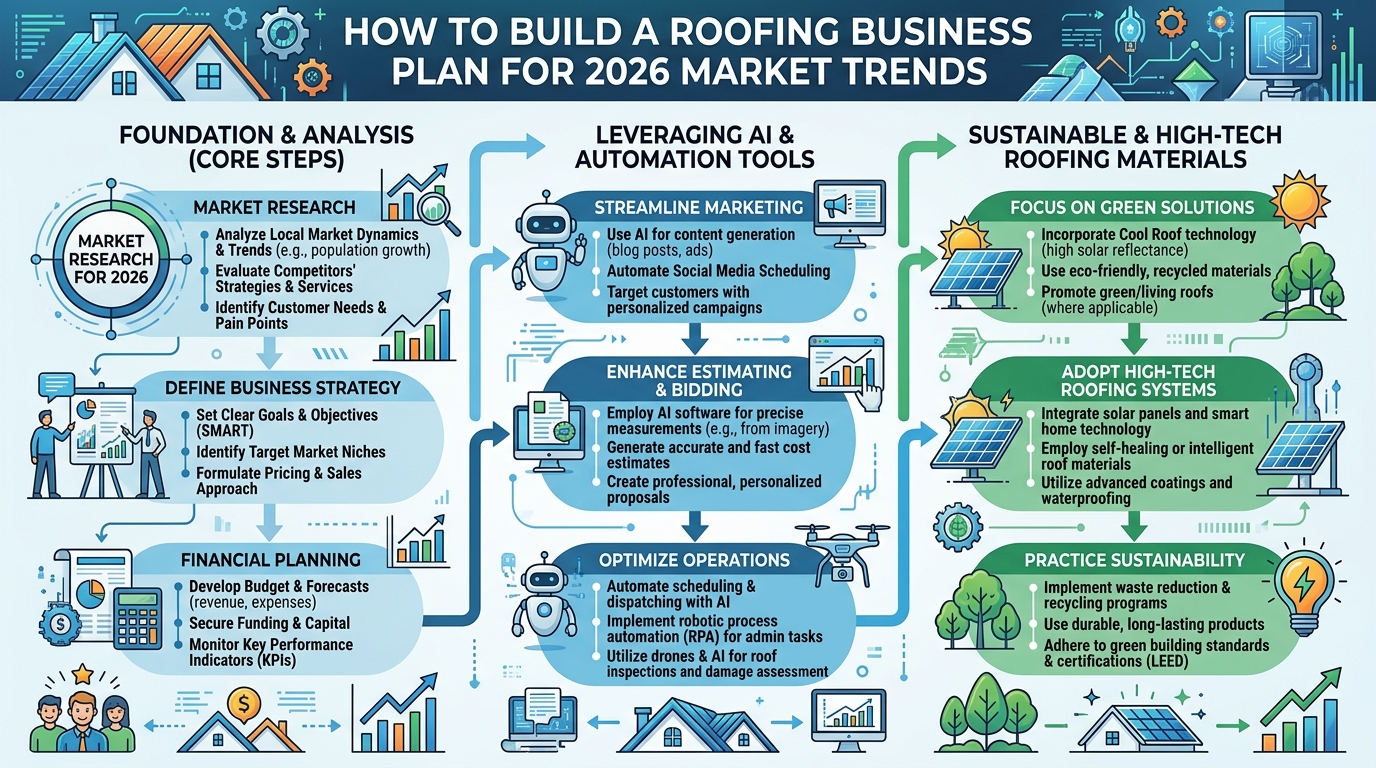
The roofing industry in 2026 is dominated by contractors who use automation to handle the 'boring' parts of the business. Your plan should mention using a platform like Hulo to automate your lead follow-ups, as data shows that responding to a lead within 5 minutes increases conversion rates by 391%. By spending less than $50 a month on software, you can eliminate the need for a part-time office admin who would cost $2,500 monthly.
AI-driven estimating tools are also becoming a standard part of a modern roofing business plan. Tools that integrate with EagleView or RoofSnap allow you to get precise roof measurements via satellite imagery for about $30 to $60 per report. This prevents the 'measuring error' that often leads to a 5-10% loss in profit due to over-ordering or under-ordering materials like bundles of shingles or rolls of underlayment.
Customer communication has shifted toward SMS and WhatsApp in 2026, and your plan must reflect this. Automated project updates—sending a text when the materials are delivered and another when the crew is 30 minutes away—increases customer satisfaction scores by 25%. These high scores lead to more Google reviews, which are the primary driver of organic leads for roofing companies in the current digital landscape.
Sustainable and High-Tech Roofing Materials
Sustainability is no longer a niche market; in 2026, 'cool roofs' and solar-ready shingles are major growth sectors. Your business plan should include a section on how you will offer Energy Star-rated materials that can save homeowners 10-15% on their cooling costs. Brands like GAF Energy with their Timberline Solar shingles are making solar integration accessible for traditional roofing crews without needing a separate electrical license in many jurisdictions.
Metal roofing continues to gain market share due to its 50+ year lifespan and 100% recyclability at the end of its life. While the material cost for standing seam metal is 2-3 times higher than asphalt, the labor can be priced at a premium, often resulting in a $5,000+ net profit per job. Including a strategy for metal roofing allows your business to pivot if asphalt shingle prices spike due to petroleum market volatility.
Synthetic slate and shake products, like those from DaVinci Roofscapes, offer another high-margin opportunity for your 2026 plan. These products are lightweight and easier to install than real stone but command a similar luxury price point of $1,500 to $2,200 per square. By positioning your company as a 'specialty installer' for these high-end materials, you can separate yourself from the hundreds of 'shingle-only' contractors in your city.
Pro Tip: Use satellite measurement reports for every estimate to eliminate human error and increase your professional image during sales presentations.
Ready to put this into action?
Hulo gives you everything to run your roofing business — website, CRM, scheduling, and invoicing. Join the waitlist for V2.
Join the WaitlistWhat roofing business plan tips help secure financing?
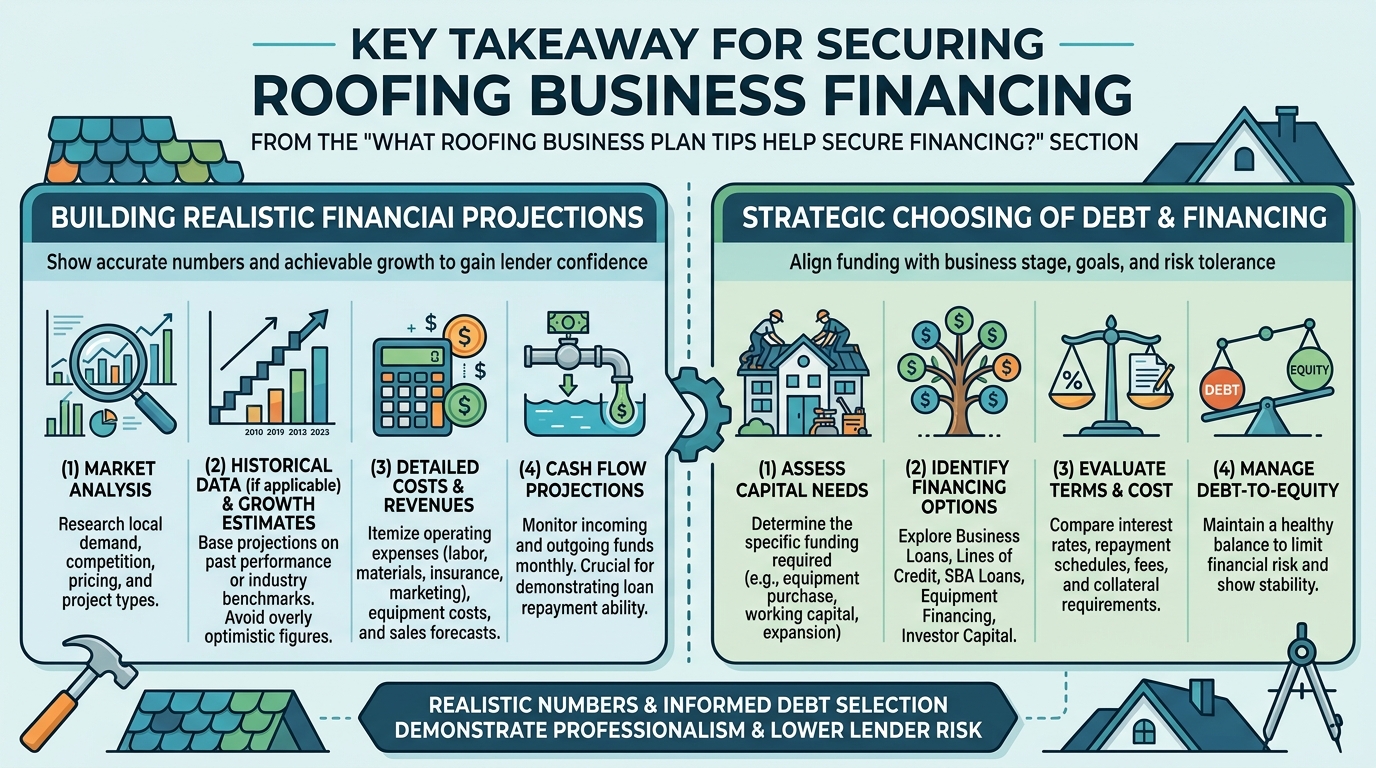
Creating Realistic Financial Projections
Lenders want to see a 3-year financial forecast that includes a Profit and Loss (P&L) statement, a Balance Sheet, and a Cash Flow Statement. For year one, project a conservative 15-20% net profit after all expenses, including your own salary. If you project 50% profit, banks will view your plan as unrealistic and high-risk, as the industry average for a well-run roofing company is typically 20-35%.
Break down your 'Cost of Goods Sold' (COGS) into three categories: Materials (30-35%), Labor (25-30%), and Disposal/Permits (5%). This level of detail shows you understand the math of a roofing job and won't be caught off guard by a $500 dumpster fee or a 10% increase in plywood prices. Use current 2026 pricing for these calculations, such as $120 per square for mid-grade architectural shingles.
Specify your 'Break-Even Point'—the exact number of roofs you need to install each month to cover your fixed overhead like truck payments, insurance, and software. For most solo contractors, this number is usually 1.5 to 2 roofs per month. Knowing this number allows you to manage your stress levels and marketing spend more effectively during the slower winter months or rainy seasons.
Choosing the Right Business Debt and Financing
Your business plan should outline how you will fund your initial growth, whether through personal savings, a Small Business Administration (SBA) loan, or a business line of credit. An SBA 7(a) loan is a popular choice for contractors as it offers lower interest rates and longer repayment terms for amounts up to $5 million. However, be prepared to provide a personal guarantee and collateral, such as equity in your home, for these types of loans.
Equipment financing is another specific strategy to include in your roofing business plan. Rather than paying $20,000 cash for a truck, you can lease it for $450 a month, preserving your liquid cash for marketing and payroll. Companies like Crest Capital specialize in contractor equipment and often provide 'application-only' financing for amounts under $250,000, which speeds up the procurement process significantly.
Finally, consider offering 'Customer Financing' as a tool to increase your average job size. Partnering with companies like Hearth or Service Finance allows you to offer homeowners monthly payments of $150 for a $15,000 roof. This can increase your estimate closing rate by 30% because it removes the 'sticker shock' of a large lump-sum payment and makes a new roof affordable for more families.
Key Takeaway: Lenders value conservative, data-backed financial projections over optimistic 'best-case' scenarios.
How do you get your first roofing leads in 2026?
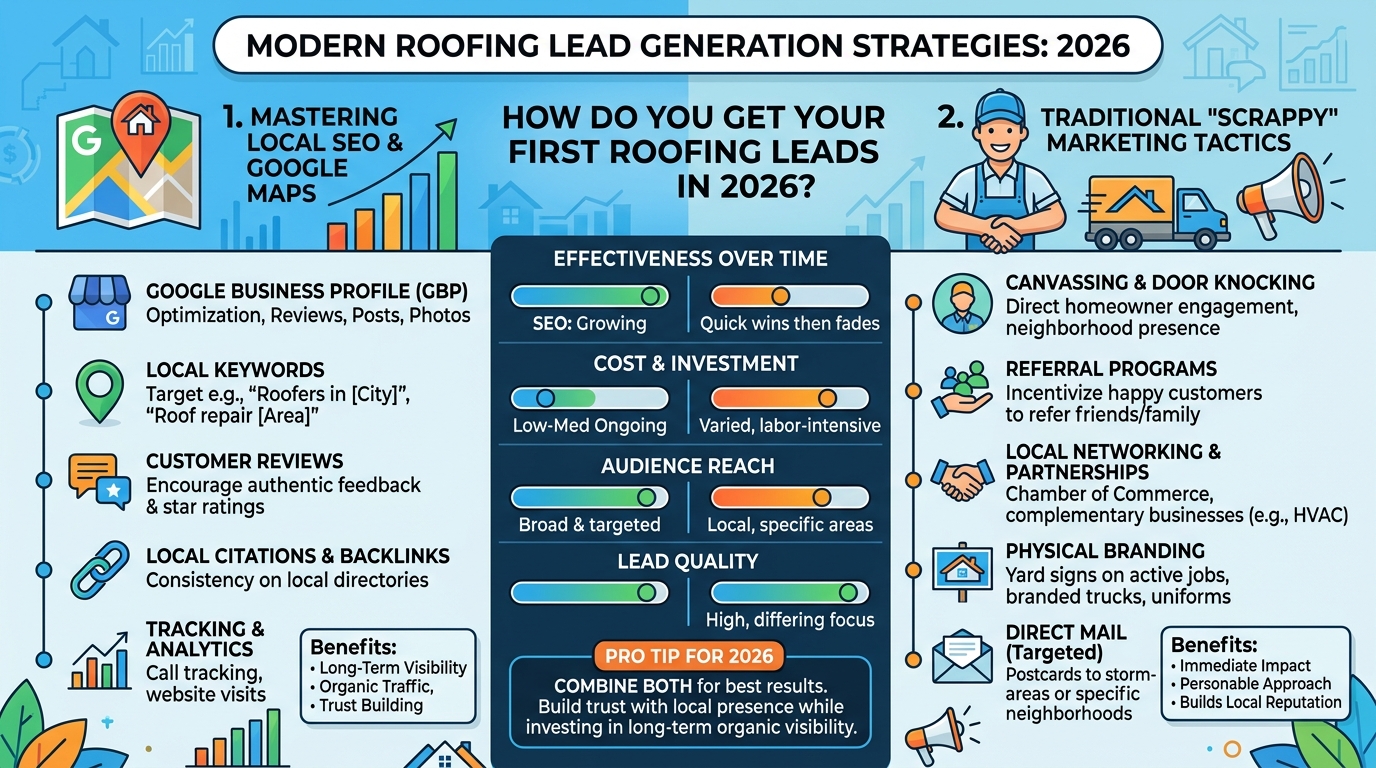
Mastering Local SEO and Google Maps
In 2026, your Google Business Profile (GBP) is your most valuable marketing asset. Your business plan should include a strategy for collecting at least 20 five-star reviews within your first 90 days of operation. Statistics show that businesses in the 'Local 3-Pack' on Google receive 70% of the clicks, so optimizing your profile with high-quality job site photos and localized keywords is essential for survival.
Local Services Ads (LSAs)—the 'Google Guaranteed' checks—are the fastest way to get your phone ringing, but they require a background check and a set budget. Expect to pay between $50 and $150 per qualified lead depending on your market's competitiveness. Your plan should allocate at least $1,000 a month to LSAs during your first six months to ensure a steady stream of inspection opportunities while your organic SEO builds.
Content marketing for roofing should focus on solving homeowner problems, such as 'How to spot a roof leak after a storm' or 'The cost of metal roofing in [Your City]'. By publishing one helpful blog post a week, you build authority and improve your website's ranking for long-tail keywords. This organic traffic is 'free' in the long run and helps lower your overall Customer Acquisition Cost (CAC) compared to relying solely on paid ads.
Traditional 'Scrappy' Marketing Tactics
Door knocking remains one of the most effective ways for a new roofing company to land its first 10 jobs, especially after a localized hail storm. Your plan should include a 'cloverleaf' strategy: whenever you are working on a roof, knock on the two houses to the left, the two to the right, and the five across the street. Handing out a simple flyer with a QR code to your website can generate 1-2 leads per job site for almost zero cost.
Yard signs are a roofing staple for a reason; they work as 24/7 neighborhood endorsements. Invest in high-quality, 18x24 inch corrugated plastic signs with your logo, phone number, and a clear call to action like 'Free Inspections.' Placing a sign at every job site (with the homeowner's permission) and at busy local intersections can generate 5-10 calls a month for a one-time investment of $300.
Networking with local real estate agents and insurance adjusters is a long-term strategy that should be in every roofing business plan. Real estate agents often need quick roof certifications or repairs to close a sale, and insurance adjusters appreciate working with honest contractors who provide detailed, photo-backed estimates. These relationships can provide a 'referral engine' that keeps your schedule full even when your digital ads are turned off.
| Channel | Avg. Cost Per Lead | Closing Rate | Time to Result |
|---|---|---|---|
| Google LSAs | $60 - $140 | 15 - 25% | Immediate |
| Door Knocking | $5 (Flyer cost) | 5 - 10% | Daily |
| SEO / Organic | $0 (Time-based) | 20 - 30% | 6 - 12 Months |
| Yard Signs | $15 per sign | 2 - 5% | Ongoing |
2026 Roofing Lead Generation Comparison
Wrapping Up
A well-crafted roofing business plan is the difference between a struggling side-hustle and a scalable, profitable enterprise. By focusing on accurate startup costs, modern automation tools like Hulo, and a diversified marketing strategy, you can build a roofing company that thrives in the 2026 market. Start small, track every dollar, and use this guide as your blueprint for long-term contractor success.
Frequently Asked Questions
How much does it cost to start a roofing business in 2026?
A solo roofing contractor can start with $5,000 to $15,000 if they already own a truck. This budget covers essential tools like nail guns ($500), ladders ($800), initial insurance premiums ($1,500), and state licensing fees ($500-$1,000). If you need to purchase a truck, expect your total startup capital requirement to jump to $25,000 to $40,000.
What's the difference between a roofing estimate and a roofing bid?
An estimate is a rough calculation of costs based on preliminary measurements and is often used for initial budget discussions with a homeowner. A bid is a formal, legally binding document that specifies the exact materials (e.g., IKO Dynasty Shingles), labor costs, and timeline for the project. In 2026, most professional roofers use software like Hulo to turn estimates into digital bids that can be signed on a tablet.
Do I need a specific license to start a roofing business?
Yes, most states require a specialized roofing or general contractor license, such as the C-39 in California or the CBC in Florida. These licenses usually require passing a trade exam, a law/business exam, and proving a minimum level of financial stability or bonding. Check your local Secretary of State or Department of Professional Regulation for specific 2026 requirements in your area.
How long does it take to write a professional roofing business plan?
A comprehensive plan typically takes 15 to 25 hours to research and write from scratch. This includes time for local market analysis, getting insurance quotes, and building out a 3-year financial spreadsheet. Using a template can reduce this time to 5-10 hours, but you must customize the data to your specific local market and niche.
What certifications do I need for Roofing in 2026?
Beyond a state license, you should aim for manufacturer certifications from GAF (Master Elite), Owens Corning (Platinum Preferred), or CertainTeed (Select ShingleMaster). These certifications allow you to offer enhanced warranties that are backed by the manufacturer, which is a major selling point for 80% of residential homeowners. Additionally, an OSHA 10-hour safety card is highly recommended for all crew members.
How do I get paid faster as a Roofing contractor?
The most effective way to get paid faster is to offer digital payment options like credit cards and ACH through your invoicing software. Platforms like Hulo allow you to send an invoice via text message the moment the job is finished, with a 'Pay Now' button that deposits funds into your account within 24-48 hours. Avoid the 'check in the mail' trap, which can delay your cash flow by 7-14 days.
Is roofing software worth it for a small business with only 2 people?
Absolutely, because small teams have the most to gain from automation and professional appearance. For under $50 a month, software handles your lead tracking and professional bidding, making you look like a much larger company to the homeowner. It also prevents 'lost' leads that could be worth $15,000 each, making the ROI on the software nearly immediate.
What are the average profit margins for a roofing company?
Gross profit margins for roofing typically range from 40% to 50%, while net profit margins—what you keep after paying yourself and overhead—usually land between 20% and 35%. Specialty roofing like metal or slate can see net margins as high as 45% due to the higher labor premiums. Maintaining these margins requires strict material waste management and accurate labor time-tracking.
Ready to Launch Your Roofing Business with Professional Tools?
Hulo provides the all-in-one platform solo roofers need to manage leads, send professional estimates, and get paid faster—all for under $50/mo. Stop juggling spreadsheets and start growing your crew today.
Join the WaitlistMore from the Blog
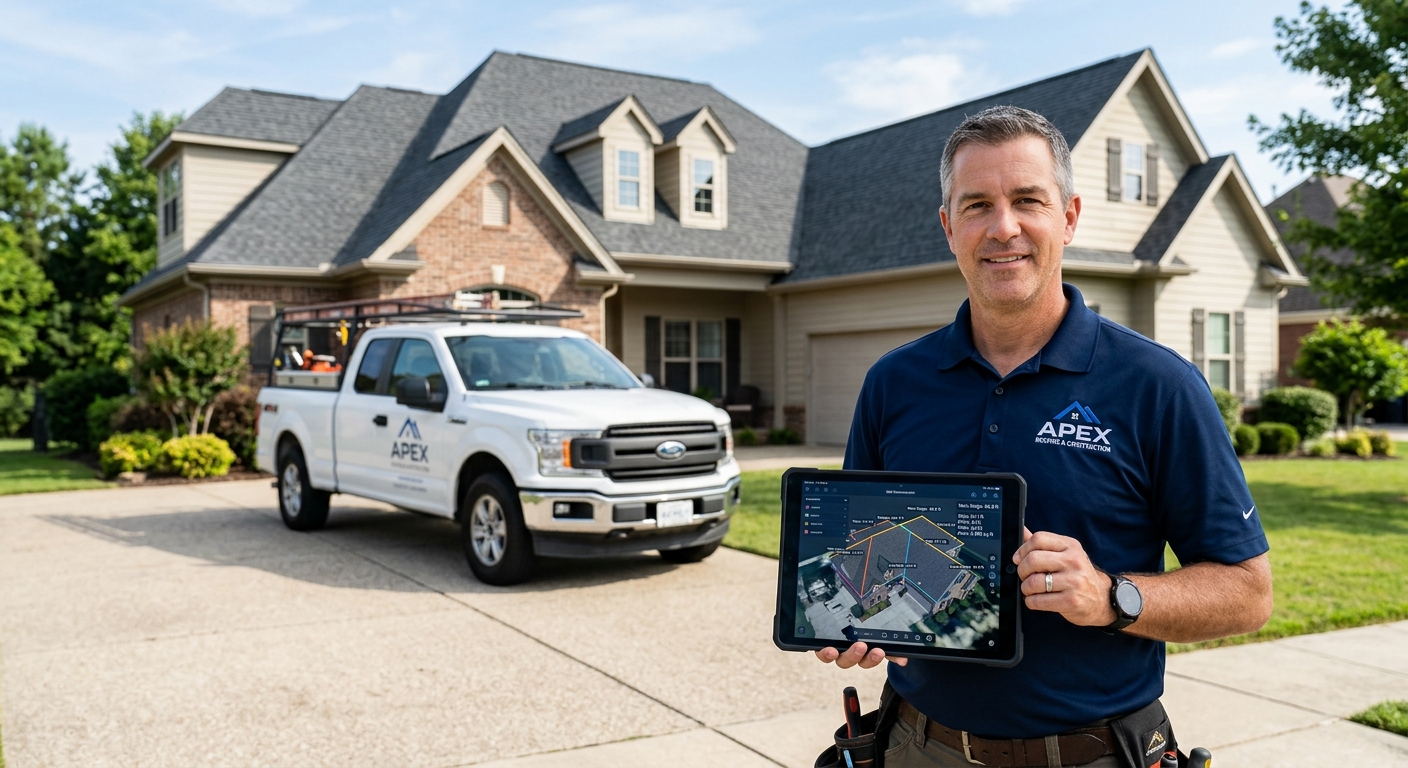
7 Smart Steps to How to Estimate a Roofing Job for Contractors (2026 Guide)
To estimate a roofing job, you must calculate the total square footage of the roof and divide by 100 to determine the nu...
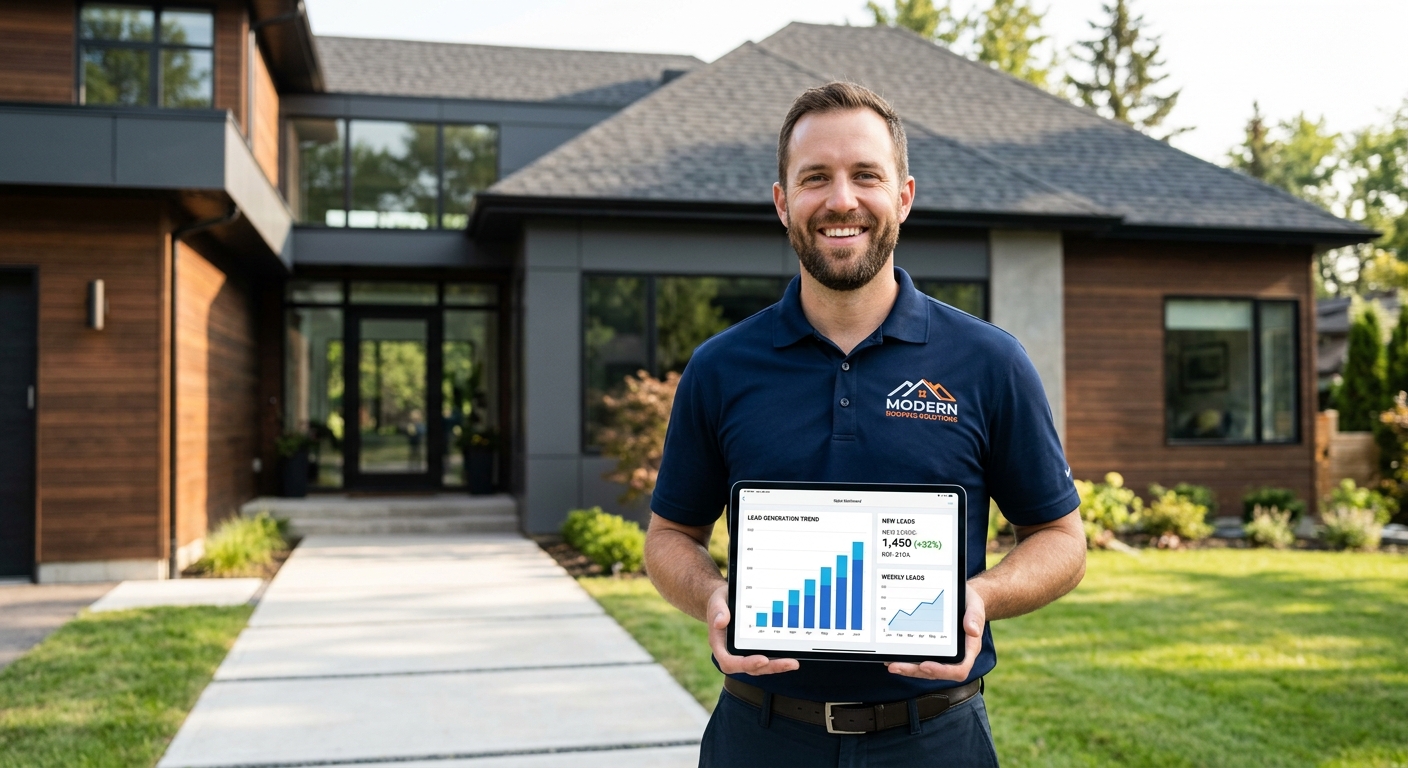
11 Expert Ways to Get Roofing Leads Without Door Knocking for Contractors (2026)
To get roofing leads without door knocking, you must implement a multi-channel digital strategy focusing on Google Local...
How to Get Roofing Leads: 15 Proven Strategies for 2026
The roofing industry in 2026 is a $56.7 billion market, yet many contractors struggle to maintain a consistent pipeline ...