7 Smart Steps to How to Estimate a Roofing Job for Contractors (2026 Guide)
17 min read·Updated April 4, 2026To estimate a roofing job, you must calculate the total square footage of the roof and divide by 100 to determine the number of 'squares' required for materials. Add a waste factor of 10% to 15% and multiply by your labor rate, material costs, and overhead to reach a final bid. In 2026, standard asphalt shingle jobs typically range from $450 to $750 per square depending on your local market and material grade. This guide provides the exact formulas and industry benchmarks used by top-tier contractors to ensure maximum profitability on every project.
Table of Contents
Step-by-Step Overview
- 1
Measure Total Roof Surface Area
Calculate the square footage of all roof planes using a tape measure or aerial tools like EagleView. For a standard 2,500 sq. ft. home, the roof area is often 1.3x to 1.5x the floor footprint. Divide the total square footage by 100 to find the number of 'squares' needed. A 3,000 sq. ft. roof equals 30 squares, which serves as your baseline for all material ordering.
- 2
Apply Pitch and Waste Factors
Adjust your measurements based on roof steepness; a 7/12 pitch requires more surface area than a 4/12 pitch. Add a 10% waste factor for simple gable roofs and 15-18% for complex hip roofs with multiple valleys. This ensures you have enough shingles, underlayment, and drip edge. Expect to pay $120-$160 per square for quality architectural shingles in 2026.
- 3
Calculate Component Material Costs
Itemize every component including synthetic underlayment ($100 per 10-square roll), ice and water shield ($75 per 33-foot roll), and starter strips. Don't forget 1.25-inch coil nails, which cost roughly $45 per box and cover 15-20 squares. Total material costs for a 30-square job typically land between $4,500 and $6,000 in the current market.
- 4
Determine Labor and Crew Rates
Calculate labor costs by multiplying the number of squares by your crew's per-square rate, usually $150-$350. For a 30-square roof, labor might cost $7,500 if the crew charges $250 per square. Factor in a 'steep charge' of $25-$50 extra per square for pitches over 8/12 to account for slower production and increased safety rigging requirements.
- 5
Factor in Disposal and Equipment
Include the cost of a 20-yard or 30-yard dumpster rental, which averages $450-$650 per drop. Account for fuel surcharges and equipment wear-and-tear, which usually adds 2-3% to the total job cost. If you are using specialized equipment like an Equipter for debris management, factor in the $150 daily operational cost to your overhead calculation.
- 6
Apply Overhead and Profit Margins
Add your company overhead (typically 10-15%) and desired net profit (usually 10-20%) to the subtotal. Use a markup multiplier of 1.35 to 1.50 on your direct costs to ensure you cover office staff, insurance, and marketing. A job with $12,000 in direct costs should be bid at $16,200 to $18,000 to maintain a healthy 25% gross margin.
How do you calculate the square footage of a roof for an estimate?
Measuring Roof Pitch and Slope
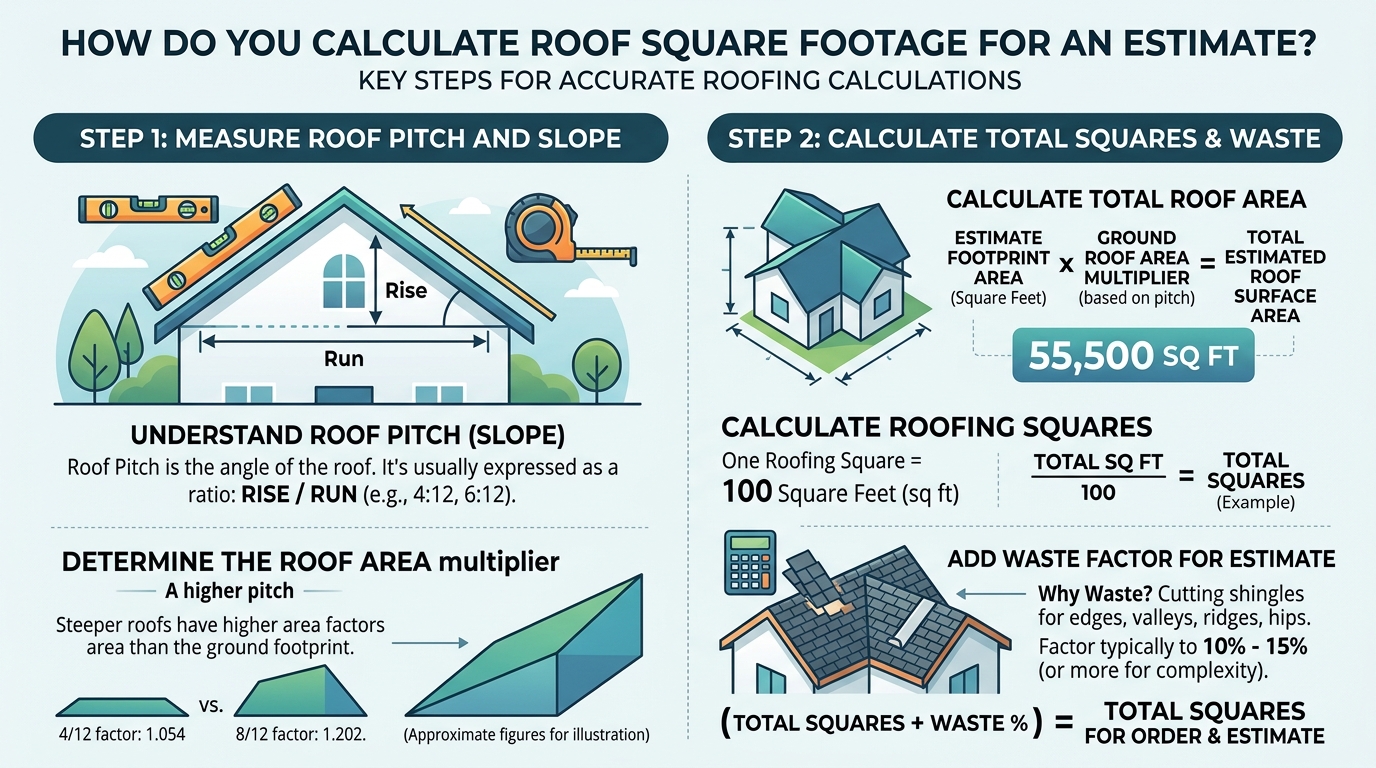
Measuring roof pitch is the first critical step because it dictates both the total surface area and the labor difficulty. Pitch is defined as the vertical rise over a 12-inch horizontal run, and a 6/12 pitch means the roof rises 6 inches for every foot of horizontal distance. In 2026, most residential roofs fall between 4/12 and 9/12, with anything above 7/12 requiring specialized safety equipment like roof jacks and harnesses.
To calculate the pitch-adjusted area, you must multiply the flat footprint area by a pitch multiplier, such as 1.12 for a 6/12 pitch or 1.25 for an 8/12 pitch. For example, a 2,000-square-foot footprint on an 8/12 roof actually has 2,500 square feet of surface area. Using a digital pitch gauge or an app like Pitch Gauge can reduce measurement errors by up to 15% compared to manual level measurements.
Understanding the slope also helps you determine the type of underlayment required by local building codes and the International Residential Code (IRC). Low-slope roofs (2/12 to 4/12) often require double-layered underlayment or a full ice and water shield coverage, which can add $2.00 to $3.50 per linear foot to your estimate. Failing to account for these pitch-specific requirements can lead to a 5% margin erosion before the job even starts.
Calculating Total Squares and Waste
The roofing industry operates on the 'square' unit, which represents 100 square feet of roof surface. Once you have your total adjusted square footage, divide by 100 to find your base squares; a 2,850-square-foot roof equals 28.5 squares. In 2026, precision is key as material costs for premium brands like GAF or Owens Corning have risen by 4-6% annually.
You must always add a waste factor to your base squares to account for cuts at valleys, hips, and ridges. A standard gable roof typically requires a 10% waste factor, while a complex hip roof with multiple dormers requires 15% to 20% waste. For a 30-square base measurement on a hip roof, you should order 35 or 36 squares of shingles to ensure you don't run short mid-project.
Accurate waste calculation prevents 'short-order' fees from distributors, which can cost $75 to $150 per unplanned delivery. National Roofing Contractors Association (NRCA) data suggests that improper waste estimation is the leading cause of material shortages on 22% of residential projects. Using satellite measurement services like EagleView provides a waste-calculation report that is accurate within 1-2%, significantly reducing human error.
1.25
Pitch Multiplier
The standard multiplier for an 8/12 pitch roof to calculate true surface area.
Key Takeaway: Always use a pitch multiplier to convert horizontal footprint to actual surface area to avoid underestimating materials by 10-25%.
how to how to estimate a roofing job: step-by-step guide for contractors
Inspecting the Decking and Substrate
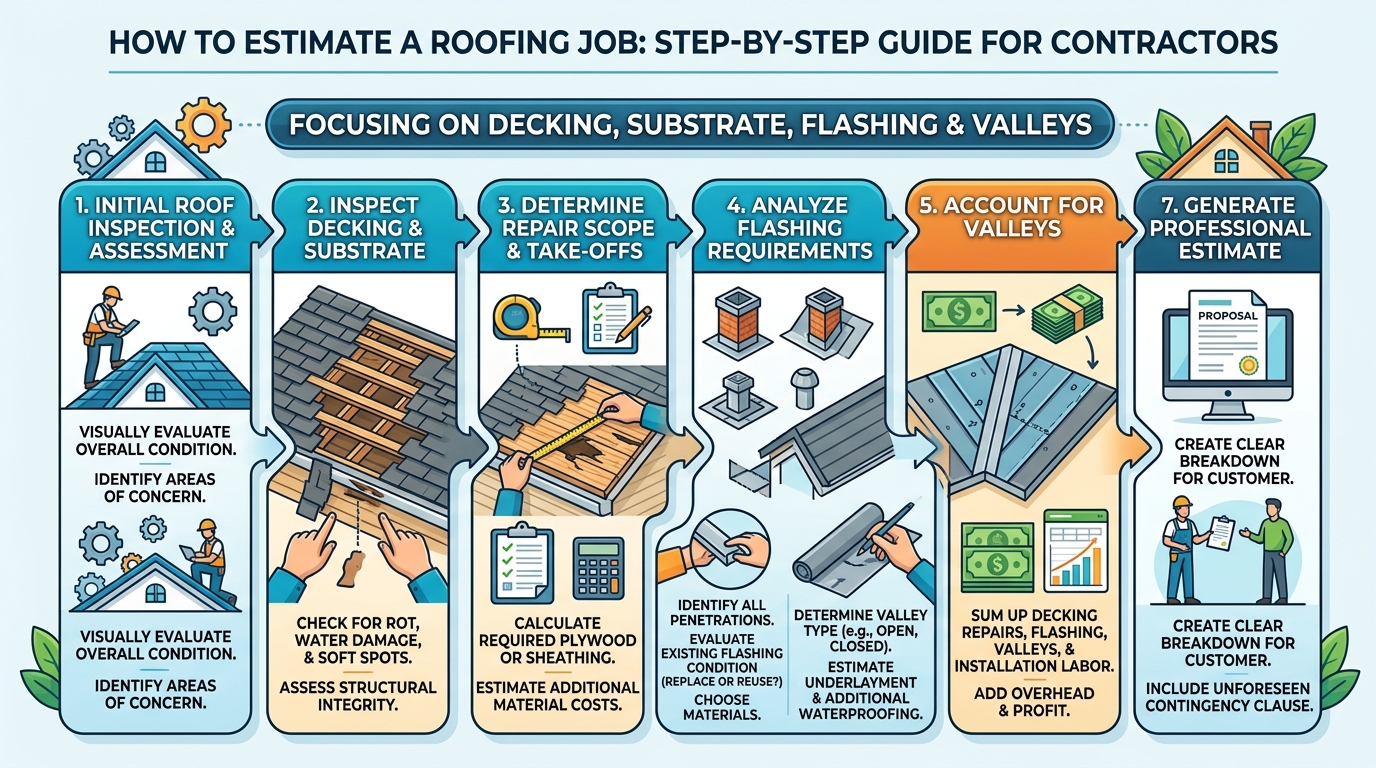
A comprehensive estimate must account for the condition of the plywood or OSB decking beneath the old shingles. During your initial inspection, look for soft spots or sagging that indicate wood rot, which costs approximately $85 to $110 per sheet to replace in 2026 labor and material rates. Most contractors include a 'decking clause' in their contracts that specifies the cost per 4x8 sheet for any wood found to be damaged after the tear-off.
Check the thickness of the existing decking to ensure it meets current OSHA and local building codes for fastener pull-out strength. If you find 3/8-inch plywood where 1/2-inch or 5/8-inch is now required, the entire roof may need a new layer of sheathing. This can add $1,500 to $3,000 to a standard 25-square job, and missing this detail during the estimate phase can destroy your profit margin.
Inspect the spacing between boards on older homes with plank decking; if gaps exceed 1/4 inch, you cannot legally install asphalt shingles over them without adding a layer of OSB. This 're-deck' process adds roughly $1.50 per square foot in materials and $1.00 in labor. Documenting these potential issues with photos during the estimate build-out builds trust and justifies a higher bid price to the homeowner.
Accounting for Flashing and Valleys
Flashing is where most roof leaks occur, making it a critical line item in your 2026 roofing estimate. Estimate $15 to $25 per linear foot for copper or high-quality aluminum flashing around chimneys, dormers, and wall intersections. For a standard chimney (2x2 feet), factor in $250 to $400 for a professional counter-flashing installation that includes grinding into the mortar joints.
Valleys require extra protection, either through an 'open' metal valley or a 'closed' shingle-over valley. Open valleys using 20-inch wide W-metal cost about $12 per linear foot and provide superior water shedding in areas with high snow loads. Closed valleys are cheaper but require more shingles; ensure you add an extra 2 bundles of shingles for every 50 feet of valley to cover the overlap.
Don't forget to estimate the cost of kick-out flashing at the end of wall-to-roof intersections, as required by modern building codes to prevent siding rot. These small components cost $15 each but require 30 minutes of labor to install correctly. Including these details in your itemized bid shows the client you are following NRCA best practices rather than cutting corners.
Pro Tip: Include a 'hidden damage' contingency of 5% in your internal budget to cover unexpected issues like rotted fascia or rusted flashing discovered after tear-off.
how to estimate a roofing job: step-by-step guide for contractors for beginners
Understanding Material Bundles
For beginners, the most common mistake is confusing 'bundles' with 'squares.' In the roofing world, 3 bundles typically equal 1 square of coverage for standard architectural shingles. If you need 30 squares, you must order 90 bundles; however, heavier designer shingles may require 4 or 5 bundles per square, which increases both material cost and labor time for the crew.
Starter strips and ridge caps are sold separately and must be calculated by linear footage rather than square footage. A standard bundle of ridge caps covers about 30 linear feet, while starter strips cover 100 linear feet per bundle. For a 30-square roof with a 100-foot ridge, you'll need 4 bundles of caps and 2 bundles of starter, adding roughly $450 to your material subtotal.
Beginners should also account for the cost of nails and staples; a typical 30-square job requires two 7,200-count boxes of 1.25-inch coil nails. At $45 per box, this is a small but essential cost that many new contractors forget to include. Always check the manufacturer's 'high wind' installation requirements, which may require 6 nails per shingle instead of 4, increasing your nail count and labor time by 20%.
Standard Labor Rates for Newbies
When you are just starting out, you might be tempted to underbid labor to win jobs, but this is a fast track to business failure. In 2026, a fair labor rate for a subcontracted crew is $150 to $225 per square for a standard 'rip and replace' on a 4/12 to 6/12 pitch. If you are running your own in-house crew, your labor burden (wages, taxes, workers' comp) will likely be $300 to $450 per square.
Workers' compensation insurance for roofing is notoriously expensive, often ranging from 20% to 40% of the total payroll. If you pay a roofer $30 per hour, your actual cost is closer to $42 per hour once you add FICA, FUTA, SUTA, and insurance premiums. Beginners must calculate this 'labor burden' to ensure they aren't losing money on every hour worked.
Regional differences play a massive role in labor estimation; a crew in Seattle or New York City will cost 40% more than a crew in rural Alabama. Use local labor statistics from the Bureau of Labor Statistics (BLS) to benchmark your rates against the local average of $24.50 to $32.00 per hour for skilled roofers. Always get a firm quote from your subcontractors before finalizing your estimate to the customer.
how to estimate a roofing job: step-by-step guide for contractors tips
Using Aerial Measurement Tools
One of the best tips for modern roofing contractors is to stop climbing ladders for every initial estimate. Aerial measurement tools like Hover or EagleView provide high-resolution reports with 99% accuracy for about $35 to $65 per report. These reports provide total squares, pitch, valley lengths, and even suggested material orders, saving you 2-3 hours of manual measurement time per lead.
Using these tools also increases your professional image; presenting a 12-page satellite report to a homeowner justifies your pricing and builds immediate authority. In 2026, homeowners expect digital-first communication, and providing a 3D model of their home with different shingle colors can increase your closing rate by 15-20%. This technology pays for itself by allowing you to bid 5x more jobs in the same timeframe.
Aerial reports also serve as a legal record of the roof's condition before your crew arrives. If a homeowner claims you damaged a chimney or a gutter, you can refer back to the high-resolution satellite imagery taken on the day of the estimate. This risk mitigation is invaluable in a litigious market where a single insurance claim can raise your premiums by 25%.
Grouping Material Deliveries
To maximize your margins, you should aim to group your material deliveries to avoid multiple 'stop' charges from your supplier. Most distributors charge $50 to $125 for every delivery truck they send to a job site. By ordering your shingles, underlayment, and drip edge in one bulk delivery, you save on transportation costs and ensure your crew has everything they need at 7:00 AM on day one.
Consider 'roof-loading' your shingles whenever possible, which means the distributor uses a boom truck to place the pallets directly on the roof. This service usually costs an extra $1.00 to $2.00 per square but saves your crew 3-4 hours of manual carrying time. For a 30-square job, paying $60 for roof-loading can save you $250 in labor costs, a net gain of $190 in profit.
Always verify the delivery schedule 24 hours in advance to avoid 'dry runs' where your crew is waiting on materials. In 2026, labor is the most expensive variable; having a 5-man crew sitting idle at $40/hour costs you $200 every single hour materials are late. Establish a relationship with a dedicated rep at ABC Supply or SRS Distribution to get priority delivery slots during the busy summer season.
$35-$65
Cost per Aerial Report
The average price for a professional satellite roof measurement report in 2026.
how to estimate a roofing job: step-by-step guide for contractors 2026
Sustainable Material Costs
In 2026, sustainable and energy-efficient roofing materials are no longer a niche market; they are a major profit center. Cool-roof shingles that reflect UV rays can cost 10-15% more than standard shingles but are often required by updated Title 24-style energy codes. Estimate these shingles at $160 to $190 per square, and ensure you mention the potential 20% savings on the homeowner's cooling bills.
Solar shingles, like those from GAF Energy (Timberline Solar), are seeing a 30% year-over-year increase in adoption. Estimating a solar roofing job is more complex, requiring an electrical sub-estimate and knowledge of the 30% Federal Investment Tax Credit (ITC). A typical solar shingle installation might be bid at $1,200 to $1,800 per square, offering significantly higher gross profit dollars than traditional asphalt.
Recycled rubber shingles and metal roofing are also gaining traction due to their 50-year lifespans. Metal roofing estimates should factor in $400 to $900 per square for materials and a specialized labor rate that is 2x higher than asphalt. As traditional petroleum-based shingle prices fluctuate with oil markets, offering these alternatives can stabilize your revenue streams in 2026.
Digital Estimating Software Integration
The days of paper estimates are officially over; in 2026, 85% of top-performing roofing contractors use integrated CRM and estimating software. Platforms like Hulo allow you to build an estimate on-site, apply your pre-set margins, and send a professional PDF to the client's phone before you leave their driveway. This 'one-call close' strategy can improve your conversion rate by 30% compared to mailing a bid three days later.
Software integration also ensures that your material pricing is always up to date via API links with major distributors. When Owens Corning raises prices by 5% on the first of the month, your software automatically updates your bid templates, preventing you from accidentally selling a job at last year's prices. This automated accuracy is essential for maintaining a consistent 35-40% gross margin.
Using a system like Hulo also streamlines the transition from estimate to invoice, reducing the administrative 'dead time' that plagues small businesses. You can set up automated follow-ups for unsigned estimates, which can recover up to 10% of 'lost' leads that simply forgot to respond. For under $50/mo, these tools provide the infrastructure of a million-dollar company to solo contractors and small crews.
Key Takeaway: Adopt digital estimating and CRM tools in 2026 to increase closing rates by 30% and protect your margins from material price volatility.
Ready to put this into action?
Hulo gives you everything to run your roofing business — website, CRM, scheduling, and invoicing. Join the waitlist for V2.
Join the Waitlisthow to estimate a roofing job: step-by-step guide for contractors guide
Calculating Your Labor Burden
Your labor burden is the true cost of employing a worker beyond their hourly wage, and failing to calculate it is the #1 reason roofing companies go bankrupt. To find your burden, add the costs of Social Security (6.2%), Medicare (1.45%), and Workers' Comp (varies, but often 25% for roofers). For a worker earning $25/hour, your actual cost is at least $35.25/hour before you even consider health insurance or retirement contributions.
You must also account for non-billable time, such as drive time to the job site, equipment maintenance, and safety meetings. If your crew spends 5 hours a week on these tasks, that's 12.5% of their time that isn't generating revenue. Adjust your hourly labor rate in your estimate by at least 15% to cover this 'leakage' and ensure every billable hour is profitable.
In 2026, labor shortages have pushed wages higher, so you should revisit your labor burden every 6 months. Use a simple spreadsheet to track total payroll costs divided by total billable squares to find your 'Real Cost Per Square.' If your real cost is $210 but you are only charging $200 for labor in your bids, you are losing $300 on every 30-square roof you install.
Determining Your Minimum Profit Margin
A common mistake is confusing markup with margin; a 50% markup results in a 33% gross margin. To maintain a healthy roofing business in 2026, you should target a 35% to 45% gross margin on residential projects. This margin must cover your overhead (rent, marketing, software like Hulo) and still leave 10% to 15% in net profit for the business owner.
To calculate a 40% margin, take your total direct costs (labor + materials + disposal) and divide by 0.60. If a job costs you $10,000 to produce, your bid should be $16,666 ($10,000 / 0.60). If you simply add 40% to the cost ($14,000), you are only achieving a 28% margin, which may not be enough to cover your overhead during the slow winter months.
Track your 'net profit per square' as your primary KPI (Key Performance Indicator). A successful roofing contractor in 2026 should net between $1,500 and $2,500 per average 25-square job after all expenses are paid. If your net profit is consistently below $1,000, you need to either raise your prices or find ways to reduce your material waste and labor inefficiencies.
| Desired Gross Margin | Required Markup Multiplier | Bid Price (on $10k Cost) |
|---|---|---|
| 25% | 1.33 | $13,300 |
| 30% | 1.43 | $14,300 |
| 35% | 1.54 | $15,400 |
| 40% | 1.67 | $16,700 |
| 45% | 1.82 | $18,200 |
2026 Roofing Margin vs. Markup Reference
What materials and waste factors should you include in a roofing estimate?
Shingle Quality Tiers
Your estimate should clearly define the tier of shingle being used, as prices vary significantly between 3-tab, architectural, and luxury shingles. 3-tab shingles are the budget option, costing around $90-$110 per square, but they only carry a 25-year warranty and are rated for lower wind speeds. Architectural shingles, the 2026 industry standard, cost $120-$160 per square and offer lifetime limited warranties.
Luxury or 'Designer' shingles, such as CertainTeed Grand Manor, can cost $250 to $400 per square. These shingles are much heavier, often requiring 4-5 bundles per square, which increases the labor cost for carrying and installation. When estimating luxury shingles, you must also factor in specialized ridge caps that match the profile, which can cost $150 per bundle compared to $50 for standard caps.
Always provide the homeowner with a 'Good-Better-Best' proposal to show the value of higher-tier materials. In 2026, 40% of homeowners choose the 'Better' or 'Best' option when presented with clear benefits like higher wind ratings or better curb appeal. This strategy allows you to capture higher-margin work without needing to find more leads, simply by increasing the average job size.
Underlayment and Ice/Water Shields
Modern roofing systems rely on synthetic underlayment rather than traditional 15lb or 30lb felt paper. Synthetic underlayment is 10x stronger and costs about $0.10 to $0.15 per square foot, or roughly $100 for a 1,000-square-foot roll. Because it is lighter and covers more area per roll, it reduces labor time by 20% compared to felt, making it a more profitable choice for the contractor.
Ice and water shield is a self-adhering membrane required by code in valleys and along the eaves in cold climates (zones 5 and above). A 3-foot by 33-foot roll costs approximately $75 to $95 and covers about 1 square. For a 30-square roof with 120 linear feet of eaves and 60 feet of valleys, you will need at least 6 rolls of ice and water shield, adding $500 to $600 to your material estimate.
Ensure your estimate includes the cost of new drip edge, which is essential for directing water into the gutters. Drip edge comes in 10-foot sticks and costs about $15 to $22 per stick depending on the gauge and finish. For a standard 2,500-square-foot roof, you will likely need 20-25 sticks, adding $400 to the bid. Missing these 'small' material items can quickly add up to $1,000 in unquoted costs.
How do you calculate labor costs and overhead for a roofing bid?
Insurance and Workers' Compensation
Insurance is the largest overhead expense for roofing contractors, and it must be baked into every estimate. General Liability (GL) insurance typically costs 2% to 5% of your gross revenue, while Workers' Comp for roofers is the highest in the trades, often exceeding $20 per $100 of payroll. If your labor cost on a job is $5,000, you might be paying $1,000 just for the insurance to cover that labor.
To simplify this in your estimating formula, calculate your 'Insurance Multiplier' by dividing your total annual insurance premiums by your total annual squares installed. If you pay $50,000 in insurance and install 2,000 squares, every square you bid must include $25 for insurance. This ensures that your fixed costs are covered even on smaller repair jobs that might otherwise slip through the cracks.
OSHA compliance and safety gear also fall under overhead; things like new harnesses, ropes, and anchors cost about $300 per roofer and should be replaced every 2-3 years. Factor in a 'Safety Charge' of $50 per job to cover the depreciation and inspection of this equipment. In 2026, an OSHA fine for lack of fall protection starts at $16,131, so investing in safety is both a legal requirement and a financial necessity.
Administrative and Software Overhead
Running a modern roofing business involves significant administrative costs, from office rent and utilities to marketing and software subscriptions. Total overhead for a small roofing company typically ranges from 10% to 20% of gross revenue. If your goal is to do $1 million in sales per year, you need to account for $150,000 in overhead, or roughly $12,500 per month.
Software tools like Hulo provide an incredible ROI by consolidating your CRM, invoicing, and scheduling into a single $50/mo payment. Compared to using separate tools that can cost $300-$500/mo, Hulo saves you $3,000 to $5,000 annually in software fees alone. Furthermore, the time saved on manual data entry allows you to spend more time on sales, which is worth thousands more in potential revenue.
Marketing costs, such as Google Local Services Ads or lead generation services, usually cost $150 to $300 per qualified lead. If your closing rate is 25%, you are spending $600 to $1,200 in marketing just to acquire one customer. This 'Customer Acquisition Cost' (CAC) must be factored into your overhead percentage to ensure your marketing budget is self-sustaining and scalable.
Pro Tip: Use an all-in-one platform like Hulo to manage your estimates and invoices for under $50/mo, significantly lowering your administrative overhead compared to expensive enterprise software.
Wrapping Up
Estimating a roofing job accurately is the difference between a thriving business and one that is barely scraping by. By using pitch multipliers, accounting for every material component, and factoring in your true labor burden, you can ensure your 2026 bids are both competitive and highly profitable. Start using professional tools like Hulo today to streamline your estimating process and win more jobs.
Frequently Asked Questions
How much does a roofing estimate cost?
Most roofing contractors provide residential estimates for free as part of their sales process, but some charge a $75 to $150 'inspection fee' for detailed insurance claim reports or real estate certifications. In 2026, many top-tier contractors credit this fee back to the homeowner if the contract is signed. Charging for estimates can help filter out 'tire-kickers' and cover the 2-3 hours of time spent driving and measuring.
What is the difference between a square and a bundle?
A 'square' is a unit of measurement equal to 100 square feet of roof surface area, while a 'bundle' is the physical package shingles are sold in. For standard architectural shingles, it takes 3 bundles to cover 1 square. Heavier designer shingles may require 4 or 5 bundles per square to achieve the same 100-square-foot coverage due to their thickness and overlap requirements.
Do I need NRCA certification to estimate roofing jobs?
While not legally required to provide an estimate, being a member of the National Roofing Contractors Association (NRCA) provides you with the standardized formulas and safety guidelines that lend authority to your bids. Homeowners in 2026 increasingly look for certifications like the NRCA ProCertification to ensure the contractor follows industry-best practices. This credential can allow you to charge a 5-10% premium over uncertified competitors.
How long does it take to create a roofing estimate?
A manual estimate involving a site visit and ladder measurements typically takes 2 to 4 hours including travel and office time. Using aerial measurement tools like EagleView and estimating software like Hulo can reduce this to 15-30 minutes. In a competitive 2026 market, the speed of delivery is critical, as 50% of homeowners hire the first contractor to provide a professional, written bid.
How do I get paid faster as a roofing contractor?
To improve cash flow, use a platform like Hulo to send digital invoices that allow homeowners to pay via credit card or ACH immediately upon completion. Implementing a 'progressive billing' schedule—where you collect 40% upfront for materials, 40% upon start, and 20% upon completion—ensures you aren't financing the job out of your own pocket. Automated text reminders for unpaid invoices can reduce your average Days Sales Outstanding (DSO) by 10-15 days.
Is EagleView worth it for small roofing businesses?
Yes, EagleView is worth the $35-$65 cost because it eliminates measurement errors that can cost you $500 to $1,000 in wasted materials or labor. It also provides a professional 'Roof Report' that you can include in your proposal, which increases your perceived value to the client. For a small business, the 2-3 hours of time saved per estimate is better spent on lead generation or crew management.
What is the average profit margin for a roofing job in 2026?
A healthy roofing company should target a 35% to 45% gross profit margin and a 10% to 15% net profit margin. For a $15,000 roof replacement, this means the business should keep $1,500 to $2,250 in clear profit after all labor, materials, and overhead are paid. Contractors operating below a 30% gross margin often struggle to survive unexpected costs like equipment failure or workers' comp audits.
How much waste should I calculate for a hip roof?
For a hip roof with multiple valleys and ridges, you should calculate a waste factor of 15% to 18%. Gable roofs are simpler and usually only require 10% waste. If the roof has many dormers or a high degree of complexity, some contractors even go as high as 20% to avoid the high cost of ordering just 1 or 2 extra bundles mid-job.
Ready to Professionalize Your Roofing Estimates?
Stop using paper bids and start winning more jobs with Hulo. For under $50/mo, you get a complete CRM, professional estimating templates, and instant invoicing designed for roofing contractors.
Join the WaitlistMore from the Blog
11 Expert Ways to Get Roofing Leads Without Door Knocking for Contractors (2026)
To get roofing leads without door knocking, you must implement a multi-channel digital strategy focusing on Google Local...
How to Get Roofing Leads: 15 Proven Strategies for 2026
The roofing industry in 2026 is a $56.7 billion market, yet many contractors struggle to maintain a consistent pipeline ...
How to Start a Roofing Company: Complete Business Guide (2026)
The roofing industry in 2026 is projected to exceed $56 billion in annual revenue, driven by a combination of aging infr...