7 Proven Ways to Increase Your Roofing Business Profit Margin for Contractors (2026)
16 min read·Updated April 4, 2026A healthy roofing business profit margin typically falls between 20% and 40% for gross profit, while net profit margins generally range from 5% to 15% after all expenses. Top-performing residential contractors in 2026 target a 35% gross margin on shingle replacements to ensure they can cover rising overhead costs and equipment depreciation. Understanding these benchmarks is the first step toward financial sustainability in a market where material costs from suppliers like GAF and Owens Corning can fluctuate by 5-10% annually. This guide provides the exact formulas, cost breakdowns, and operational strategies you need to maximize your bottom line this year.
Table of Contents
Step-by-Step Overview
- 1
Calculate Your True Labor Burden
Determine the total cost of your crew beyond their hourly wage, including workers' compensation insurance (often 15-25% of payroll), payroll taxes, and benefits. In 2026, a roofer earning $30 per hour actually costs the business roughly $42 per hour when these factors are included. Failing to account for this 40% 'burden' is the most common reason for thin roofing business profit margins among new contractors.
- 2
Establish a Minimum Gross Margin Target
Set a firm gross margin target of at least 30-35% for every residential estimate. Use the formula: (Total Sales - Cost of Goods Sold) / Total Sales. If a job costs $7,000 in materials and labor, you must price it at $10,770 to achieve a 35% margin. This buffer protects your business from unexpected site conditions or minor material price hikes during the project cycle.
- 3
Implement Daily Job Costing
Track every dollar spent on materials, dump fees, and labor hours against your original estimate in real-time. Use mobile apps to log hours on-site so you can identify labor overages before they ruin your project's profitability. Contractors who review job costs weekly typically see a 4-6% increase in net profit simply by identifying and correcting waste early in the production process.
- 4
Negotiate Tiered Material Pricing
Partner with local distributors like ABC Supply or Beacon to secure volume-based discounts on shingles, underlayment, and flashing. By committing to a single manufacturer like CertainTeed for 80% of your jobs, you can often unlock 3-5% rebates or preferred pricing tiers. In 2026, saving even $5 per square on 500 squares of roofing adds $2,500 directly to your net profit margin.
- 5
Optimize Your Sales Pipeline Efficiency
Reduce your customer acquisition cost (CAC) by focusing on high-conversion lead sources and automated follow-ups. Aim for a lead-to-contract conversion rate of at least 25% to keep marketing expenses below 10% of total revenue. Using a platform like Hulo can help you automate text and email responses, ensuring you reach prospects within 5 minutes, which significantly increases your chances of closing the deal.
- 6
Automate Invoicing and Collections
Transition to digital invoicing to reduce the time between job completion and payment, which currently averages 22 days for traditional paper-based roofing companies. Implement progress payments—30% down, 40% on start, 30% on completion—to maintain positive cash flow. Tools like Hulo integrate professional invoicing and payment processing, allowing you to get paid 3-5 days faster while reducing administrative labor costs.
What are the standard roofing business profit margins in 2026?
Gross Profit vs. Net Profit in Roofing
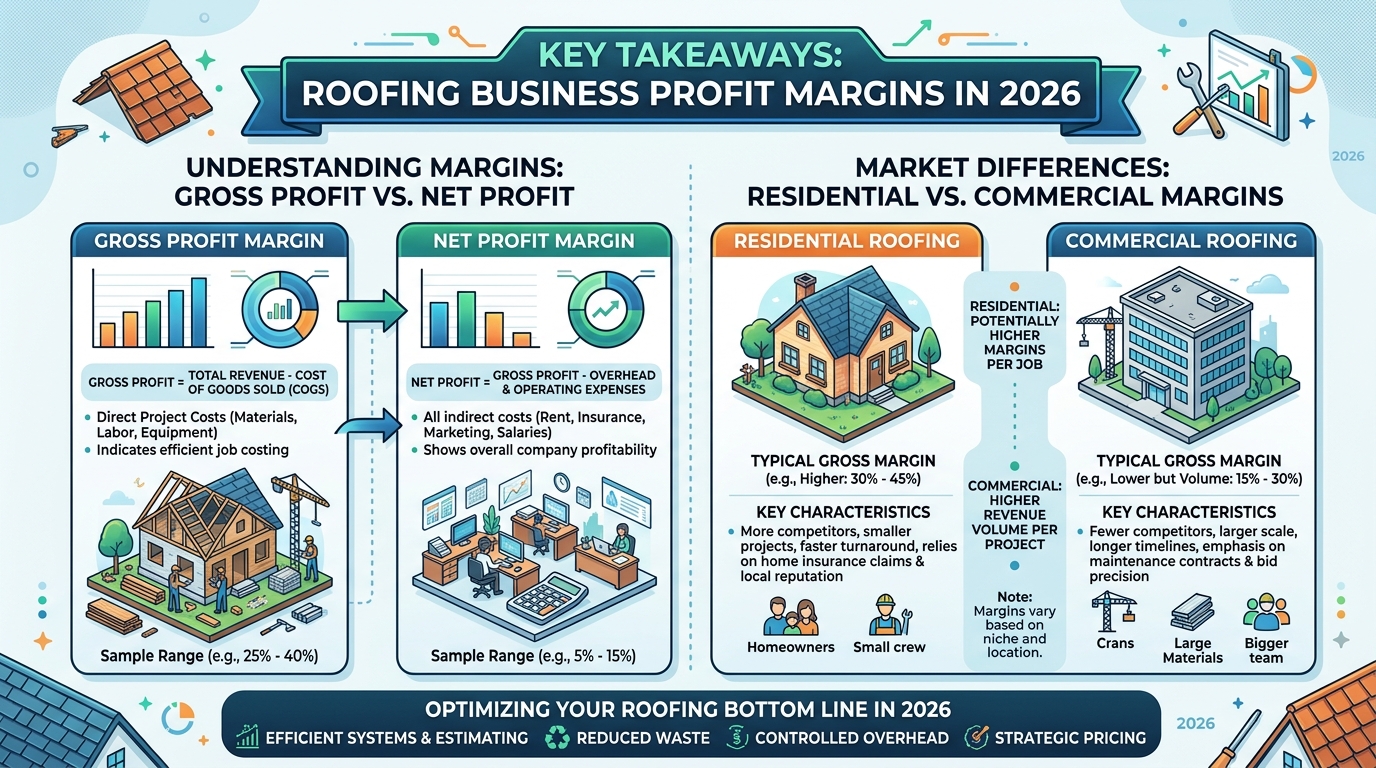
In the roofing industry, gross profit is the amount left after subtracting direct costs—materials, labor, and disposal—from the total contract price. For a standard $12,000 residential roof replacement, your direct costs might include $4,000 for GAF Timberline HDZ shingles and $3,500 for a 4-man crew over two days. This leaves a gross profit of $4,500, or a 37.5% gross profit margin, which is considered healthy for a modern roofing enterprise.
Net profit is the final amount remaining after paying all indirect expenses, including office rent, vehicle leases, marketing, and administrative salaries. Many contractors confuse the two, leading them to believe they are making more money than they actually are. In 2026, a net profit margin of 10% is the industry standard for established companies, meaning on that same $12,000 job, the owner takes home $1,200 in actual profit after everyone else is paid.
Maintaining these margins requires a disciplined approach to overhead management and consistent pricing. If your overhead costs exceed 25% of your total revenue, your net roofing business profit margin will quickly erode, even if your field crews are highly efficient. High-growth companies often invest in specialized training from associations like the National Roofing Contractors Association (NRCA) to ensure their estimators are using current data for their calculations.
It is critical to remember that net profit is what allows for business reinvestment, such as purchasing a new $65,000 Ford F-250 or hiring a dedicated production manager at $75,000 per year. Without a clear understanding of your net margin, you may find yourself with a growing bank balance but an inability to cover the tax liabilities that come due at the end of the fiscal year.
Commercial vs. Residential Margin Differences
Commercial roofing projects, such as TPO or EPDM installations on warehouses, typically operate on lower gross margins but higher total dollar amounts compared to residential work. A $200,000 commercial project might only carry a 20% gross margin, but the $40,000 in gross profit can cover significant overhead in a single month. These jobs require specialized equipment like $15,000 hot-air welders and significantly higher insurance limits, which can reach $5 million or more in aggregate coverage.
Residential roofing, conversely, offers higher margins—often 35% to 45%—because the projects are smaller, shorter in duration, and require less specialized equipment. A typical residential shingle job can be completed in 24 to 48 hours, allowing a company to cycle through projects quickly and maintain high cash flow. However, the customer acquisition cost for residential work is often higher, frequently ranging from $500 to $1,500 per signed contract in competitive 2026 markets.
Contractors who balance both sectors often see the most stable roofing business profit margin across the fiscal year. Commercial maintenance contracts can provide steady, predictable income during the winter months when residential reroofing slows down in northern climates. By securing 5-10 commercial service agreements at $2,500 per year each, a small roofing business can cover its basic shop rent before a single shingle is nailed down.
Ultimately, the choice between commercial and residential focus depends on your capital availability and crew expertise. Commercial work often involves 60-day or 90-day payment cycles, which can strain the cash flow of a beginning contractor. Residential work, with its immediate payment terms upon completion, is generally more forgiving for those looking to maximize their liquid roofing business profit margin in the short term.
10-15%
Average Net Profit
Based on 2026 NRCA industry data for mid-sized roofing firms.
Key Takeaway: Aim for a 35% gross margin on residential jobs and a 20% gross margin on commercial projects to maintain a healthy 10% net profit.
How to roofing business profit margins: industry benchmarks and how to improve for residential contractors?
Material Cost Management Strategies
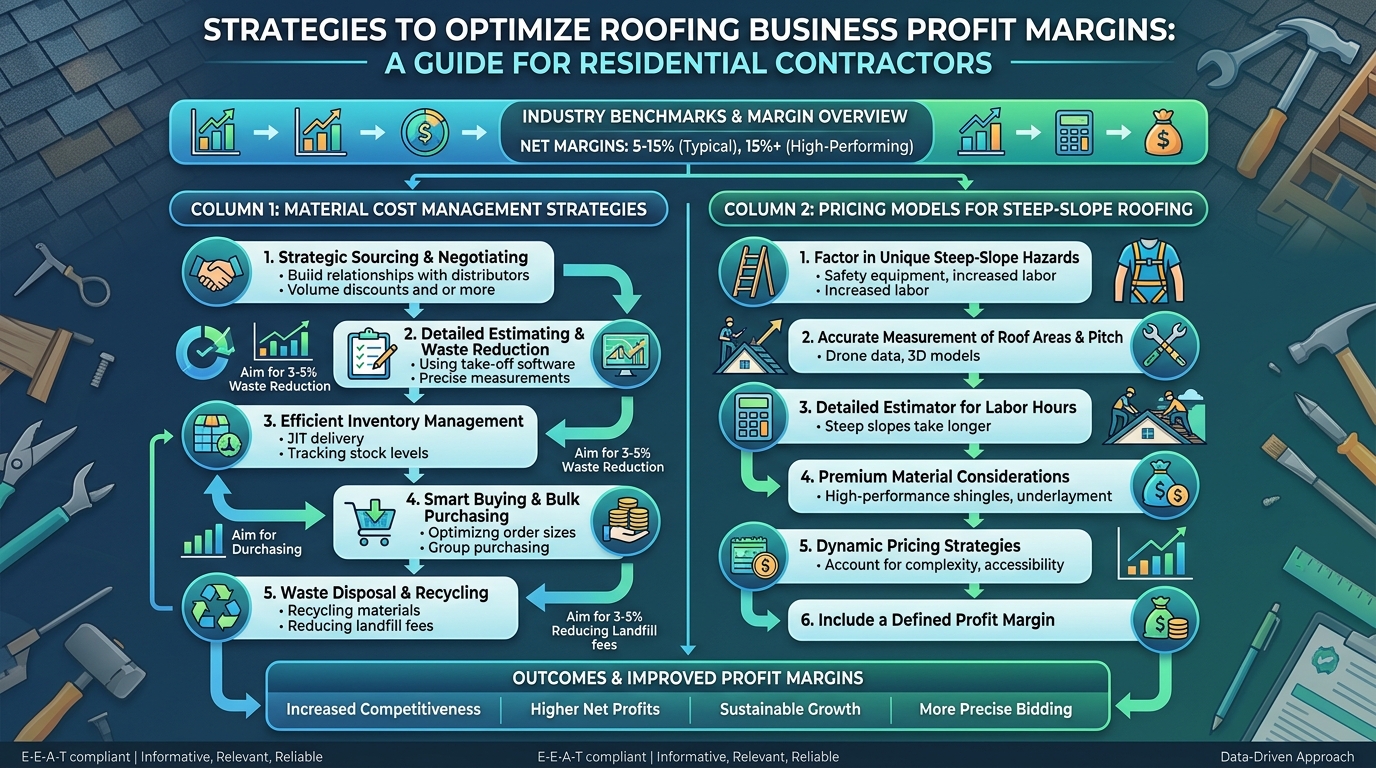
Material costs account for approximately 35% to 45% of a residential roofing estimate, making it the largest variable in your roofing business profit margin. In 2026, architectural shingles have stabilized at roughly $110 to $130 per square, but accessories like synthetic underlayment and ice-and-water shield can add another $20 per square to the bill. To improve margins, you must minimize waste by using digital measurement tools like EagleView or RoofSnap, which provide accuracy within 1-2% of actual field measurements.
Ordering materials in bulk can also yield significant savings, provided you have the warehouse space to store pallets of coil nails and rolls of starter strip. Most major distributors offer a 'job-pack' discount when you order everything for a project at once, which can save you $100 to $300 per job. Additionally, monitoring the scrap rate of your crews is essential; a crew that consistently produces 15% waste on a 10% waste estimate is effectively stealing 5% of your gross margin on every project.
Another strategy is to upsell high-margin products like ridge vents, solar-powered attic fans, or premium shingle lines such as the Owens Corning Duration series. These items often have lower labor requirements relative to their price point, allowing you to increase the total contract value without a proportional increase in labor hours. For instance, adding a $600 attic fan might only take 30 minutes to install but can contribute $300 in pure gross profit to the job.
Finally, keep a close eye on the 'extra' materials that tend to disappear from job sites, such as unused bundles of shingles or extra tubes of sealant. Implementing a return policy with your distributor for unopened bundles can recover $50 to $150 per project that would otherwise be wasted. Over the course of 50 jobs a year, these small recoveries can boost your annual roofing business profit margin by several thousand dollars.
Pricing Models for Steep-Slope Roofing
Steep-slope roofing, typically defined as any pitch over 6:12, requires additional safety equipment and slower production rates, which must be reflected in your pricing. Many contractors fail to adjust their labor rates for pitch, leading to a significant drop in their roofing business profit margin on complex Victorian or Tudor-style homes. In 2026, it is standard practice to add a 'pitch premium' of $15 to $35 per square for every two points of pitch above 6:12.
A 'per square' pricing model is the most common in the industry, but it can be dangerous if it doesn't account for job site accessibility and tear-off difficulty. A roof with three layers of old shingles and a steep pitch requires significantly more labor and higher disposal fees at the local landfill, which might charge $80 to $120 per ton. If your base price is $500 per square, a difficult tear-off could easily push your actual costs to $450 per square, leaving you with a meager 10% gross margin.
To protect your margins, move toward a 'cost-plus' or a detailed line-item estimating model that accounts for every specific challenge of the job. Include line items for protection of landscaping (using systems like the Catch-All), chimney flashing replacement, and plywood deck replacement at $90 to $110 per sheet. This transparency not only protects your profit but also builds trust with the homeowner, who can see exactly what they are paying for.
Implementing a minimum job fee is also crucial for maintaining a healthy roofing business profit margin on small repairs. If you send a two-man crew to fix a leak that takes one hour, your overhead for the truck, insurance, and travel time likely exceeds $200. Setting a minimum repair fee of $450 to $650 ensures that small jobs remain profitable and don't distract your team from high-margin full replacements.
Pro Tip: Use a 10% waste factor for simple gable roofs and 15-20% for complex hip roofs with multiple valleys to avoid under-ordering materials.
What are the roofing business profit margins: industry benchmarks and how to improve tips for labor costs?
Subcontractors vs. W2 Employees
The choice between using subcontractors or W2 employees is a pivotal factor in determining your roofing business profit margin and your long-term liability. Subcontractors are often paid a flat rate per square—typically $80 to $120 for labor only in 2026—which makes your job costing highly predictable and reduces your overhead for benefits and equipment. However, relying solely on subs can lead to quality control issues and scheduling conflicts, as you are not their only client.
W2 employees offer greater control over quality and safety, but they come with significant 'hidden' costs known as the labor burden. In addition to their hourly wage, you must pay for Federal Insurance Contributions Act (FICA) taxes, State Unemployment Insurance (SUI), and high-risk workers' comp premiums. In states like Florida or New York, roofing workers' comp can cost $20 to $40 for every $100 of payroll, which can drastically lower your net profit if not priced correctly.
Many successful roofing firms utilize a hybrid model: a core team of W2 employees for repairs, inspections, and quality control, supplemented by trusted subcontractors for large-scale production. This allows the business to scale up during the peak storm season without the permanent overhead of a massive payroll. Regardless of the model, you must ensure all workers are properly insured; a single OSHA fine for lack of fall protection can exceed $16,131 per violation in 2026, which can wipe out the profit from five average jobs.
To improve labor efficiency, consider implementing a performance-based bonus system for your W2 crews. If a crew completes a 30-square job in two days instead of three while maintaining a zero-callback record, sharing a portion of the labor savings with them incentivizes speed and quality. This approach not only boosts your roofing business profit margin through faster job turnover but also improves employee retention in a highly competitive labor market.
Safety Compliance and Insurance Premiums
Safety is not just a moral obligation; it is a critical component of your roofing business profit margin strategy. High-performance safety programs can lower your Experience Modification Rate (EMR), which insurance companies use to calculate your workers' comp premiums. A company with an EMR of 0.85 pays 15% less than the industry average, while a company with a 1.20 EMR pays a 20% surcharge, potentially costing an extra $10,000 to $30,000 annually.
Investing in high-quality fall protection equipment, such as Miller Revolution harnesses and Guardian Fall Protection anchors, costs roughly $500 per roofer but pays for itself by preventing catastrophic accidents. In 2026, the average cost of a roofing-related injury claim exceeds $50,000, which can cause your insurance premiums to skyrocket for years. By maintaining a clean safety record, you position your business as a 'preferred risk,' allowing you to negotiate lower rates with carriers like Travelers or Liberty Mutual.
General liability insurance is another significant expense, typically costing 2% to 5% of your total revenue depending on your location and claims history. To keep these costs low, ensure your contracts have clear 'limitation of liability' clauses and that you are only working with subcontractors who carry their own insurance with limits matching your own. This prevents 'pass-through' claims where a subcontractor's mistake ends up costing your business and damaging your profit margin.
Regular safety training sessions, documented through apps or sign-in sheets, can also provide a 'safety credit' on many insurance policies. These sessions should cover ladder safety, heat stress prevention, and the proper use of specialized tools like pneumatic nailers. A culture of safety reduces downtime, minimizes equipment damage, and ensures that your roofing business profit margin isn't drained by preventable legal and medical expenses.
$16,131
Min OSHA Fine
The minimum fine for a 'serious' violation in 2026, emphasizing the cost of non-compliance.
Key Takeaway: Your labor burden is likely 30-40% higher than the base hourly wage; always use the fully burdened rate when estimating jobs.
Ready to put this into action?
Hulo gives you everything to run your roofing business — website, CRM, scheduling, and invoicing. Join the waitlist for V2.
Join the WaitlistHow do roofing business profit margins: industry benchmarks and how to improve for beginners starting out?
Reducing Overhead in the First Year
For beginners, the key to a sustainable roofing business profit margin is keeping overhead as low as possible while building a reputation. Avoid the temptation to lease a large warehouse or buy a brand-new fleet of trucks in your first six months; instead, operate out of a home office and use one reliable used truck. In 2026, the cost of a commercial lease for a small shop can easily reach $2,500 per month, which requires $25,000 in annual revenue just to break even on rent.
Focus your initial marketing budget on high-ROI activities like door knocking in neighborhoods with recent storm damage or setting up a professional Google Business Profile. Avoid expensive lead generation services that charge $100+ per lead until you have a high closing rate and a solid system for following up. Beginners who focus on localized, organic growth often see net profit margins as high as 20% because their fixed costs are so much lower than established competitors.
Utilizing all-in-one software platforms can also save significant money for new contractors. Instead of paying for separate CRM, invoicing, and scheduling tools, a platform like Hulo provides everything a new roofer needs for under $50 per month. This consolidation reduces 'software creep,' where multiple small subscriptions eventually add up to hundreds of dollars in monthly overhead that eats into your roofing business profit margin.
Finally, be wary of 'buying' jobs just to stay busy. It is common for new contractors to underbid projects by 20% to win work, but this often leads to doing the work for free or even losing money after all expenses are paid. It is better to lose a bid than to win a job that doesn't meet your minimum 30% gross margin requirement. Remember, you are in business to make a profit, not just to move shingles from the distributor to a roof.
Estimating Accuracy for New Contractors
Inaccurate estimating is the number one killer of new roofing businesses. Beginners often forget to include 'small' items like flashing, drip edge, or the cost of a dumpster, which can add $1,000 to a project's cost. To avoid this, create a standardized estimating checklist that includes every possible component of a roof, from the plywood deck to the final ridge cap. In 2026, a 20-yard dumpster rental typically costs $450 to $600, a cost that must be passed on to the customer.
Take the time to physically inspect every roof before providing a final quote, looking for signs of rotted decking or multiple layers of existing shingles. Discovering that a roof needs 10 sheets of new OSB after you've already started the job can cost you $1,000 in unplanned expenses if you haven't included a 'decking replacement' clause in your contract. Most homeowners understand that rot cannot be seen from the ground, but they will resist paying extra if it wasn't mentioned as a possibility upfront.
New contractors should also account for their own time when calculating the roofing business profit margin. If you are spending 10 hours a week on sales and 30 hours on-site, you must pay yourself a fair market wage within the job costs. If the business only makes a profit because you aren't taking a salary, you don't have a profitable business; you have a low-paying job. Aim to price your work so that it covers a professional salary for yourself plus a 10% net profit for the company.
Lastly, leverage the expertise of your material suppliers. Many distributors offer free training or estimating assistance to new contractors who commit to using their products. They can help you understand the nuances of local building codes, such as the specific ice-and-water shield requirements in your climate zone, ensuring your estimates are both accurate and code-compliant. This support is invaluable for maintaining your margins during the critical first year of operation.
How can software and automation boost your roofing business profit margin?
CRM and Lead Management Efficiency
In 2026, the speed to lead is the most critical factor in winning high-margin roofing jobs. Statistics show that contractors who respond to a lead within 5 minutes are 7 times more likely to convert that lead into a customer. Using a CRM like Hulo allows you to automate this process, sending an immediate text message and email to the prospect as soon as they fill out a form on your website. This automation ensures you don't lose potential profit to a competitor who was simply faster to pick up the phone.
A robust CRM also helps you track your 'win rate' across different neighborhoods and lead sources. If you find that leads from Facebook ads convert at 5% while referrals convert at 50%, you can shift your marketing budget to maximize your return on investment. Reducing your customer acquisition cost by just $200 per job can increase your annual net roofing business profit margin by 2-3%, which represents a significant sum for a company doing $1 million in annual revenue.
Automation also extends to the follow-up process for unsigned estimates. Many roofers leave thousands of dollars on the table by failing to follow up more than once. An automated sequence that checks in with the homeowner at 3, 7, and 14 days after the estimate can increase your closing rate by 15-20% without any additional effort from your sales team. This 'found' revenue is highly profitable because you have already paid for the lead and the time to perform the initial inspection.
Furthermore, keeping all customer data in a centralized digital system prevents costly communication errors. When the production crew has access to the exact photos and notes from the salesperson, they are less likely to make mistakes that require expensive rework. Rework is a direct hit to your roofing business profit margin, as it involves double the labor and often additional materials for no extra revenue.
Streamlining the Invoicing Process
Cash flow is the lifeblood of a roofing company, and slow invoicing is a major drain on your effective roofing business profit margin. Every day a payment sits in 'accounts receivable' is a day your capital isn't working for you or earning interest. By using digital invoicing tools, you can send a professional bill with a 'Pay Now' button the moment the final walk-through is completed. In 2026, contractors using mobile payments are getting paid an average of 6 days faster than those who mail paper invoices.
Integrated payment processing through platforms like Hulo also allows you to offer financing options to homeowners. For a $15,000 roof, a $200 monthly payment is often much more attractive than a lump sum, allowing you to maintain your full price rather than offering discounts to close the deal. Financing companies typically charge a small merchant fee, but the ability to win more jobs at higher margins far outweighs this cost.
Automated reminders for overdue invoices can also save hours of administrative work each week. Instead of having an office manager call customers to ask for payment, the system can send polite nudges at set intervals. This reduces the 'awkwardness' of collections and ensures that you aren't paying interest on your own business loans while your customers are sitting on your cash. A 1% reduction in bad debt directly correlates to a 1% increase in your net roofing business profit margin.
Finally, digital systems provide real-time financial reporting that allows you to make data-driven decisions. Instead of waiting until the end of the quarter to see if you were profitable, you can look at a dashboard today and see your exact gross margin for the month. This visibility allows you to pivot quickly if material prices spike or if a particular crew is consistently underperforming, protecting your bottom line before the damage becomes permanent.
Pro Tip: Offer a 2% discount for payments made via ACH or check to avoid credit card processing fees on large $10k+ contracts.
Wrapping Up
Mastering your roofing business profit margin requires a combination of precise estimating, disciplined labor management, and modern automation. By targeting a 35% gross margin and leveraging tools like Hulo to reduce administrative overhead, you can build a resilient company that thrives in any market. Start tracking your job costs today to ensure your 2026 is your most profitable year yet.
Frequently Asked Questions
What is a good profit margin for a roofing company?
A healthy roofing business profit margin is typically 30% to 40% for gross profit and 10% to 15% for net profit. In 2026, top-tier contractors aim for these numbers to ensure they can cover a marketing budget of 8-10% and still have capital for growth. If your net margin is below 5%, your business is at high risk during economic downturns or periods of slow sales.
How much does a standard roof replacement cost in 2026?
The average cost for a professional residential roof replacement ranges from $10,000 to $18,000 for a 2,000-square-foot home using architectural shingles. This price includes labor, materials like GAF or CertainTeed shingles, disposal fees, and a standard 10-year workmanship warranty. Prices can exceed $30,000 for premium materials like metal or slate or for roofs with complex steep-slope designs.
What certifications do I need for a successful roofing business?
At a minimum, you need a state-issued roofing or general contractor license and proof of general liability and workers' comp insurance. To maximize your roofing business profit margin, pursue manufacturer certifications like GAF Master Elite or Owens Corning Platinum Preferred, which allow you to offer enhanced warranties. These certifications often command a 10-15% price premium because of the added peace of mind they provide to homeowners.
How long does a typical residential roofing job take?
Most residential shingle replacements take 1 to 2 days to complete with a standard 4-to-6 person crew. Larger or more complex roofs (over 40 squares) may take 3 to 4 days, especially if multiple layers of old roofing need to be removed. Efficient scheduling is key to profitability; every extra day a crew spends on a site increases labor costs and delays the start of the next revenue-generating project.
How do I get paid faster as a roofing contractor?
The fastest way to get paid is to use digital invoicing with integrated credit card and ACH payment options, like those provided by Hulo. Require a 30% deposit upon contract signing, 40% when materials are delivered to the site, and the final 30% immediately upon completion. This 'progress payment' structure ensures your cash flow remains positive throughout the duration of the project.
Is roofing software like Hulo worth it for a small business?
Yes, for a small roofing business, an all-in-one platform like Hulo is highly cost-effective as it replaces multiple expensive subscriptions for under $50/mo. It streamlines lead management, scheduling, and invoicing, which can save a business owner 10-15 hours of administrative work per week. This time can then be redirected toward high-value activities like sales and project management to further improve profit margins.
What is the difference between gross and net profit in roofing?
Gross profit is the revenue remaining after paying for direct job costs like labor, shingles, and dump fees. Net profit is what remains after you also subtract indirect overhead costs like rent, marketing, insurance, and office salaries. A roofing business profit margin calculation must account for both to ensure the company is truly sustainable and not just 'busy.'
How do I calculate labor burden for my roofing crew?
To calculate labor burden, take the employee's hourly wage and add the costs of payroll taxes (7.65% for FICA), workers' comp insurance (often 20%+ for roofing), health benefits, and PTO. In 2026, a roofer paid $25/hr typically costs the business $35-$40/hr in total. Failing to use this burdened rate in your estimates will result in a significantly lower roofing business profit margin than expected.
Ready to Maximize Your Roofing Profits in 2026?
Hulo provides the all-in-one toolkit roofing contractors need to automate leads, scheduling, and invoicing for under $50/mo. Stop wasting time on paperwork and start growing your bottom line today.
Join the WaitlistMore from the Blog
7 Smart Steps to How to Estimate a Roofing Job for Contractors (2026 Guide)
To estimate a roofing job, you must calculate the total square footage of the roof and divide by 100 to determine the nu...
11 Expert Ways to Get Roofing Leads Without Door Knocking for Contractors (2026)
To get roofing leads without door knocking, you must implement a multi-channel digital strategy focusing on Google Local...
How to Get Roofing Leads: 15 Proven Strategies for 2026
The roofing industry in 2026 is a $56.7 billion market, yet many contractors struggle to maintain a consistent pipeline ...