11 Actionable Roofing Crew Management Tips for Contractors (2026)
14 min read·Updated April 4, 2026Effective roofing crew management tips focus on implementing structured communication protocols, offering competitive hourly wages between $25 and $55, and providing OSHA-compliant safety training. Building a reliable team requires a mix of performance-based incentives, such as a $500 quarterly safety bonus, and modern scheduling tools that reduce job site downtime by 15% or more. In the high-turnover roofing industry, where labor shortages often exceed 20%, these strategies ensure you maintain a skilled workforce that delivers quality results consistently. This guide provides a comprehensive roadmap for roofing contractors to scale their operations by focusing on the human element of the business.
Table of Contents
Step-by-Step Overview
- 1
Define Clear Job Roles and Pay Scales
Establish a tiered hierarchy ranging from general laborers earning $20-$25/hour to lead foremen earning $45-$60/hour. Document specific responsibilities for each role in a 2-page employee handbook to prevent task overlap. This clarity reduces friction during complex tear-offs and installations, ensuring every crew member knows their specific station on the roof. Expect to spend 10-15 hours initially drafting these role descriptions to align with local market rates in 2026.
- 2
Implement a Standardized Recruitment Process
Utilize platforms like Indeed or specialized trade boards, budgeting roughly $300-$500 per month for sponsored listings. Screen candidates for NRCA (National Roofing Contractors Association) certifications or previous experience with specific materials like GAF or Owens Corning shingles. Conduct practical 2-hour 'trial days' where candidates demonstrate basic shingle alignment or flashing techniques. This vetting process filters out 70% of unqualified applicants before they reach a live job site.
- 3
Execute a 3-Day Safety and Skills Orientation
Devote the first 72 hours of employment to safety training, specifically focusing on OSHA Subpart M (Fall Protection) requirements. Provide each new hire with a personal fall arrest system (PFAS) valued at $250-$400 and demonstrate proper anchor point installation. Include a hands-on session on tool maintenance, specifically pneumatic nailers and specialized cutters. Proper orientation can reduce workplace accidents by 40% within the first six months of a crew member's tenure.
- 4
Adopt Integrated Field Management Software
Deploy a platform like Hulo to handle scheduling, time tracking, and daily job logs for under $50/month. Digital time-stamping prevents 'time theft' and ensures crews are compensated accurately for every minute of labor, including travel between sites. Use the photo-documentation feature to capture 10-15 progress shots per job, which protects the crew from liability and simplifies the foreman's reporting duties. This automation saves the average roofing owner 5-8 hours of administrative work weekly.
- 5
Establish a Performance-Based Bonus Structure
Create a monthly bonus pool based on zero-callback metrics and material waste reduction. Offer a $100 bonus for every 10 consecutive jobs completed without a leak-related callback or safety violation. Track these metrics transparently so the crew can see their progress toward the goal in real-time. Incentivizing quality over raw speed typically improves customer satisfaction ratings by 25% and reduces expensive rework costs that eat into your 30-40% profit margins.
- 6
Schedule Bi-Weekly Feedback and Growth Meetings
Hold 30-minute 'toolbox talks' every other Friday to discuss upcoming projects and address crew concerns. Use this time to identify top performers who are ready for advanced training, such as CERTA (Certified Roofing Torch Applicator) certification. Investing $1,200 in a senior laborer's professional development can increase their long-term value and foster loyalty. Consistent communication reduces turnover rates by up to 35% by making employees feel like valued stakeholders.
How to roofing crew management tips: how to build and retain a reliable team?
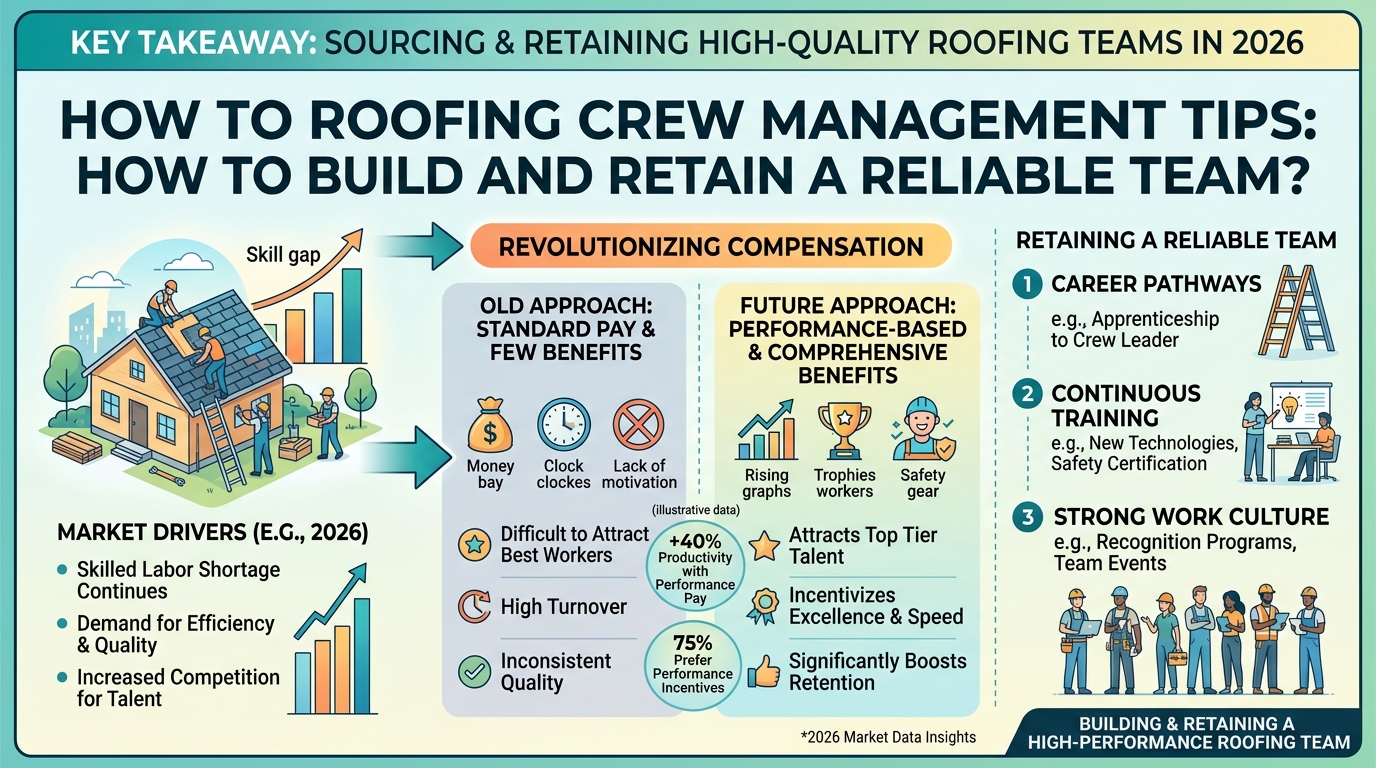
Sourcing High-Quality Roofing Talent in 2026
Recruiting for a roofing company in 2026 requires a proactive approach that goes beyond posting on generic job boards. You must actively target trade school graduates and military veterans who possess the discipline required for 10-hour shifts in varied weather conditions. Many successful contractors are now offering $1,000 sign-on bonuses, paid out in $250 increments over the first four months of employment, to attract more reliable candidates. This strategy helps mitigate the risk of 'ghosting' which currently affects nearly 15% of the construction industry hiring process.
Establishing a referral program is another essential roofing crew management tip that leverages your current team's network. Offer a $500 referral bonus to any employee who brings in a new hire who stays for at least 90 days. This creates an internal vetting system where your best workers only recommend people they trust, as their own reputation is on the line. Data shows that referred employees have a 25% higher retention rate after one year compared to those hired through external job advertisements.
Social media recruitment has become a dominant force for roofing companies looking to build a brand that attracts talent. Use Instagram and TikTok to showcase 60-second clips of your crew using high-end equipment like the Equipter RB4000 or working on prestigious commercial projects. Potential hires want to see a professional environment where safety is prioritized and the equipment is modern. A strong digital presence can reduce your cost-per-hire by up to 40% while increasing the quality of the applicant pool.
The Role of Competitive Compensation and Benefits
In 2026, a competitive wage for a roofing laborer starts at $22 per hour, while experienced installers often command $35 to $45 per hour depending on the region. To retain a reliable team, you must offer more than just a base salary; consider adding health insurance stipends or 401(k) matching programs. Offering a $200 monthly health stipend is often more cost-effective for small roofing firms than managing a full group plan. These benefits signal to your crew that you are invested in their long-term well-being, which is critical in a physically demanding trade.
Performance bonuses should be tied to specific, measurable KPIs such as 'shingles laid per hour' or 'cleanliness of the job site.' For example, awarding a $150 bonus for a perfectly clean site inspection at the end of a 3-day project encourages the crew to take pride in the final result. This not only keeps the team motivated but also directly impacts your company's online reviews and referral rate. Transparent tracking of these bonuses ensures that every crew member feels the system is fair and based on merit rather than favoritism.
Paid time off (PTO) is no longer optional for roofers who want to maintain a reliable team in the modern economy. Even providing 5 days of paid vacation after one year of service can drastically reduce burnout during the peak roofing season from June to September. Roofers who feel they have the opportunity to rest and recover are 50% less likely to suffer from on-the-job injuries related to fatigue. Balancing the high-intensity work schedule with scheduled downtime is a hallmark of a mature, well-managed roofing operation.
$1,000
Sign-on Bonus Average
Many top-tier roofing firms are using tiered sign-on bonuses to improve 90-day retention rates in 2026.
Key Takeaway: Building a reliable team starts with a recruitment strategy that prioritizes referrals and social proof, backed by a compensation package that includes performance bonuses and PTO.
Roofing crew management tips: how to build and retain a reliable team guide for onboarding?
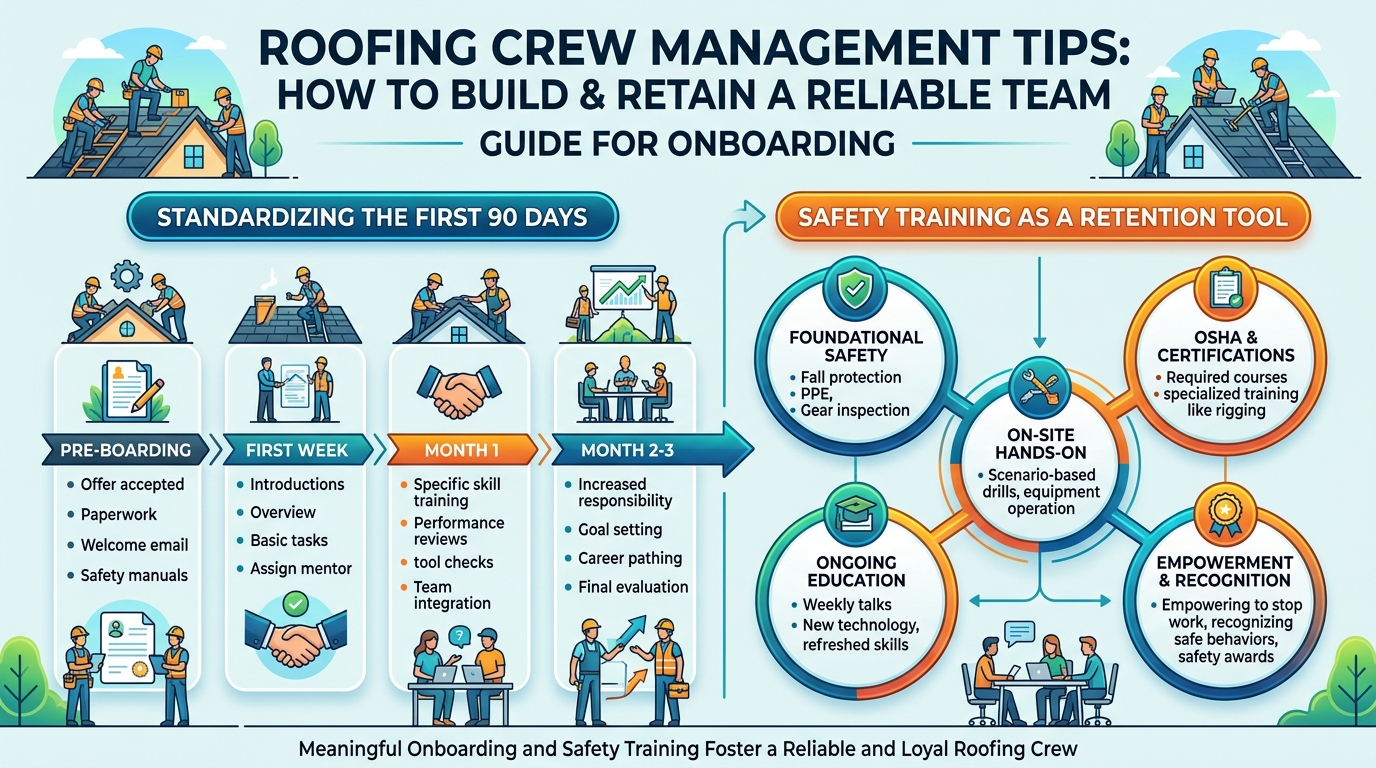
Standardizing the First 90 Days
A structured onboarding process is the foundation of any 'roofing crew management tips: how to build and retain a reliable team guide.' The first week should be strictly focused on safety protocols and company culture rather than raw production speed. Provide every new hire with a 'Starter Kit' that includes high-visibility vests, a brand-new hammer tacker, and a 50-foot tape measure. This $150 investment immediately makes the new employee feel like a professional member of the team rather than a temporary laborer.
Assigning a 'mentor' or 'buddy' for the first 30 days is a proven way to accelerate the learning curve for new roofers. A senior installer can show the new hire the nuances of flashing a chimney or installing a ridge vent that aren't always covered in basic training. This mentorship program should include a small $50 weekly bonus for the mentor to ensure they take the responsibility seriously. Proper mentorship reduces the likelihood of costly installation errors by roughly 20% during the critical first month of employment.
Check-ins at the 30, 60, and 90-day marks are essential for catching potential issues before they lead to a resignation. Use these meetings to ask specific questions about their comfort level with different roofing systems, from TPO to traditional asphalt shingles. If a new hire is struggling with a specific task, schedule a 2-hour remedial training session rather than letting them continue to make mistakes. These touchpoints demonstrate that management is attentive and committed to the employee's success within the organization.
Safety Training as a Retention Tool
Safety is the most significant concern for roofers, and a company that prioritizes it will always have a higher retention rate. Conduct weekly 15-minute 'Safety Stand-Downs' where the crew discusses a specific hazard, such as heat exhaustion or ladder securement. Investing $500 per year per employee in OSHA 10-hour or 30-hour training shows that you value their life more than the project timeline. This commitment to safety builds a culture of trust that makes it very difficult for competitors to lure your workers away.
Equipping your team with the best safety gear available, such as the latest MIPS-equipped hard hats and ergonomic harnesses, reduces the physical toll of the job. A high-quality harness might cost $300, but it is a fraction of the cost of a workers' compensation claim which can average over $40,000 for a fall. When workers see that you are willing to spend more on their protection, they respond with increased loyalty and a more diligent work ethic. This 'safety-first' mentality is a core component of building a reliable, long-term roofing team.
Documentation of safety protocols is not just for compliance; it is a management tool that sets clear expectations. Require every foreman to complete a daily safety checklist on a mobile app like Hulo before any work begins on the roof. This process takes less than 5 minutes but ensures that all anchor points are checked and all crew members are wearing their PPE. Consistent enforcement of these rules prevents the 'shortcuts' that lead to accidents and helps maintain a professional atmosphere on every job site.
Pro Tip: Use a digital onboarding checklist to ensure no step is missed, from I-9 verification to the first tool safety demonstration.
Roofing crew management tips: how to build and retain a reliable team tips for safety?
OSHA Compliance and Fall Protection Systems
Fall protection is the most cited OSHA violation in the roofing industry, and managing it effectively is a top 'roofing crew management tips: how to build and retain a reliable team tips' item. You must ensure that every worker on a roof with a slope steeper than 4:12 is protected by a guardrail system, safety net system, or personal fall arrest system (PFAS). Inspect all ropes and harnesses every Monday morning for signs of wear or UV damage, and replace any gear that looks questionable immediately. A single $15,000 OSHA fine can wipe out the profit from three average residential roofing jobs.
Implement a 'Zero Tolerance' policy for safety violations, but pair it with a positive reinforcement program. If a crew goes an entire month without a single safety infraction, reward them with a catered lunch or a $50 gift card to a local tool supplier. This creates a peer-pressure environment where crew members look out for one another's safety to ensure they all get the reward. It shifts the perception of safety from a 'management burden' to a collective team goal that everyone is invested in achieving.
Heat stress management is a critical safety factor for roofing crews working in 90-degree plus temperatures during the summer. Provide 2 gallons of water per person per day and mandate 15-minute shade breaks every 2 hours when the heat index exceeds 100 degrees. Providing branded cooling towels and electrolyte replacement drinks like Gatorade or Liquid I.V. costs less than $10 per day per crew but prevents heat stroke incidents. A crew that feels physically cared for during extreme conditions is far more likely to stay with your company long-term.
Tool and Equipment Maintenance Protocols
Properly maintained tools are safer and more efficient, which reduces crew frustration and improves overall job satisfaction. Establish a 'Tool Tuesday' where the foreman spends 30 minutes inspecting pneumatic hoses, compressor oil levels, and the condition of all ladders. Replacing a $30 worn-out hose before it bursts on the job site prevents a 2-hour delay and a potential injury. This level of organization shows the crew that you are a professional outfit that values their time and safety.
Encourage crew members to report broken tools immediately without fear of reprimand by keeping a small stock of 'backup' equipment in the warehouse. If a nail gun jams frequently, it slows down the entire crew and leads to poor installation quality that results in callbacks. Investing $400 in a high-quality Hitachi or DeWalt backup nailer ensures that production never grinds to a halt. When the crew has the right tools for the job, they can work with more confidence and less physical strain.
Vehicle safety and organization are often overlooked but are vital for a professional roofing team. Use a van shelving system to ensure that heavy bundles of shingles or rolls of underlayment are secured and easy to access. A cluttered truck leads to lost tools and wasted time, which costs the average roofing company $2,000-$5,000 per year in lost productivity. A clean, organized truck also serves as a mobile billboard that attracts both new customers and potential employees who want to work for an organized company.
| Item | Average Cost | Replacement Cycle |
|---|---|---|
| Full Body Harness | $120 - $250 | 2-3 Years |
| Vertical Lifeline (50ft) | $80 - $150 | As needed / Inspection |
| Roof Anchor (Permanent) | $30 - $60 | Per Job / Permanent |
| MIPS Safety Helmet | $90 - $140 | 5 Years / After Impact |
Common Roofing Safety Equipment Costs (2026)
Key Takeaway: Safety is the highest priority for retention; investing in top-tier PPE and heat management saves lives and protects your bottom line from OSHA fines.
Ready to put this into action?
Hulo gives you everything to run your roofing business — website, CRM, scheduling, and invoicing. Join the waitlist for V2.
Join the WaitlistRoofing crew management tips: how to build and retain a reliable team for beginners using technology?
Leveraging CRM and Scheduling Software
For beginners, the most important 'roofing crew management tips: how to build and retain a reliable team for beginners' is to stop using paper schedules and whiteboards. Using a platform like Hulo allows you to send job details, site maps, and material lists directly to your crew's smartphones. This eliminates the morning 'chaos' at the warehouse where everyone is trying to figure out where they are going. Digital scheduling can improve on-site arrival times by 20% and ensures that the right crew is sent to the right job based on their skill set.
CRM software also allows for better communication with the customer, which reduces the stress on your roofing crew. When a customer knows exactly when the crew will arrive and what the process looks like, they are less likely to hover over the workers or ask constant questions. This 'buffer' created by technology allows your crew to focus on their craft without unnecessary interruptions. A happy, informed customer is also more likely to offer the crew water or snacks, which boosts morale significantly.
Integrating photo-documentation into your daily workflow is a game-changer for new roofing business owners. Require your foreman to upload 'Before,' 'During,' and 'After' photos of every project into your management software. This creates a digital paper trail that protects your crew from false damage claims and provides you with marketing material for your website. It also allows you to remotely inspect the quality of the work, ensuring that your high standards are being met even when you aren't on the roof.
Digital Time Tracking and Payroll Accuracy
Accurate payroll is the fastest way to build trust with a new roofing crew, and digital time tracking is the best way to achieve it. Using GPS-verified clock-ins ensures that workers are paid for the exact time they are on the job site, including overtime which must be calculated at 1.5x the base rate. This transparency eliminates disputes over hours and ensures that your labor costs are accurately reflected in your job costing. Most modern software solutions cost less than $50 a month and pay for themselves by eliminating just two hours of unearned labor.
Automated payroll systems can also handle the complexities of prevailing wage jobs or different pay rates for different tasks. If a worker spends half the day on a steep-slope residential roof and the other half on a flat commercial roof, the system can track those rates separately. This level of precision is impossible with manual timecards and is essential for maintaining compliance with state labor laws. Ensuring your crew is paid correctly and on time every Friday is the single most important factor in retaining a reliable team.
Technology also facilitates better 'Tool Tracking' which prevents the loss of expensive equipment like generators or thermal imaging cameras. Assigning specific tools to specific crews via a digital inventory system holds the team accountable for their gear. When a crew knows that a $2,000 piece of equipment is checked out in their name, they are much more likely to ensure it is locked up at the end of the day. This accountability reduces equipment loss by up to 50% for growing roofing companies.
15%
Productivity Increase
Companies using field management software report an average 15% increase in daily output due to better scheduling.
Roofing crew management tips: how to build and retain a reliable team 2026 compensation trends?
The Rise of Value-Based Incentives
As we look at 'roofing crew management tips: how to build and retain a reliable team 2026,' the trend is shifting toward value-based incentives rather than just hourly pay. Many forward-thinking contractors are offering 'Profit Sharing' on specific projects where the crew receives a percentage of the savings if they finish under the estimated material or labor budget. For a $20,000 roof, a 2% savings bonus could mean an extra $400 for the crew to split. This aligns the crew's interests with the company's profitability and encourages more efficient work habits.
Another emerging trend is providing 'Longevity Bonuses' that increase every year an employee stays with the firm. For example, an employee might receive a $500 bonus on their first anniversary, $1,000 on their second, and $2,000 on their third. This creates a significant financial incentive for workers to stay put rather than jumping to a competitor for an extra $1 per hour. In an industry where the cost to replace a skilled roofer can exceed $5,000, these bonuses are a smart investment in your company's stability.
Flexible scheduling is also becoming a major compensation trend in 2026, especially for younger workers who value work-life balance. Some roofing companies are experimenting with a '4-day, 10-hour' work week, which gives the crew a 3-day weekend every week. This can be particularly effective during the summer months when working early in the morning is preferred to avoid the midday heat. Offering flexibility that other contractors won't can make your company the employer of choice in your local market.
Education and Certification as Compensation
Investing in your team's professional education is a form of compensation that pays dividends for both the employee and the employer. Paying for a lead installer to become a 'Master Elite' contractor with a manufacturer like GAF can increase your company's warranty offerings and the employee's market value. These certifications often come with a pay raise, but the primary benefit is the sense of professional growth and pride it instills in the worker. A certified roofer is a more confident and competent roofer, which leads to better job site outcomes.
Language training is another unique benefit that can help retain a diverse roofing crew. Offering English as a Second Language (ESL) classes or Spanish for Managers can bridge communication gaps and make all employees feel more integrated into the team. This investment in communication reduces misunderstandings on the job site and fosters a more inclusive company culture. When workers feel they can communicate effectively with their supervisors, job satisfaction scores typically rise by 30% or more.
Finally, providing financial literacy training can be a life-changing benefit for many trade workers. Bringing in a financial advisor once a quarter to talk about budgeting, saving for a home, or understanding taxes helps your crew build more stable lives. This stability outside of work translates to more reliable performance on the job. Roofers who are not stressed about their personal finances are more focused, more productive, and less likely to miss work due to personal crises.
Pro Tip: Offer a 'Tool Allowance' of $25 per month that accumulates, allowing workers to buy their own high-quality hand tools over time.
Wrapping Up
Building and retaining a reliable roofing team in 2026 requires a strategic combination of competitive pay, rigorous safety standards, and modern technology. By implementing these roofing crew management tips, you can reduce turnover, improve job quality, and ultimately scale your business with confidence. Start by automating your back-office with Hulo and focus your energy on leading your crew to success.
Frequently Asked Questions
How much does it cost to hire and train a new roofer in 2026?
The total cost to hire and train a new roofer typically ranges from $4,000 to $7,000 when accounting for recruitment ads ($500), onboarding time, initial safety gear ($400), and the lower productivity of the first 90 days. This investment highlights why retention is so critical for roofing profitability. Many contractors use a 90-day 'probationary period' with a $2/hour pay bump upon successful completion to justify this initial expense.
What's the difference between a roofing subcontractor and a W2 employee?
A W2 employee works directly for you, uses your tools, and you withhold taxes and provide workers' comp, whereas a subcontractor (1099) is an independent business entity that provides their own insurance and equipment. Misclassifying employees as subcontractors to save on 15.3% payroll taxes can result in IRS fines exceeding $50,000 per worker. Most high-quality roofing teams are built on a W2 model to ensure better control over safety and quality standards.
Do I need specific certifications to manage a roofing crew?
While not always legally required, having an OSHA 30-hour Construction Safety certification and a state-level roofing contractor license is essential for professional management. Certifications from manufacturers like GAF, Owens Corning, or CertainTeed (e.g., Master Shingle Applicator) allow you to offer extended warranties and prove your expertise to your crew. Membership in the NRCA also provides access to management training resources that can improve your leadership skills.
How long does it take to build a reliable roofing crew from scratch?
Building a truly cohesive and reliable roofing crew usually takes 6 to 12 months of consistent work and management. During the first 3-6 months, you will likely experience 'churn' as you filter out unreliable workers and establish your company culture. By the one-year mark, a well-managed crew should be able to complete a standard 2,500 sq. ft. residential roof in 1-2 days with minimal supervision and zero safety incidents.
What certifications do I need for Roofing crew safety?
Every crew member should have at least an OSHA 10-hour card, while foremen should possess an OSHA 30-hour card. Additionally, if your crew does torch-down roofing, CERTA (Certified Roofing Torch Applicator) certification is mandatory for insurance compliance. First Aid and CPR certifications are also highly recommended, as they can reduce the severity of on-site injuries and are often required for commercial roofing contracts.
How do I get paid faster as a Roofing contractor to pay my crew?
Use a field management tool like Hulo to send digital invoices immediately upon job completion, allowing customers to pay via credit card or ACH. Implementing a 'Progress Payment' schedule—such as 33% at signing, 33% at material delivery, and 34% at completion—ensures you have the cash flow to meet weekly payroll. Offering a 2% discount for payments made within 24 hours of completion can also accelerate your receivables by 5-10 days.
Is field management software worth it for small roofing businesses?
Yes, for a small roofing business with even one crew, software like Hulo is worth the $50/month investment because it prevents costly scheduling errors and 'lost' billable hours. The ability to track project photos and digital signatures from the job site can save a contractor 10+ hours a month in administrative tasks. Furthermore, it professionalizes the business, making it easier to attract higher-paying customers and more reliable employees.
Ready to Streamline Your Roofing Crew Management?
Hulo provides the all-in-one tools you need to schedule crews, track time, and get paid faster—all for less than $50/month. Join thousands of successful contractors who are scaling their businesses with Hulo today.
Join the WaitlistMore from the Blog
7 Smart Steps to How to Estimate a Roofing Job for Contractors (2026 Guide)
To estimate a roofing job, you must calculate the total square footage of the roof and divide by 100 to determine the nu...
11 Expert Ways to Get Roofing Leads Without Door Knocking for Contractors (2026)
To get roofing leads without door knocking, you must implement a multi-channel digital strategy focusing on Google Local...
How to Get Roofing Leads: 15 Proven Strategies for 2026
The roofing industry in 2026 is a $56.7 billion market, yet many contractors struggle to maintain a consistent pipeline ...