12 Actionable Steps: What Do I Need to Start a Roofing Business for New Contractors (2026)
18 min read·Updated March 26, 2026To start a roofing business, you need a state-specific contractor license, general liability insurance with at least $1 million in coverage, and approximately $15,000 to $25,000 in initial startup capital. You also require a legal business structure like an LLC, a reliable 3/4-ton truck, OSHA-compliant safety equipment, and a digital system for managing estimates and invoices. In this guide, you will find a complete checklist for new entrepreneurs looking to launch a profitable roofing company from scratch in 2026.
Table of Contents
What Licenses Do I Need to Start a Roofing Business in 2026?
Navigating State and Local Contractor Licenses
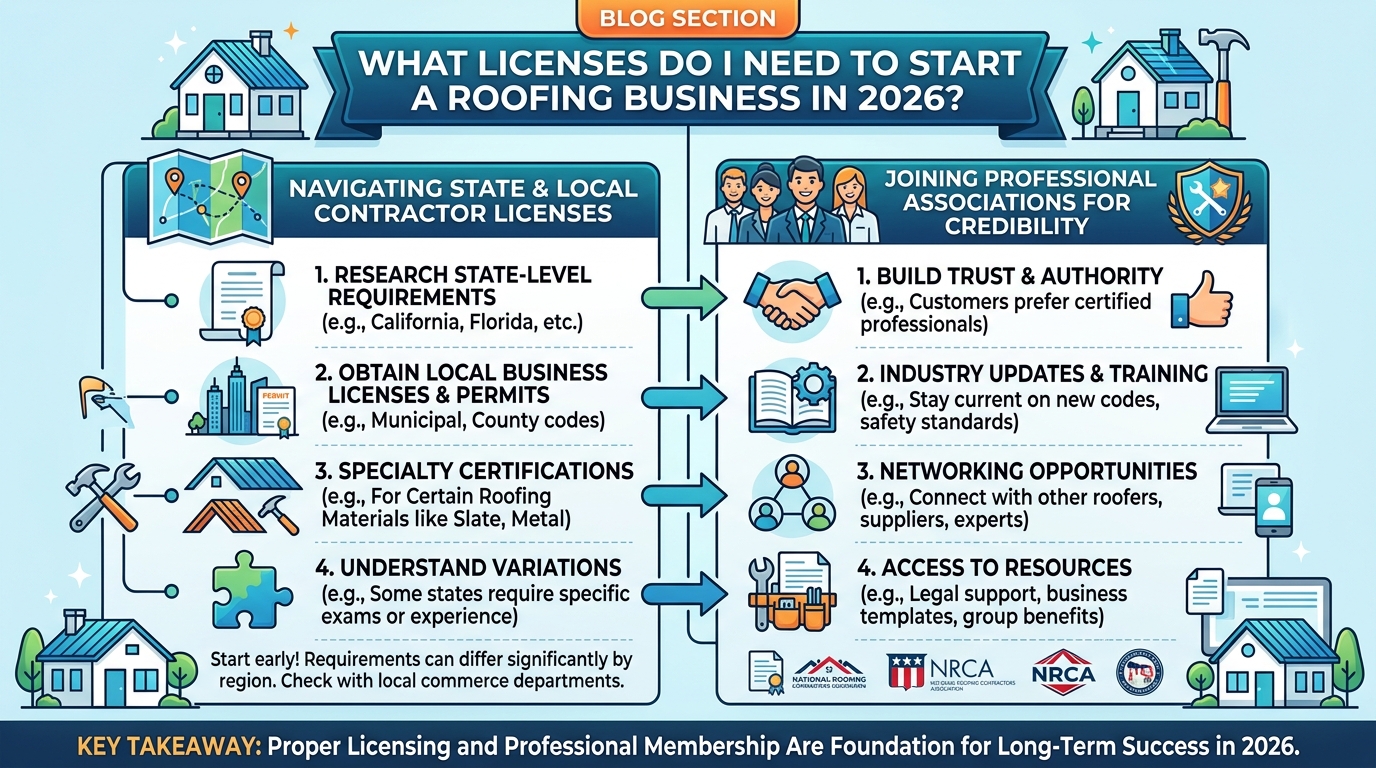
Securing the correct license is the first legal hurdle for any roofing entrepreneur in 2026. Most states, such as California with its C-39 license or Florida with its certified roofing contractor designation, require you to prove 2-4 years of field experience before you can even sit for the exam. These exams typically cover both the trade specifics—like flashing details and shingle application—and business law to ensure you understand mechanics' liens and contract obligations.
The cost for these licenses varies significantly by jurisdiction, but you should budget between $450 and $1,200 for application fees, background checks, and the examination itself. In states like Texas, where licensing is handled at the municipal level rather than the state level, you may need to register in every city or county where you plan to pull permits. Failure to hold the proper credentials can result in fines exceeding $5,000 per job site and the immediate shutdown of your operations.
Beyond the trade license, you must establish a legal business entity through your Secretary of State, with most new contractors opting for a Limited Liability Company (LLC) to protect personal assets. Filing for an LLC generally costs between $50 and $500 depending on your state, and it requires you to appoint a registered agent. Once your LLC is approved, you must apply for a federal Employer Identification Number (EIN) through the IRS website, which is a free service but essential for opening business bank accounts.
Finally, you should check for local occupational licenses or 'privilege' taxes required by your specific city or township. These are often annual renewals that cost between $50 and $200 and are required for you to legally conduct business within city limits. Keeping a digital folder of all these documents is vital, as platforms like Hulo can help you store and track expiration dates for all your professional credentials in one centralized location.
Joining Professional Associations for Credibility
While not legally required, joining professional organizations like the National Roofing Contractors Association (NRCA) provides a massive boost to your brand authority in a crowded 2026 market. Membership dues for the NRCA typically start around $500 per year for small contractors, but the access to safety training, technical manuals, and consumer leads often pays for itself within the first two projects. Being able to display an NRCA logo on your website and truck tells homeowners that you are committed to industry standards.
You should also consider manufacturer certifications from major brands like GAF, Owens Corning, or CertainTeed. To become a 'Master Elite' or 'Preferred Contractor,' you usually need to be in business for at least 2-3 years and carry a high credit rating, but even beginner-level certifications are available for those who attend manufacturer training sessions. These certifications allow you to offer enhanced warranties, such as 50-year non-prorated coverage, which 85% of homeowners prefer over standard labor warranties.
Regional associations, such as the Western States Roofing Contractors Association (WSRCA), offer localized networking and legal advice specific to your climate and regional building codes. These groups often host annual trade shows where you can get hands-on experience with new 2026 materials, like solar-integrated shingles or cool-roof coatings. Networking with these peers can also lead to subcontracting opportunities when larger firms have more work than their internal crews can handle.
Lastly, maintaining an A+ rating with the Better Business Bureau (BBB) remains a key trust signal for the 50+ demographic, who still control a large portion of residential roofing spend. The annual accreditation fee is roughly $400 to $600 for a small business, but the 'Seal of Trust' is a powerful conversion tool on your estimates. Documenting your certifications and memberships in your marketing materials ensures that you aren't just another 'guy with a ladder' in the eyes of your prospects.
$1,500
Avg. Licensing Costs
Includes exam fees, LLC formation, and local permits.
Key Takeaway: You must secure a trade-specific state license (like a C-39), form an LLC, and obtain an EIN before taking your first roofing contract.
What Insurance and Bonds are Required for Roofing Startups?
General Liability and Workers' Compensation
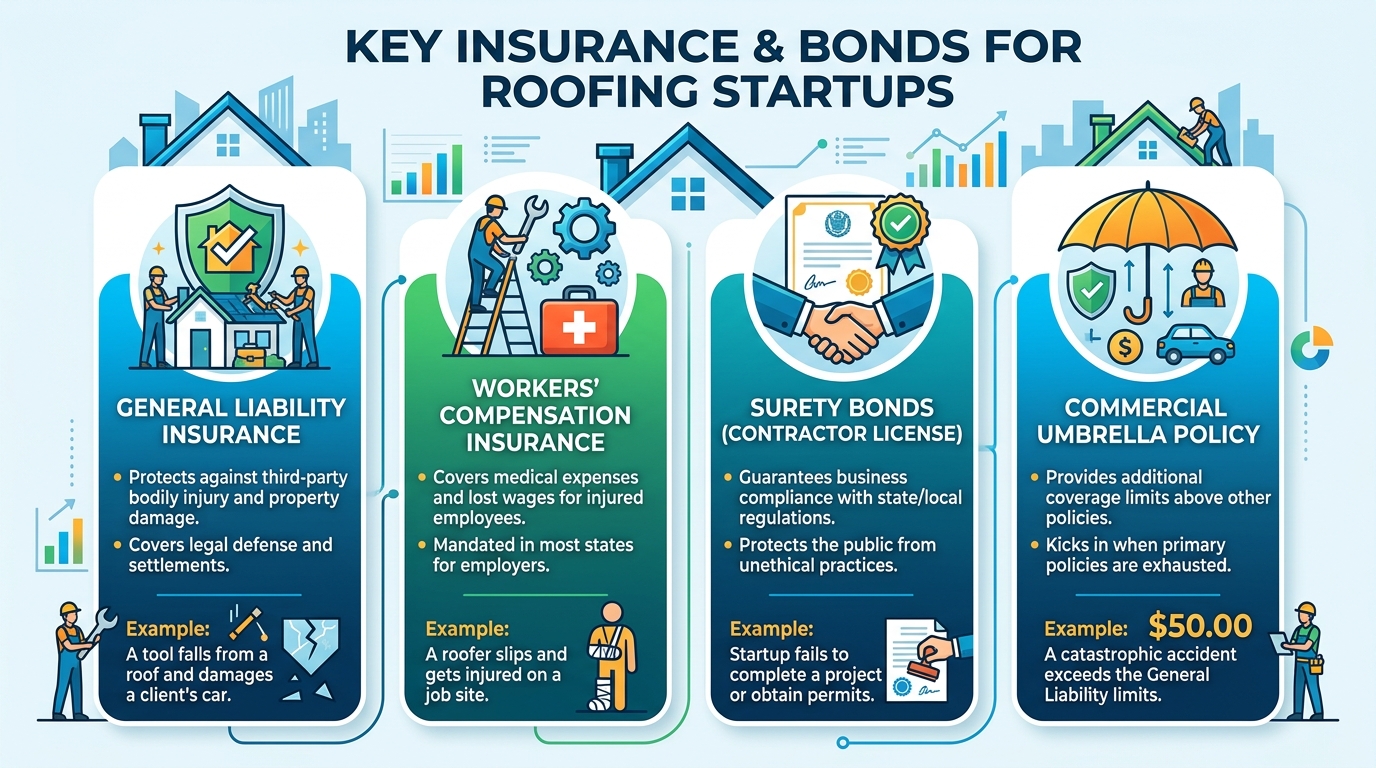
Roofing is classified as a high-risk trade, making insurance one of your largest fixed overhead costs in 2026. General Liability (GL) insurance is non-negotiable and should carry a minimum limit of $1 million per occurrence and $2 million aggregate. For a new roofing business with no claims history, expect to pay between $3,000 and $6,000 annually for GL coverage, which protects you against property damage and third-party injuries.
Workers' Compensation insurance is mandatory in nearly every state if you have even one employee, and in some states like California, it is required for all roofing contractors regardless of whether they have staff. Because of the risk of falls, 'Workers' Comp' rates for roofers are among the highest in construction, often ranging from $15 to $30 for every $100 of payroll. It is critical to use a 'pay-as-you-go' provider to avoid massive audit penalties at the end of your first year.
Inland Marine insurance, also known as a 'tool floater,' is another essential policy that covers your equipment while it is in transit or on a job site. If a $2,000 compressor or $3,000 worth of copper flashing is stolen from your truck overnight, your standard auto or GL policy likely won't cover it. This coverage is relatively affordable, usually costing around $500 to $800 per year for $20,000 worth of tool protection.
Commercial Auto insurance is also required, as personal auto policies specifically exclude coverage for vehicles used for business purposes, especially those carrying ladders and heavy materials. A policy for a single 3/4-ton truck used for roofing typically costs between $1,800 and $3,500 per year. Ensuring your policy includes 'any auto' or 'hired and non-owned' coverage is smart if you ever plan to have employees or subs drive their own vehicles for company errands.
Surety Bonds and Umbrella Policies
Many states and municipalities require a contractor license bond, which is a type of surety bond that guarantees you will follow local building codes and regulations. These bonds are usually for a set amount, such as $15,000 or $25,000, but you only pay a small percentage (1-3%) of that total as an annual premium. If your credit score is above 700, you can expect to pay as little as $150 to $250 per year for a standard $15,000 license bond.
Umbrella or Excess Liability insurance provides an additional layer of protection above your General Liability and Commercial Auto limits. In the event of a catastrophic accident involving multiple injuries or total home destruction, an umbrella policy can provide an extra $1 million to $5 million in coverage. For a small roofing firm, a $1 million umbrella policy usually costs an additional $1,000 to $1,500 per year and is often required for commercial roofing contracts.
Professional Liability or 'Errors and Omissions' (E&O) insurance is becoming more common for roofers who provide specialized consulting or architectural design services. If a roof design you proposed fails to meet drainage requirements and causes structural damage, E&O would cover the legal defense and settlement. While not standard for every residential shingle roofer, it is a wise investment for those moving into high-end custom metal or slate installations.
Managing these various policies requires careful documentation to ensure you are always 'current' when a general contractor or homeowner asks for a Certificate of Insurance (COI). Using a platform like Hulo allows you to store your COIs digitally and send them to clients instantly from your phone. This speed of response often makes the difference between winning a $20,000 job and being passed over for a more organized competitor.
Pro Tip: Always ask your insurance agent for 'per-project' aggregate limits, which ensures your full coverage is available for every job you take on.
What Equipment Do I Need to Start a Roofing Business for Beginners?
Essential Hand Tools and Safety Gear
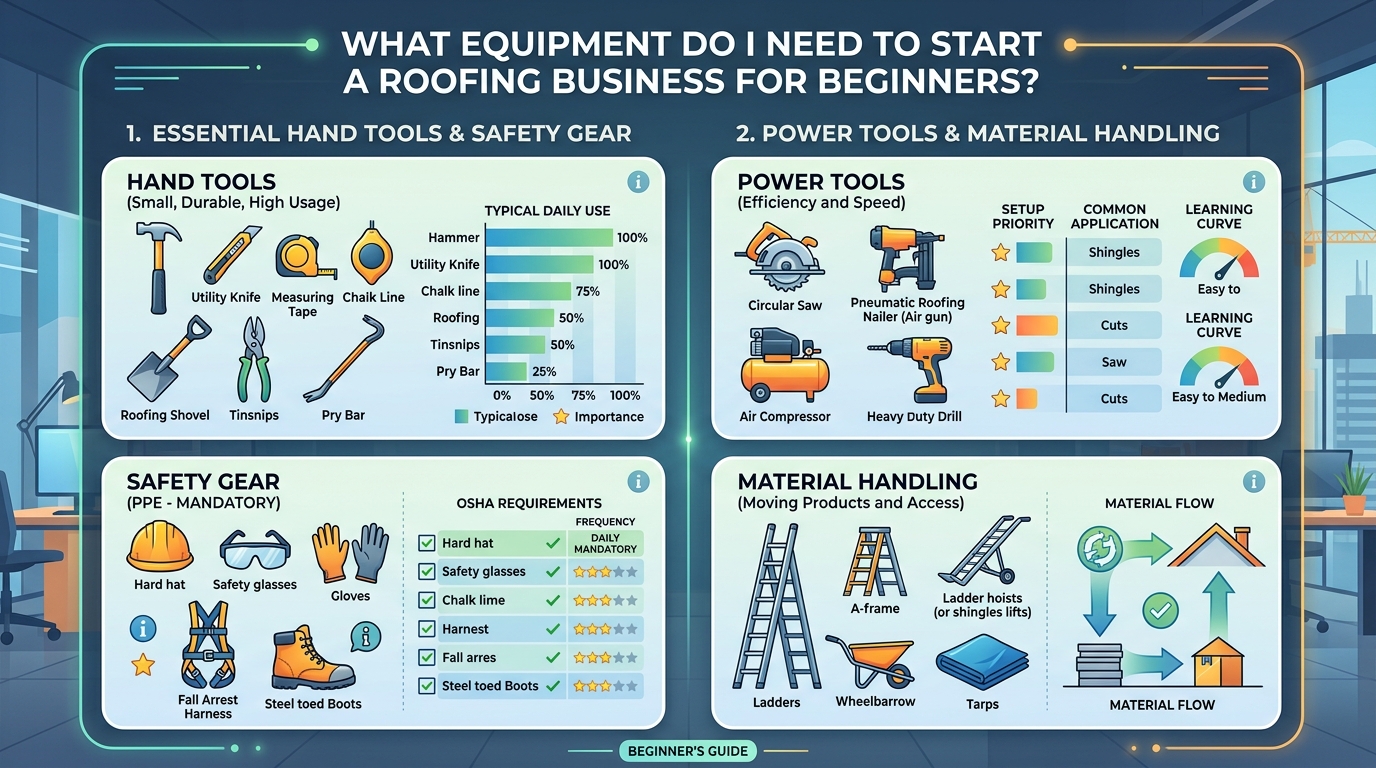
Every roofer starting in 2026 needs a high-quality set of hand tools, starting with a specialized roofing hammer (like an Estwing) and a heavy-duty utility knife with plenty of hook blades. You will also need a variety of pry bars, such as a 'shingle ripper' or 'the red bar,' for removing old materials without damaging the underlying deck. Budget approximately $500 for a complete personal tool belt setup including a chalk line, tape measure, and tin snips.
Safety gear is your most important equipment investment and must meet current OSHA 1926 subpart M standards. A complete personal fall arrest system (PFAS) includes a full-body harness, a shock-absorbing lanyard or self-retracting lifeline (SRL), and a roof anchor. A high-quality harness kit from a brand like Werner or Guardian typically costs between $200 and $400, and you should have one for every person on the roof at all times.
Ladders are the backbone of your operations, and you will need at least three types to handle most residential jobs. A 28-foot or 32-foot aluminum extension ladder is necessary for reaching two-story eaves, while a 16-foot extension ladder handles single-story work. You should also invest in a sturdy A-frame stepladder for interior attic inspections. Expect to spend $800 to $1,200 on professional-grade Grade 1A (300 lb capacity) ladders that can withstand daily job site abuse.
Don't forget the 'soft' equipment that keeps a job site clean and professional, such as heavy-duty tarps (10x12 and 20x30 sizes) and a magnetic nail sweeper. A 36-inch magnetic sweeper costs about $150 and is essential for preventing flat tires and keeping homeowners' pets safe from stray roofing nails. Using these tools to leave a spotless yard is the fastest way to earn a 5-star review and future referrals.
Power Tools and Material Handling
To be efficient in 2026, you cannot rely on hand-nailing; you need a reliable pneumatic or cordless nail gun system. A standard pneumatic setup includes a portable gas-powered or electric air compressor (like a Rolair or Makita) and 2-3 coil roofing nailers (Bostitch or DeWalt). This setup, including hoses and fittings, will cost between $1,500 and $2,500 but will allow a two-man crew to dry-in and shingle a 20-square roof in a single day.
Cordless technology has improved significantly, and many roofers are now opting for battery-powered nailers for small repairs and ridge cap work to avoid dragging hoses. A single cordless roofing nailer from Milwaukee or DeWalt costs around $400 to $600 with batteries. Additionally, a cordless circular saw and a reciprocating saw (Sawzall) are necessary for replacing rotten plywood decking or cutting out old flashing.
Material handling is the most physically demanding part of roofing, and investing in a power ladder or 'shingle lift' can save your back and reduce labor costs. A gas-powered ladder hoist (like a Reimann & Georger) can lift 400 lbs of shingles to the roof in seconds and costs between $3,500 and $5,000. While expensive, it eliminates the need to pay extra for 'ground drops' from your supplier and allows you to take jobs that have difficult access.
Lastly, consider your debris disposal strategy, which is a major operational cost. While many start by renting 20-yard or 30-yard roll-off dumpsters for $450 to $600 per pull, some contractors invest in their own dump trailer. A 14-foot hydraulic dump trailer costs between $8,000 and $12,000 but can save you thousands in rental fees over a single season if you have a truck capable of towing it and a local landfill with reasonable tipping fees.
| Category | Estimated Cost | Priority |
|---|---|---|
| Safety Harnesses & Anchors | $600 | High |
| Ladders (28' and 16') | $1,000 | High |
| Compressor & 2 Nail Guns | $1,800 | High |
| Hand Tools & Tool Belts | $500 | High |
| Magnetic Sweeper & Tarps | $300 | Medium |
| Used Dump Trailer | $8,500 | Low |
| Total Essential Kit | $4,200 | N/A |
New Roofing Business Equipment Budget (2026)
How Do New Roofing Contractors Get Their First 10 Customers?
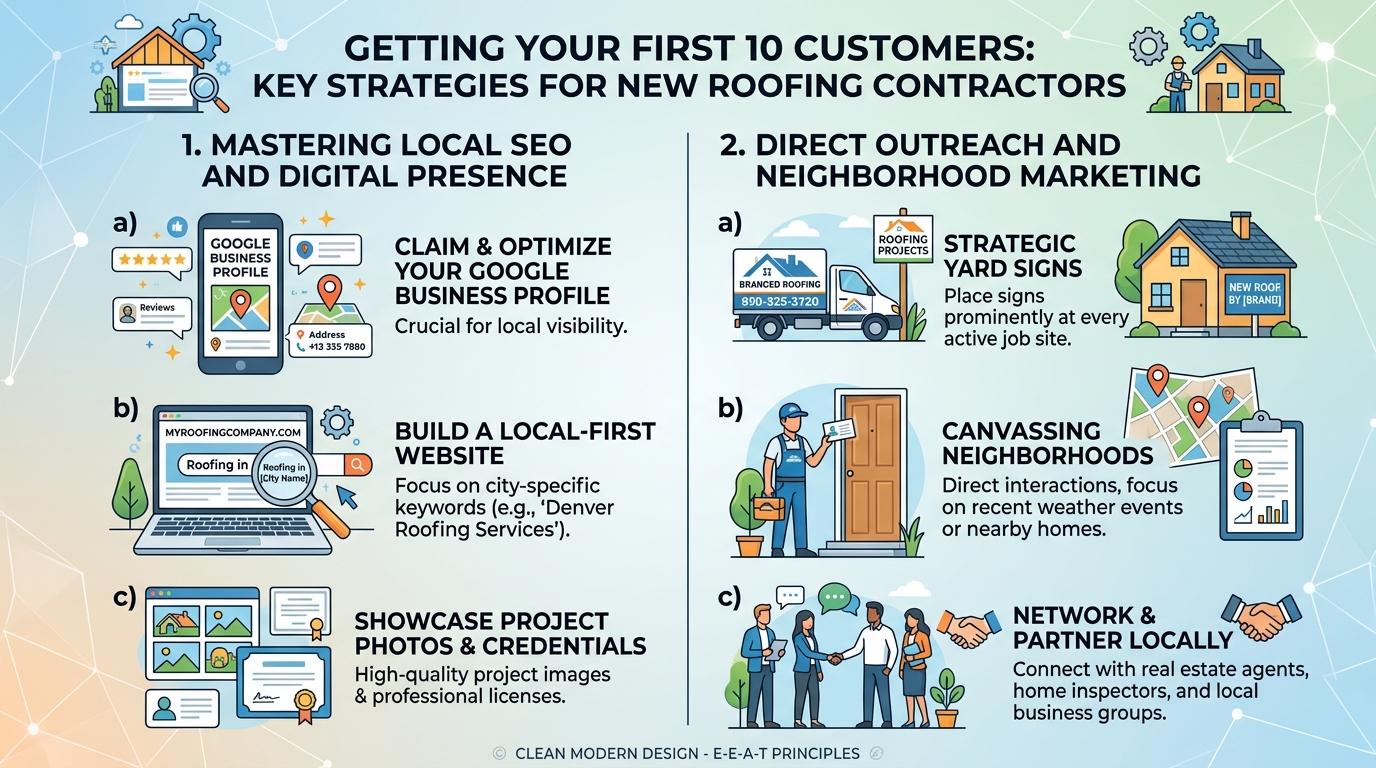
Mastering Local SEO and Digital Presence
In 2026, your digital 'curb appeal' is just as important as your actual roofing work. Start by claiming and optimizing your Google Business Profile (GBP), ensuring your business name, address, and phone number (NAP) are consistent across the web. Upload at least 20 high-resolution photos of your completed projects, your truck, and your team to show prospects that you are a legitimate local operation rather than a 'storm chaser' from out of state.
Your website doesn't need to be complex, but it must be mobile-responsive and optimized for 'roofing contractor [Your City]' keywords. A simple 5-page site should include a home page, a services page, a gallery, an 'About Us' section, and a clear contact form. Using a platform like Hulo can simplify this process by providing a conversion-optimized site that integrates directly with your lead management system for under $50 per month.
Generating reviews is the most effective way to climb the local search rankings. For your first 10 customers, offer a small 'neighborhood discount' in exchange for an honest video testimonial or a detailed Google review. Statistics show that 92% of homeowners read local reviews before hiring a contractor, and having just five 5-star reviews can increase your lead conversion rate by over 200% compared to having zero reviews.
Local Service Ads (LSAs) by Google are the fastest way to get the phone ringing if you have a modest marketing budget. These are the 'Google Guaranteed' ads that appear at the very top of search results. You only pay per lead (typically $40 to $120 for roofing), and because you must pass a background check and insurance verification to be 'Guaranteed,' these leads are often much higher quality than those from Facebook or Craigslist.
Direct Outreach and Neighborhood Marketing
Door knocking remains one of the most effective ways to get roofing leads, especially following a major weather event. However, the 'modern' way to door knock in 2026 involves using data-driven apps like SalesRabbit or Canvass to target homes with older roofs or known hail damage. Instead of a hard sell, offer a 'Free 21-Point Roof Health Inspection' to build trust and identify potential issues before they become leaks.
Yard signs are a low-cost, high-return marketing tool that every new roofer should use. Place a high-visibility sign with your logo and phone number in the yard of every active job site (with the homeowner's permission). Neighbors who see you working for several days are much more likely to call you for an estimate because they can see the quality of your crew and your cleanliness firsthand.
Strategic partnerships with related trades can provide a steady stream of referrals without the high cost of advertising. Reach out to local real estate agents, home inspectors, and insurance adjusters who are often the first to know when a roof needs replacement. Offering a $100 'referral fee' or simply reciprocating the lead can create a mutually beneficial relationship that keeps your calendar full during the slower winter months.
Direct mail is seeing a resurgence in 2026 as digital inboxes become increasingly cluttered. Sending a high-quality 'oversized' postcard to neighborhoods with homes built 15-20 years ago can yield a 1-2% response rate. If you target a neighborhood of 1,000 homes, 10-20 leads could easily result in 2-4 roof replacements, which more than covers the $800 cost of the mailing campaign.
92%
Homeowner Trust
Percentage of customers who trust online reviews as much as personal recommendations.
Ready to put this into action?
Hulo gives you everything to run your roofing business — website, CRM, scheduling, and invoicing. Join the waitlist for V2.
Join the WaitlistWhat Software Tools Do I Need to Manage a Roofing Business?
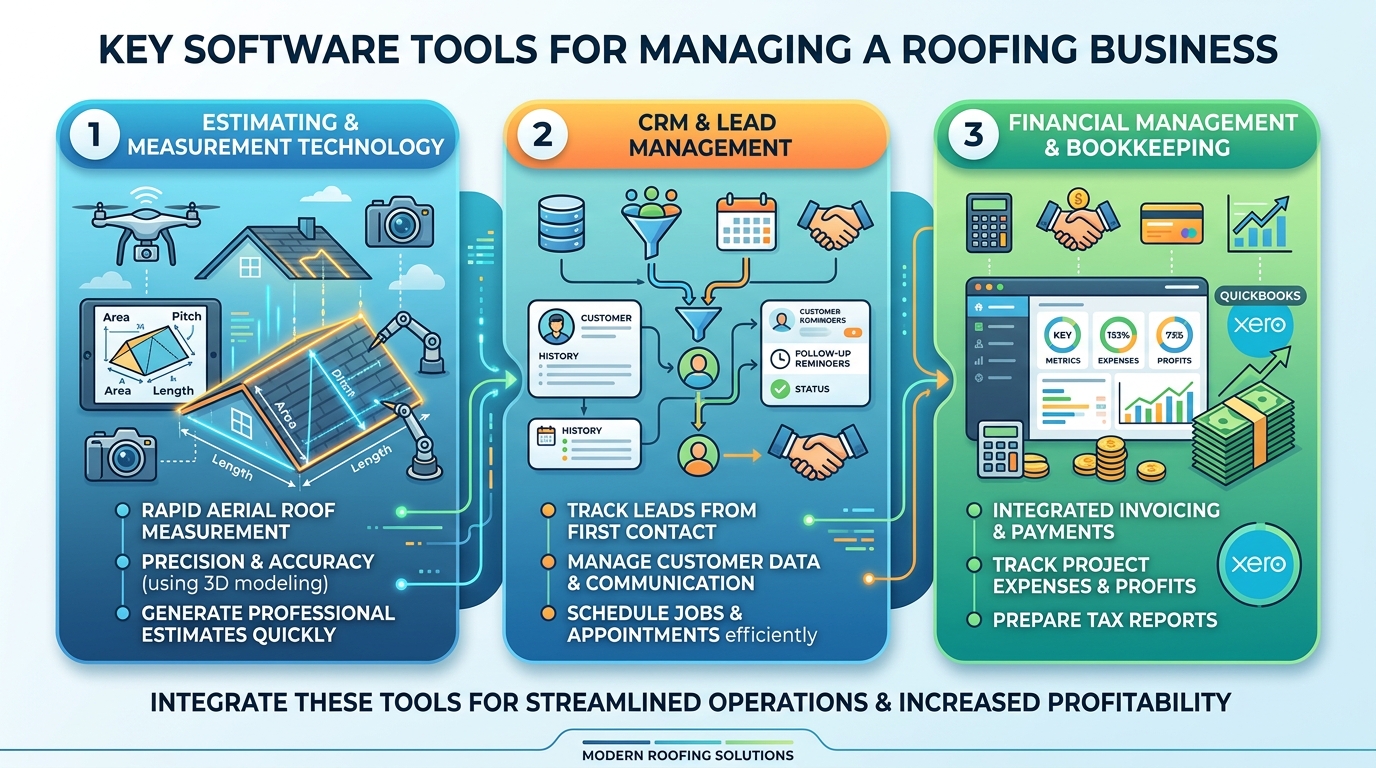
Estimating and Measurement Technology
The days of climbing a 10/12 pitch roof with a tape measure are largely over for professional contractors in 2026. Aerial measurement tools like EagleView or RoofSnap provide high-resolution satellite or drone imagery with precise measurements for squares, linear feet of ridges, and valley lengths. These reports typically cost between $30 and $70 per property but save you hours of manual labor and ensure your material orders are 99% accurate.
Once you have the measurements, you need professional estimating software to turn those numbers into a polished proposal. Modern tools allow you to build 'good-better-best' options, showing the homeowner the difference between a standard 3-tab shingle and a premium architectural shingle with a synthetic underlayment. Presenting these options digitally on a tablet often increases the average job size by 15-20% through easy upselling.
For the actual roof inspection, using a drone equipped with a 4K camera allows you to show the homeowner exactly what is wrong with their roof without them having to leave the ground. Software like DroneDeploy can even use AI to automatically identify hail hits or wind-damaged shingles. This visual evidence is incredibly powerful when negotiating with insurance adjusters or explaining a high repair cost to a skeptical homeowner.
Finally, your estimating software should integrate with your material suppliers, such as ABC Supply or Beacon. This allows you to see real-time pricing and availability for shingles, drip edge, and vents. Being able to give an 'on-the-spot' price that accounts for current material surcharges protects your profit margins in a volatile 2026 economy where asphalt prices can fluctuate by 5-10% in a single month.
CRM and Financial Management
A Customer Relationship Management (CRM) system is essential for tracking leads from the initial phone call to the final warranty registration. Without a CRM, leads will inevitably fall through the cracks, especially when you are busy on a roof. Platforms like Hulo offer a streamlined approach for new contractors, combining lead tracking, automated SMS follow-ups, and scheduling in one easy-to-use interface for under $50/month.
For financial management, QuickBooks Online remains the industry standard for roofing contractors. It allows you to track expenses, manage payroll for your crew, and generate profit and loss statements that you will need for tax season and loan applications. You should expect to pay $30 to $90 per month for a subscription that includes the ability to track 'job costing,' which is essential for knowing exactly how much profit you made on every specific roof.
Invoicing and payment processing must be digital in 2026 to ensure healthy cash flow. Most homeowners prefer to pay via credit card or ACH transfer rather than writing a physical check. Using an integrated payment processor allows you to send an invoice via text or email the moment the job is complete, often resulting in payment within minutes. Be sure to account for the 2.9% credit card processing fee in your initial project pricing.
Lastly, consider using a project management tool like Jobber or Housecall Pro if you have multiple crews. these tools allow you to assign tasks, track crew locations via GPS, and upload 'before and after' photos to each job file. This level of organization is what separates a professional roofing company from a 'chuck-in-a-truck' operation and allows you to scale your business beyond your own personal labor.
Key Takeaway: Adopt an all-in-one CRM like Hulo early to automate your lead follow-up and keep your overhead low while you scale.
What Do I Need to Start a Roofing Business 2026 Financial Plan?
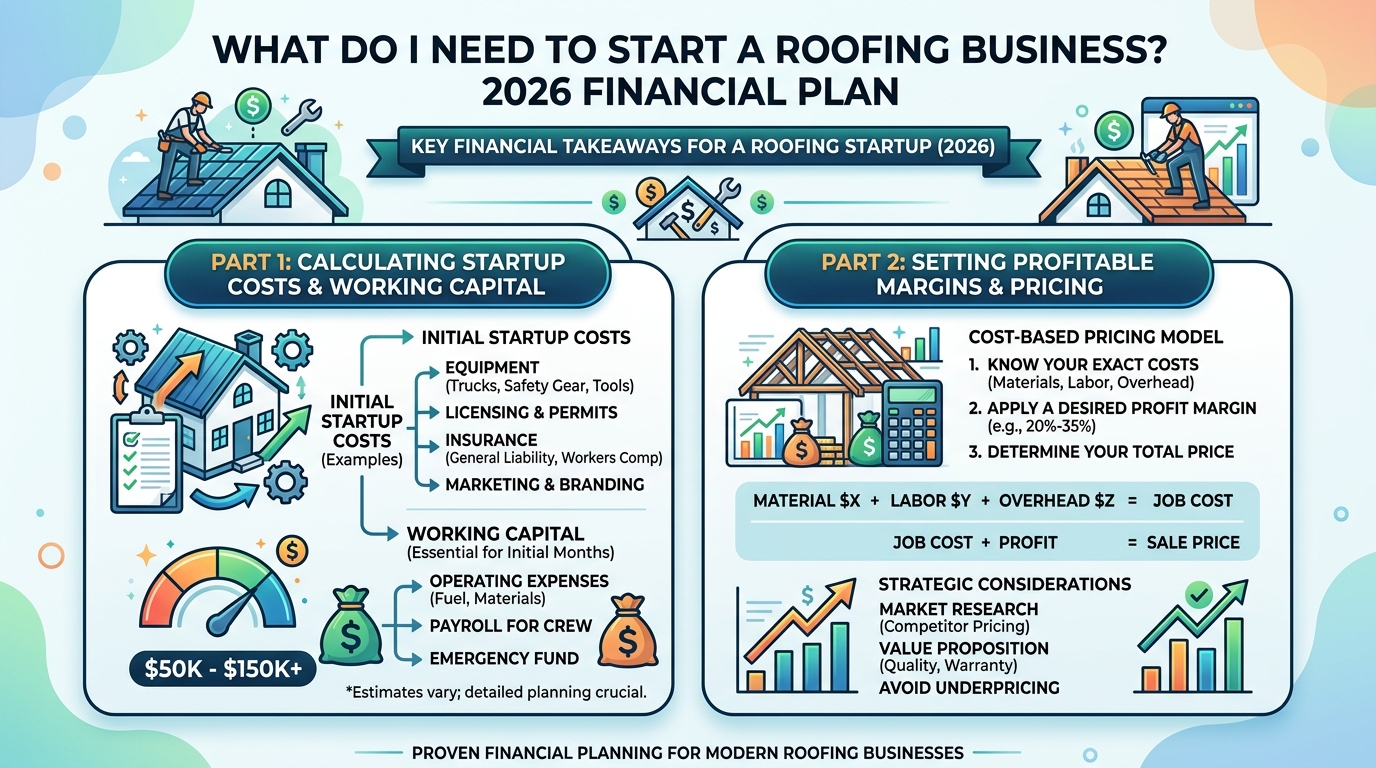
Calculating Startup Costs and Working Capital
Starting a roofing business from zero requires a realistic look at your 'burn rate' and initial investment. For a lean startup, you should have at least $15,000 to $25,000 in the bank. This covers your first three months of insurance premiums, equipment purchases, licensing fees, and a small marketing budget. Without this cushion, a single delayed payment from a customer or a week of rain can put your new business in financial jeopardy.
Working capital is the money you need to fund the materials and labor for a job before you get paid by the customer. A typical 25-square roof might cost $4,000 in materials and $3,000 in labor. If you don't require a down payment, you are 'out of pocket' $7,000 until the job is finished and the check clears. Successful 2026 roofers always require a 30-50% deposit upon signing the contract to cover these upfront material costs.
Labor costs will be your largest variable expense, whether you hire W2 employees or use 1099 subcontractors. Subcontractors typically charge 'per square' (usually $80 to $120 for a standard shingle tear-off and install), which makes your job costing simpler. However, W2 employees provide more control over quality and safety but come with the added costs of payroll taxes, unemployment insurance, and higher workers' comp premiums.
Don't forget to factor in your own salary as the owner. Many new entrepreneurs make the mistake of only taking what's 'left over' at the end of the month. Instead, build a 10-15% 'Owner's Draw' or salary into your overhead calculations from day one. This ensures that the business is actually profitable enough to support your lifestyle and isn't just a high-stress job you created for yourself.
Setting Profitable Margins and Pricing
To stay in business in 2026, your gross profit margin on roofing projects should be between 30% and 45%. This means if a job costs you $6,000 in labor and materials, you should be charging the customer at least $9,000 to $11,000. This 'margin' covers your fixed overhead—like truck payments, insurance, and software—and provides the net profit needed to grow the company.
Residential roofing is often priced 'per square' (a 10'x10' area), with national averages ranging from $450 to $750 per square depending on the material and roof complexity. A steep 12/12 pitch roof or a job requiring multiple layers of tear-off should command a significant premium. Use a detailed 'Price Book' to ensure your sales team (even if it's just you) is quoting consistent prices that protect your bottom line.
Material waste is a hidden profit killer that you must account for in every estimate. A standard gable roof usually has 10% waste, while a complex hip roof with many valleys can have 15-20% waste. If you fail to include these extra bundles in your quote, you will find yourself running to the supply house mid-job and eating into your own profit to finish the project.
Finally, track your 'Customer Acquisition Cost' (CAC) to ensure your marketing is actually working. If you spend $1,000 on Google Ads and get 10 leads, your cost per lead is $100. If you close 2 of those leads into jobs, your CAC is $500. Knowing this number allows you to confidently scale your marketing spend as your business grows, knowing exactly how much revenue every dollar of advertising will generate.
35-40%
Target Gross Margin
The sweet spot for roofing profitability after labor and material costs.
Wrapping Up
Starting a roofing business in 2026 requires a mix of technical skill, legal compliance, and modern marketing. By following this 12-step checklist—from licensing and insurance to equipment and software—you can build a foundation for a company that generates consistent six-figure profits. Focus on safety and professional presentation from day one to stand out in your local market.
Frequently Asked Questions
How much does it cost to start a roofing business?
A lean roofing startup typically costs between $15,000 and $30,000 in 2026. This includes $5,000 for a used truck, $4,000 for essential tools and safety gear, $3,000 for initial insurance down payments, and $2,000 for licensing and legal formation. Having an additional $10,000 in working capital is recommended to cover material costs for your first few jobs.
Do I need a license to start a roofing company?
In most U.S. states, a specialized roofing contractor license (such as the C-39 in California) is required for any project over a certain dollar amount, often as low as $500. You will typically need to pass a trade exam, a business law exam, and show proof of 2-4 years of experience. Always check with your state's contractor licensing board for specific 2026 requirements.
What is the best insurance for a new roofing business?
At a minimum, you need General Liability insurance ($1M/$2M limits), Workers' Compensation (mandatory in most states for roofing), and Commercial Auto insurance. You should also consider a Surety Bond for licensing and Inland Marine insurance to protect your tools from theft. Expect to pay 10-15% of your gross revenue toward insurance premiums due to the high-risk nature of the trade.
How do I get roofing leads without spending a fortune?
The most cost-effective leads come from a well-optimized Google Business Profile and local 'door-to-door' networking. Offering free roof inspections in neighborhoods with 15-20 year old homes can generate high-quality leads for the cost of your time and a few yard signs. Additionally, platforms like Hulo can help you capture and nurture leads from your website automatically for under $50/month.
What kind of truck is best for a roofing business?
A 3/4-ton or 1-ton pickup truck (like a Ford F-250 or Chevy 2500) is the industry standard for roofing. These vehicles have the towing capacity for dump trailers and the payload capacity for heavy ladder racks and emergency material pick-ups. While a van can work for repair-only businesses, a heavy-duty truck is essential for full-scale roof replacements.
How long does it take to set up a roofing company?
You can typically have the legal and administrative side of a roofing business set up in 4 to 8 weeks. This includes the time needed to file for an LLC, obtain your EIN, secure insurance, and wait for your state contractor license application to be processed. Marketing and lead generation should begin at least 30 days before your official launch date.
Is a roofing business profitable in 2026?
Yes, roofing remains one of the most profitable trades with average net profit margins ranging from 10% to 20% for well-managed companies. With the average residential roof replacement costing between $12,000 and $25,000, a single crew can generate significant revenue. Success depends on tight job costing, efficient labor management, and consistent lead generation.
What certifications do I need for roofing?
Beyond a state license, you should obtain OSHA 10-hour or 30-hour safety certification for yourself and your crew. Manufacturer certifications from brands like GAF or Owens Corning are also highly valuable as they allow you to offer extended warranties to your customers. These certifications usually require an application fee and attendance at a technical training seminar.
How do I get paid faster as a roofing contractor?
To improve cash flow, always require a 30-50% deposit before materials are delivered to the job site. Use digital invoicing through a platform like Hulo to send the final bill immediately upon completion, allowing customers to pay via credit card or ACH. Setting clear payment terms in your contract, such as 'Due Upon Receipt,' is essential for avoiding long collection delays.
Ready to Launch Your Roofing Business for Under $50/Mo?
Hulo provides the website, CRM, and automated lead follow-up tools you need to look professional and win jobs from day one. Stop losing leads to the big guys and start growing your roofing empire today.
Join the WaitlistMore from the Blog
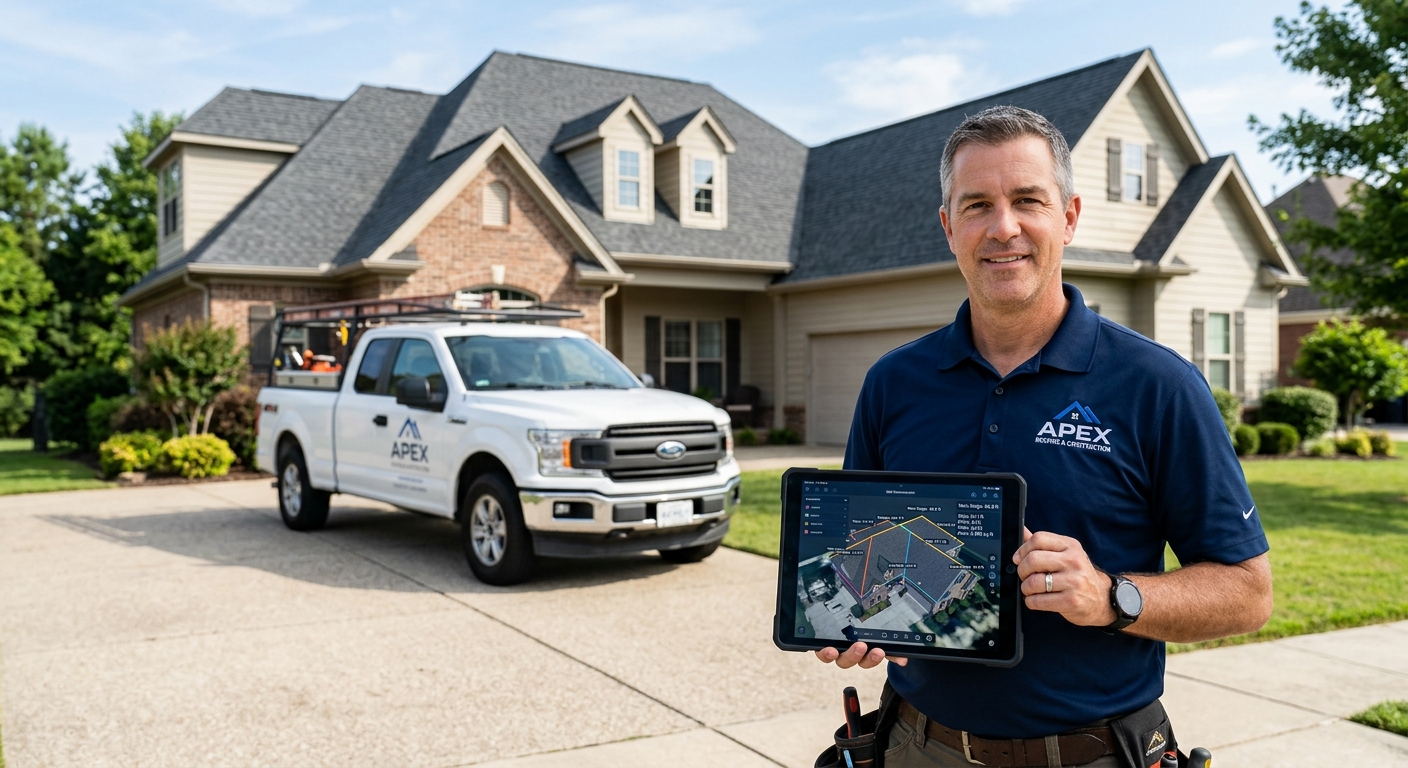
7 Smart Steps to How to Estimate a Roofing Job for Contractors (2026 Guide)
To estimate a roofing job, you must calculate the total square footage of the roof and divide by 100 to determine the nu...
11 Expert Ways to Get Roofing Leads Without Door Knocking for Contractors (2026)
To get roofing leads without door knocking, you must implement a multi-channel digital strategy focusing on Google Local...
How to Get Roofing Leads: 15 Proven Strategies for 2026
The roofing industry in 2026 is a $56.7 billion market, yet many contractors struggle to maintain a consistent pipeline ...